Introduction
PAS 2030 has become a critical framework for domestic energy efficiency improvements across the UK. It was created to ensure that retrofit work on existing homes meets rigorous, consistent standards—safeguarding property owners, installers, and funders alike.
At its heart, PAS 2030 provides a structured approach to improving the performance of dwellings. But this isn’t about merely ticking boxes. It’s about embedding best practice and quality control at every stage of the installation process.
PAS 2030 complements the broader PAS 2035 framework, which focuses on the assessment and design of retrofit projects. Together, they ensure a joined-up, whole-house approach.
If you’re an installer, assessor, coordinator, or homeowner looking to benefit from funded energy efficiency schemes, understanding PAS 2030 is essential. In this guide, we’ll walk you through every key component—from certification and documentation to installation standards and compliance strategies.
What is PAS 2030 and Why Does It Matter?
PAS 2030 is a Publicly Available Specification developed by the British Standards Institution (BSI). It sets out the installation requirements for energy efficiency measures in existing dwellings.
Originally launched in 2013, and significantly updated in 2017 and 2019, PAS 2030 works in tandem with PAS 2035, which covers assessment, design, and evaluation. Together, they underpin the government’s commitment to high-quality, low-carbon housing retrofit.
PAS 2030 is essential because it:
- Establishes consistent standards for retrofit installers
- Enables access to funding via schemes like ECO4 and Warm Homes
- Supports the reduction of carbon emissions and fuel poverty
- Enhances safety, durability, and occupant wellbeing
By setting a clear benchmark for installers, PAS 2030 helps ensure that retrofit measures perform effectively over the long term.
The Role of PAS 2030 in Retrofit Projects
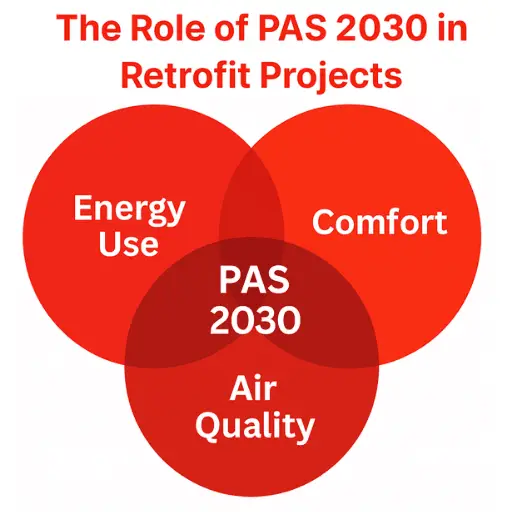
The key difference between PAS 2030 and PAS 2035 is that PAS 2030 governs the execution phase of a domestic retrofit. Where PAS 2035 ensures the project is well-assessed and designed, PAS 2030 ensures it is installed competently and safely.
Its role includes:
- Setting minimum competency requirements for installers
- Requiring a Quality Management System (QMS)
- Mandating use of certified products and approved installation techniques
- Supporting TrustMark registration and consumer protection
The framework ensures that installations:
- Meet technical standards
- Follow safety and regulatory guidelines
- Deliver intended energy savings
- Protect homeowners and funders
In practice, PAS 2030 ensures that what is designed under PAS 2035 is executed accurately and professionally.
Timeline: The Development of PAS 2030
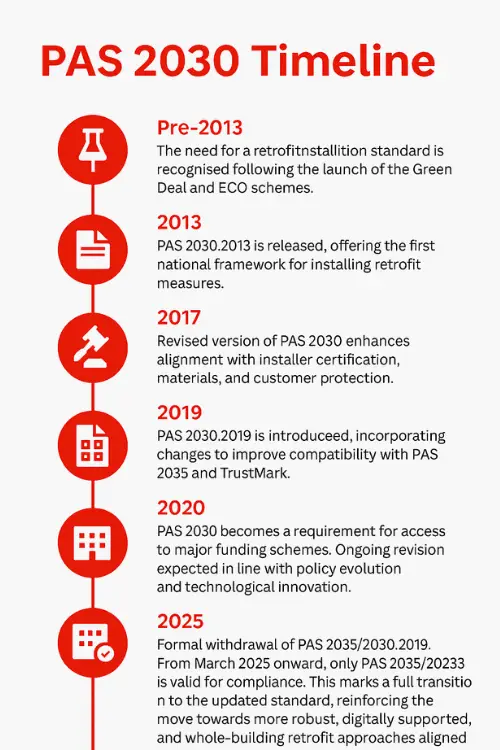
Pre-2013
The need for a retrofit installation standard is recognised following the launch of the Green Deal and ECO schemes.
2013
PAS 2030:2013 is released, offering the first national framework for installing retrofit measures.
2017
Revised version of PAS 2030 enhances alignment with installer certification, materials, and customer protection.
2019
PAS 2030:2019 is introduced, incorporating changes to improve compatibility with PAS 2035 and TrustMark.
2020
PAS 2030 becomes a requirement for access to major funding schemes. Ongoing revisions expected in line with policy evolution and technological innovation.
2025
Formal withdrawal of PAS 2035/2030:2019. From March 2025 onward, only PAS 2035/2030:2023 is valid for compliance. This marks a full transition to the updated standard, reinforcing the move towards more robust, digitally supported, and whole-building retrofit approaches aligned with national policy.
Who Needs to Comply with PAS 2030?
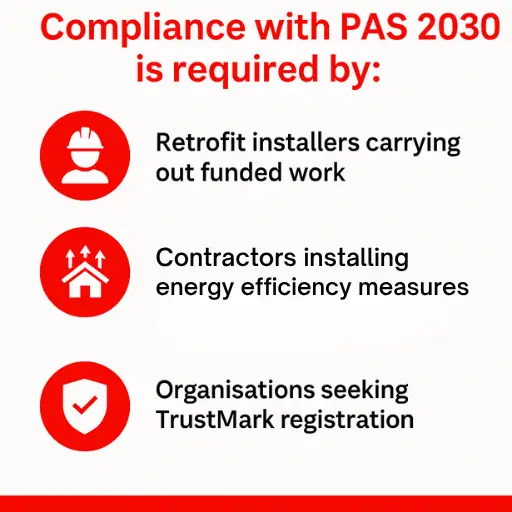
Compliance with PAS 2030 is required by:
- Retrofit installers carrying out funded work
- Contractors installing energy efficiency measures under schemes
- Organisations seeking TrustMark registration
In addition, PAS 2030 is increasingly being adopted voluntarily by:
- Private developers
- Housing associations
- Local authorities
Compliance is becoming an industry norm, and non-certified installers are often excluded from competitive retrofit work.
Key Requirements Under PAS 2030
PAS 2030 sets out detailed requirements including:
- Certification by a UKAS-accredited Certification Body
- Compliance with PAS 2035 coordination and assessment
- Operation of a documented Quality Management System (QMS)
- Use of competent, trained personnel
- Robust record keeping
- Use of appropriate materials and technologies
- Clear customer handover and support process
Installers must be able to demonstrate that each project meets these conditions, with evidence retained for audits and reviews.
How PAS 2030 Works with PAS 2035
PAS 2035 defines the overall retrofit process:
- Assessment of building condition
- Identification of risks
- Development of a whole-house retrofit plan
- Ongoing monitoring and evaluation
PAS 2030 focuses specifically on the installation of measures identified in the PAS 2035 plan.
This means:
- No PAS 2030 installation can occur without a PAS 2035 design
- The Retrofit Coordinator appointed under PAS 2035 is responsible for managing overall quality
- PAS 2030 installers must communicate closely with the Retrofit Coordinator
This integration ensures that retrofit is not piecemeal but holistic, strategic, and effective.
Training and Certification for PAS 2030
Installers must:
- Hold valid qualifications for the measures they install (e.g., NVQ Level 2/3)
- Be assessed by a Certification Body such as Simply Certification, NICEIC, or BBA
- Provide evidence of technical competence, site practice, and customer care
Approved qualifications include:
- NVQ/SVQ in Insulation and Building Treatments
- City & Guilds Retrofit Installer Awards
- CPD in ventilation, air tightness, and moisture risk
Certification Bodies also audit the QMS, health and safety practices, and complaint handling procedures.
Understanding Installation and Handover Processes
Under PAS 2030, each installation must follow a defined process:
- Pre-installation survey and risk assessment
- Safe, compliant installation of the chosen measure
- Quality checks during and after installation
- Customer handover including documentation, manuals, and support
Installers must:
- Document work at each stage
- Provide photographic evidence
- Log details in the TrustMark Data Warehouse
- Ensure customers understand maintenance and warranty details
Proper handover reduces call-backs, complaints, and system failures.
Differences Between PAS 2030:2017, PAS 2030:2019, and PAS 2030:2023
While all versions aim to improve retrofit quality, each revision of PAS 2030 introduced key changes to reflect evolving policy goals and sector needs.
PAS 2030:2017 was largely focused on the installation of individual energy efficiency measures, with minimal reference to holistic planning. It required basic quality control measures but lacked integration with a whole-building approach.
PAS 2030:2019 introduced significant upgrades:
Integration with PAS 2035: Mandatory use of Retrofit Coordinators and a fabric-first, whole-building methodology.
TrustMark compliance: Required installers to register with TrustMark, enhancing consumer protection and project oversight.
Improved record-keeping: Introduced photographic evidence and digital data storage standards.
Measure-specific competency: Installers required detailed and verifiable qualifications for each installed measure.
PAS 2030:2023 (enforced from March 30, 2025) builds on the 2019 standard with even more emphasis on:
Digital compliance: Projects must be recorded in the TrustMark Data Warehouse with enhanced traceability.
Alignment with PAS 2035:2023: Risk Pathways and assessment methodology are now synchronised with the 2023 version.
Stricter ventilation and moisture protocols: Clearer requirements to mitigate unintended consequences of fabric interventions.
Updated installer competence: CPD expectations are formalised, with a greater emphasis on site supervision and training.
Overall, the 2023 version reflects a maturing retrofit industry, demanding higher levels of professionalism, data integrity, and integrated planning.
Transitioning from Older Standards
Installers certified under PAS 2030:2017 or 2019 were required to transition by:
Undertaking gap training aligned with 2023 competence expectations
Updating internal procedures and QMS documentation
Engaging with PAS 2035:2023-trained Retrofit Coordinators
Ensuring all work from March 30, 2025, complies with the new requirements
Certification Bodies provided support via transition plans, audit preparation guidance, and policy briefings.
Comparison Table: PAS 2030 Standards
| Feature | PAS 2030:2017 | PAS 2030:2019 | PAS 2030:2023 |
|---|---|---|---|
| Retrofit Scope | Measure-specific | Whole-house aligned with PAS 2035 | Enhanced PAS 2035:2023 integration |
| TrustMark Requirement | Not required | Mandatory | Mandatory with stricter controls |
| Competence Requirements | Basic NVQ-level | Measure-specific qualifications | CPD + digital record validation |
| Documentation Standards | Minimal paper-based | Digital/photo evidence required | Enhanced digital compliance |
| Moisture and Ventilation Protocols | Not specified | Introduced | Expanded and enforced |
| Risk Pathways | Not applicable | PAS 2035:2019 linked | Fully aligned with PAS 2035:2023 |
| Implementation Cut-off | Superseded in 2020 | Withdrawn March 2025 | Active from March 2025 onward |
Building Fabric Measures under PAS 2030
“Fabric first” is a guiding principle of PAS 2030. Improving a building’s insulation and airtightness reduces the load on heating systems and improves comfort.
Approved measures include:
- Cavity wall insulation
- Loft and roof insulation
- Internal and external wall insulation
- Floor insulation
- Draught-proofing and airtightness solutions
Installers must assess:
- Thermal bridging
- Vapour control and moisture risks
- Ventilation impacts
All works must use certified materials and comply with design specifications developed under PAS 2035.
Heating and Ventilation System Requirements
PAS 2030 also governs the installation of heating and ventilation systems, ensuring they are efficient, sized correctly, and safe.
Covered systems include:
- Heat pumps (air source, ground source)
- High-efficiency boilers
- Mechanical ventilation with heat recovery (MVHR)
- Heating controls and zoning systems
Installers must:
- Ensure proper commissioning
- Demonstrate CO2 savings
- Maintain manufacturer guidelines
Coordination with PAS 2035 assessments is essential to ensure compatibility and avoid unintended consequences.
Quality Assurance and On-Site Checks
PAS 2030 requires a robust quality assurance process throughout installation:
- Site audits by Certification Bodies
- Internal supervision and self-inspection
- Use of checklists and photographic records
Installers must:
- Record non-conformances
- Implement corrective actions
- Maintain a complaints log
Quality assurance is not a one-time task—it must be embedded in the daily work of retrofit teams.
Roles and Responsibilities in a PAS 2030 Project
Every PAS 2030 retrofit involves key stakeholders:
Installer Organisation:
- Responsible for on-site works, QMS, and compliance.
Certification Body:
- Audits competency, documentation, and installations.
Retrofit Coordinator (via PAS 2035):
- Ensures oversight, risk management, and strategic planning.
TrustMark:
- Hosts project data and consumer protection framework.
Homeowner/Client:
- Final sign-off and feedback.
Clear communication and delineation of responsibility are vital to project success.
Documentation and Audit Trail Requirements
PAS 2030 requires extensive documentation to ensure traceability and transparency. Installers must maintain:
- Design documentation and risk assessments
- Material specifications and delivery records
- Installation checklists and photos
- Commissioning certificates
- Customer feedback forms
These records are audited by Certification Bodies and may be required for funding claims or dispute resolution.
Certification Bodies and Accreditation Pathways
To become PAS 2030 certified, installer organisations must:
- Select a UKAS-accredited Certification Body
- Submit applications and initial documentation
- Undergo an office audit and site inspections
- Address non-conformances and corrective actions
Popular Certification Bodies include:
- Simply Certification
- British Board of Agrément (BBA)
- Stroma
Maintaining certification requires annual surveillance audits and continual adherence to scheme rules.
How to Pass a PAS 2030 Compliance Audit
Key tips include:
- Keep your QMS up to date and tailored to retrofit
- Train all site staff in PAS 2030 requirements
- Maintain full job records in real time
- Pre-empt common audit findings (e.g. missing photos, unclear sign-offs)
- Engage openly with auditors
A compliance checklist and internal pre-audits can significantly boost your confidence ahead of external inspections.
Accessing Funding via PAS 2030
PAS 2030 certification is a gateway to public and private retrofit funding.
Approved schemes include:
- ECO4
- Boiler Upgrade Scheme (BUS)
- Local Authority Delivery (LAD)
Only PAS 2030-certified installers registered with TrustMark can deliver funded works.
This ensures:
- Proper use of public funds
- Consumer protection
- Alignment with Net Zero strategy
Installers should liaise with scheme administrators for the latest eligibility rules and deadlines.
Consumer Protection and TrustMark
TrustMark acts as the assurance and data platform underpinning PAS 2030 compliance.
Requirements include:
- Project registration on the Data Warehouse
- Adherence to TrustMark Code of Conduct
- Provision of financial protection (e.g. insurance-backed guarantees)
- Consumer complaints procedure
TrustMark allows clients to verify installer credentials, project records, and performance metrics.
Being TrustMark registered is a mandatory requirement for publicly funded retrofit work under PAS 2030.
How PAS 2030 Supports Net Zero and Policy Goals
PAS 2030 plays a direct role in achieving the UK’s legally binding commitment to net zero carbon emissions by 2050.
By enforcing high standards for retrofit installations, PAS 2030:
- Supports long-term carbon savings
- Enables the rollout of energy efficiency measures at scale
- Provides data and oversight through TrustMark integration
- Ensures consistency with Building Regulations and local policy
It also aligns with major strategies such as:
- The Net Zero Strategy
- Heat and Buildings Strategy
- Future Homes Standard
- Energy Company Obligation (ECO4)
Together, these policies make PAS 2030 a vital tool in the UK’s climate action framework.
Common Barriers to PAS 2030 Implementation
While PAS 2030 brings clear benefits, many installers and organisations encounter hurdles during adoption. These include:
- Complexity of QMS development
- Upfront training and certification costs
- Integration with PAS 2035 processes
- Capacity for consistent documentation and audits
For smaller installers in particular, the transition can be resource-intensive.
Overcoming Practical and Financial Challenges
Solutions to common challenges include:
- Using template QMS systems designed for retrofit
- Accessing subsidised training via schemes like Retrofit Academy
- Partnering with Retrofit Coordinators early
- Phased implementation of processes
Government incentives such as grant-funded training and simplified access to TrustMark can also ease the burden.
Supporting Skills and Workforce Development
Upskilling is essential to delivering PAS 2030-compliant retrofit at scale. Priority areas include:
- Building fabric installation
- Heat pump design and commissioning
- Moisture and ventilation risk management
- Site-based quality assurance
Organisations such as CITB, BEIS, and local authorities are increasingly funding courses and apprenticeships to meet demand.
Upcoming Changes to PAS 2030 Standards
The next revision of PAS 2030 is expected to include:
- Enhanced digital tools for record-keeping and verification
- Expanded recognition of new technologies (e.g. hybrid systems, smart controls)
- Stronger ventilation benchmarks
- Closer integration with the Future Homes Standard
The changes will ensure PAS 2030 remains a robust and relevant benchmark as housing policy and technologies evolve.
The Future of Domestic Retrofit and Energy Efficiency
The coming years will see retrofit move from a niche activity to a national infrastructure priority. Trends include:
- More local authority-led retrofit programmes
- Scaling of whole-street or area-based upgrades
- Mainstreaming of low-carbon heating systems
- Increased role of digital performance monitoring
PAS 2030 will continue to be the anchor for quality assurance, helping retrofit projects deliver lasting results.
Final Thoughts on Achieving PAS 2030 Compliance
PAS 2030 is more than just a standard—it is the operational blueprint for delivering safe, efficient, and accountable retrofit installations in UK homes.
By following PAS 2030 requirements, installers:
- Improve project outcomes
- Access government funding
- Build credibility in a competitive market
Property owners, in turn, benefit from long-term savings, comfort, and protection.
Commitment to PAS 2030 means commitment to best practice, customer care, and climate responsibility.
Getting Started with Your PAS 2030 Journey
To begin your PAS 2030 journey:
Step 1: Set Up Your Quality Management System (QMS)
Create a QMS that outlines how your business ensures quality, compliance, and consistency. It should include procedures for customer service, training, health & safety, record-keeping, and continuous improvement.
Step 2: Document Everything
Your QMS must be fully documented to meet PAS 2030:2023 standards. Include policy statements, process flows, defined roles, and audit schedules.
Step 3: Appoint a Retrofit Coordinator (for PAS 2035 projects)
If your work falls under PAS 2035, you must engage a qualified and independent Retrofit Coordinator who holds a Level 5 Diploma and is TrustMark registered.
Step 4: Ensure Installer Competence
All installers must be trained and competent in the measures they deliver. Acceptable evidence includes NVQs, manufacturer certifications, and site-specific training records.
Step 5: Get the Right Insurance
You’ll need public and employers’ liability insurance, and professional indemnity if you carry out design work. Workmanship warranties may also be required.
Step 6: Book Your Certification Assessment
Apply to a UKAS-accredited certification body. The assessment includes a review of your documentation, an on-site audit of an installation, and interviews with key staff.
Many installers find success faster when working with retrofit consultants or training providers throughout the process.

Frequently Asked Questions
Is PAS 2030 a legal requirement? Not in itself, but it is mandatory for participation in government-funded schemes like ECO and HUG.
What types of buildings does PAS 2030 cover? It applies to existing domestic dwellings of all types across the UK.
Do I need PAS 2035 as well? Yes. PAS 2035 provides the assessment and design framework for retrofit. PAS 2030 only covers installation.
How long does certification take? Most organisations achieve it in 2 to 4 months, depending on preparedness.
Can I access funding without TrustMark registration? No. TrustMark is a required component of funded retrofit under PAS 2030.