What is ISO 9001? In simple terms, ISO 9001 is an internationally recognised standard that defines the requirements for a Quality Management System (QMS).
It provides a structured framework that enables organisations to consistently deliver products and services that meet customer, statutory, and regulatory requirements.
The standard promotes efficiency, accountability, and continual improvement across all areas of operation.
By implementing ISO 9001, organisations can create a culture of quality that strengthens customer trust, supports operational excellence, and enhances long-term sustainability.
ISO 9001 is not restricted to any specific industry or size of organisation — its flexible framework can be applied to everything from small start-ups to multinational corporations.
Full Name
The full name of the standard is ISO 9001:2015 – Quality Management Systems – Requirements.
This title identifies three key aspects:
- ISO refers to the International Organization for Standardization, the body responsible for developing and maintaining the standard.
- 9001 indicates that it is part of the ISO 9000 family of quality management standards.
- 2015 refers to the year of the most recent revision, which incorporates the latest concepts in business improvement and risk management.
In essence, the full name signals both its global credibility and its focus on structured, requirement-based quality management.
Publisher
ISO 9001 is published by the International Organization for Standardization (ISO), a non-governmental, independent global body headquartered in Geneva, Switzerland.
ISO develops and publishes standards that promote consistency, safety, and quality across industries and international borders.
The organisation brings together experts from over 160 national standards bodies to create consensus-based standards that reflect global best practices.
By publishing ISO 9001, ISO provides organisations with a globally recognised benchmark for managing and improving quality performance.
Revision Year
The current and most widely used version of the standard is ISO 9001:2015, published in September 2015.
This revision introduced several key updates, including:
- Greater emphasis on risk-based thinking to identify and manage potential issues before they occur
- Stronger focus on leadership and strategic alignment of the QMS with business objectives
- Enhanced flexibility in documentation requirements
- Integration of the Annex SL structure, allowing easier alignment with other management system standards (such as ISO 14001 and ISO 45001)
The 2015 revision ensures that ISO 9001 remains relevant in a modern, dynamic business environment, encouraging innovation while maintaining robust quality control.
In summary, ISO 9001 serves as the foundation for effective quality management worldwide.
It provides a common language and framework that enables organisations to demonstrate competence, reliability, and a clear commitment to customer satisfaction.
Purpose of ISO 9001

The purpose of ISO 9001 is to establish a consistent and structured approach to managing quality across an organisation, and this overview highlights how the standard achieves this in practice.
It helps ensure that every process — from planning and production to delivery and aftercare — is carried out in a controlled, efficient, and accountable manner.
At its core, ISO 9001 aims to help organisations meet customer expectations while complying with all relevant legal and regulatory requirements.
It also fosters a culture of continuous improvement, encouraging teams to identify inefficiencies, manage risks, and refine performance over time.
By embedding these principles, ISO 9001 transforms quality management from a reactive process into a proactive strategy that supports long-term success.
Consistency
One of the fundamental objectives of ISO 9001 is to create consistency across all operations.
Consistent processes lead to predictable outcomes, which in turn improve reliability and customer satisfaction.
ISO 9001 helps organisations achieve this by:
- Establishing standardised procedures for all key activities
- Reducing variation in how products and services are delivered
- Ensuring that quality objectives are clearly defined and measurable
- Supporting repeatable outcomes through documented processes and training
Consistency ensures that quality is not dependent on individual performance but built into the organisation’s structure and culture.
This allows businesses to deliver dependable results regardless of changes in staff, demand, or market conditions.
Compliance
Another core purpose of ISO 9001 is to help organisations meet regulatory and statutory requirements relevant to their products or services. Compliance is critical for maintaining credibility, reducing legal risks, and operating responsibly within a given industry.
Through ISO 9001, organisations can:
- Identify and interpret all applicable legal and regulatory obligations
- Establish processes that ensure continuous compliance
- Maintain accurate records and traceability for auditing purposes
- Build confidence with regulators, customers, and stakeholders
Compliance within ISO 9001 is not simply about avoiding penalties. It’s about developing responsible, transparent operations that reflect integrity and professionalism.
Customer Satisfaction
At the heart of ISO 9001 lies customer satisfaction. The standard recognises that consistent quality, clear communication, and reliable delivery are essential for maintaining customer trust and loyalty.
ISO 9001 supports customer satisfaction by:
- Gathering and analysing customer feedback
- Monitoring performance metrics related to customer expectations
- Ensuring that complaints are handled promptly and effectively
- Aligning organisational goals with customer needs
By prioritising customers throughout every stage of the business process, organisations can build long-term relationships and strengthen their reputation in competitive markets.
Continuous Improvement
Continuous improvement is a defining feature of ISO 9001. It ensures that quality management is not static but evolves as the organisation grows, technologies change, and customer needs develop.
The standard promotes ongoing improvement through:
- Regular internal audits and management reviews
- Root-cause analysis of issues and nonconformities
- Implementation of corrective and preventive actions
- Encouragement of innovation and best-practice sharing
Continuous improvement ensures that the QMS remains effective and relevant over time, helping organisations adapt to new challenges while maintaining operational excellence.
In summary, the purpose of ISO 9001 extends well beyond compliance.
It builds a culture of quality that enhances consistency, strengthens customer relationships, ensures compliance, and drives sustained business growth through continuous improvement.
Why ISO 9001 Is Used

Organisations adopt ISO 9001 for many strategic, operational, and commercial reasons.
While it is often seen as a quality assurance standard, its real value lies in how it improves efficiency, reduces risk, and strengthens reputation.
ISO 9001 offers a proven framework that helps businesses operate more effectively, win customer trust, and compete confidently in demanding markets.
Its use is widespread across industries because it provides tangible results — both internally, through better processes, and externally, through enhanced customer confidence.
Competitive Advantage
Achieving ISO 9001 certification provides a clear competitive advantage. It signals to customers, suppliers, and partners that an organisation operates according to internationally recognised quality management principles.
ISO 9001 gives organisations a competitive edge by:
- Differentiating them from competitors that lack formal quality certification
- Demonstrating a commitment to consistency and reliability
- Enhancing credibility in tendering and procurement processes
- Increasing access to new markets where certification is a prerequisite
In an environment where customers prioritise trust and proven performance, ISO 9001 certification serves as a strong indicator of professional excellence and reliability.
Operational Efficiency
Another key reason organisations use ISO 9001 is to improve operational efficiency. The standard helps identify inefficiencies, eliminate duplication, and ensure resources are used effectively.
ISO 9001 enhances efficiency by:
- Streamlining business processes and reducing unnecessary complexity
- Encouraging the use of data to monitor and improve performance
- Promoting consistent training and competence across the workforce
- Aligning departmental activities with wider business objectives
By focusing on process control and measurement, organisations can lower operational costs, increase productivity, and deliver better results with fewer resources.
Risk Management
ISO 9001 integrates risk-based thinking into every aspect of quality management. This approach encourages organisations to anticipate potential problems before they occur, rather than reacting after the fact.
The standard helps organisations manage risks by:
- Identifying potential risks that could affect product or service quality
- Assessing the likelihood and impact of these risks on operations
- Implementing controls to prevent or mitigate negative outcomes
- Reviewing and updating risk assessments regularly as conditions change
Effective risk management protects both the organisation and its customers, ensuring stability, consistency, and confidence in the long term.
Customer Confidence
One of the strongest motivations for using ISO 9001 is to build customer confidence. Certification demonstrates that an organisation has robust systems in place to deliver quality products and services consistently.
ISO 9001 helps foster customer trust by:
- Providing transparent processes that customers can rely on
- Reducing errors, delays, and product defects
- Ensuring issues are handled promptly and systematically
- Demonstrating a commitment to continual improvement and accountability
For many organisations, ISO 9001 is not only about winning new customers — it’s about retaining existing ones by consistently meeting or exceeding their expectations.
Regulatory and Tender Requirements
In many industries, ISO 9001 certification is a key requirement for participation in public and private sector tenders. It is also used to demonstrate compliance with national and international regulations.
ISO 9001 supports these obligations by:
- Providing clear evidence of a controlled and compliant management system
- Simplifying documentation and reporting for regulatory audits
- Helping organisations meet contract-specific quality requirements
- Demonstrating reliability to government bodies and corporate clients
By achieving certification, organisations position themselves as trusted partners capable of delivering to regulated or contractually defined standards.
International Recognition
ISO 9001 is recognised and respected worldwide, making it a valuable credential for organisations seeking to expand internationally.
Its global reputation offers several advantages:
- Facilitates entry into international markets by meeting universal quality expectations
- Provides a consistent framework that can be applied across multiple countries and sites
- Builds trust among international customers, suppliers, and partners
- Demonstrates alignment with global best practices in management and governance
This international recognition allows organisations to compete on a global stage with the assurance that their quality systems meet universally accepted benchmarks.
In summary, ISO 9001 is used because it delivers clear and measurable value.
It enhances competitive positioning, improves operational performance, reduces risk, and builds enduring customer confidence.
Whether required by contract or chosen as a strategic improvement tool, ISO 9001 remains one of the most powerful mechanisms for achieving sustainable organisational excellence.
Applicability
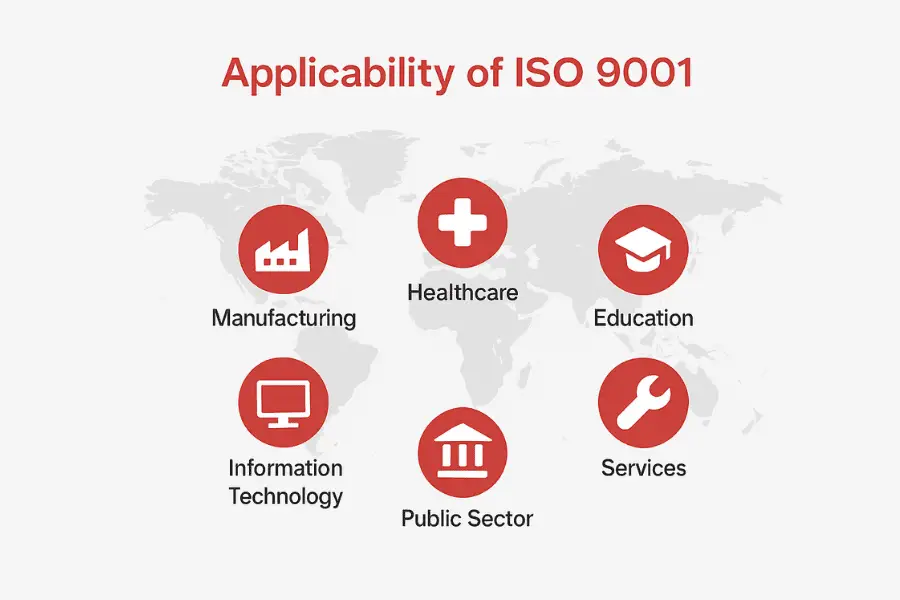
One of the key strengths of ISO 9001 is its universal applicability.
The standard is designed to be flexible and adaptable, allowing it to fit any organisation regardless of size, sector, or geographic location.
It focuses on how quality management principles are applied, rather than dictating how specific products or services should be delivered.
This means ISO 9001 can be implemented by a wide range of organisations — from small local businesses to large international corporations, from public bodies to private enterprises.
It’s this adaptability that makes ISO 9001 the most widely adopted quality management standard in the world.
Organisation Size
ISO 9001 is suitable for organisations of any size.
The requirements can be scaled to match the complexity and resources of the business, ensuring that both small and large entities can benefit.
For small and medium-sized enterprises (SMEs), ISO 9001 provides:
- A simple but structured framework to organise operations more effectively
- A clear set of processes that promote consistency and control
- A professional image that supports growth and credibility in competitive markets
- An opportunity to reduce waste and streamline limited resources
For larger organisations, the benefits are equally strong. ISO 9001 helps them:
- Maintain consistency across multiple departments or global sites
- Standardise practices while allowing for local flexibility
- Improve coordination between teams and locations
- Support corporate governance and long-term strategic planning
Regardless of scale, ISO 9001 ensures that quality management becomes embedded throughout every level of the organisation — from leadership to day-to-day operations.
Industry Coverage
ISO 9001 is industry-neutral. It has been successfully implemented in almost every sector, demonstrating its flexibility and relevance across different business environments.
The standard is used in:
- Manufacturing – to maintain production consistency, minimise defects, and ensure traceability
- Service industries – to enhance customer experience, manage performance, and reduce complaints
- Construction and engineering – to control project quality, safety, and compliance with regulations
- Healthcare – to improve patient care processes and regulatory adherence
- Education – to standardise procedures, support accreditation, and improve outcomes
- Public sector organisations – to increase transparency, efficiency, and public confidence
Because ISO 9001 focuses on processes rather than outputs, it can be tailored to fit the unique operational requirements of each industry without losing its integrity or intent.
In summary, ISO 9001’s adaptability makes it one of the most versatile management tools available.
Its process-based structure ensures that organisations of all types and sizes can achieve consistent quality, operational control, and continual improvement without being constrained by industry-specific requirements.
Core Quality Management Principles

At the heart of ISO 9001 lie seven key Quality Management Principles (QMPs).
These principles form the foundation of the standard and provide a framework for building a culture of consistent quality, accountability, and improvement.
Each principle supports a different aspect of effective management — from understanding customers and empowering people to making decisions based on evidence and maintaining strong relationships.
When applied together, they ensure that an organisation can achieve both customer satisfaction and operational excellence.
Customer Focus
The first and most important principle of ISO 9001 is customer focus.
Every organisation depends on its customers, so understanding and meeting their needs is central to long-term success.
ISO 9001 encourages organisations to:
- Identify both stated and implied customer requirements
- Monitor and analyse customer satisfaction regularly
- Use feedback to improve products, services, and overall experience
- Balance customer expectations with organisational capabilities
By prioritising the customer, organisations can align their operations with what matters most — delivering value, building trust, and creating loyalty.
A strong customer focus turns quality management into a driver of business growth.
Leadership
Leadership plays a vital role in ensuring the success of any quality management system. ISO 9001 emphasises the need for leaders to set a clear vision, provide direction, and actively engage in promoting a culture of quality.
Effective leadership under ISO 9001 involves:
- Establishing a unified purpose and clear organisational objectives
- Creating an environment where people are motivated to achieve these goals
- Demonstrating commitment through visible involvement in the QMS
- Providing the resources needed to sustain quality and improvement
Strong leadership ensures that quality is not an afterthought but an integral part of the organisation’s strategy and decision-making.
Engagement of People
The engagement of people principle recognises that competent, empowered, and motivated employees are essential to achieving quality objectives.
Everyone in the organisation contributes to the performance and success of the QMS.
This principle encourages organisations to:
- Involve employees in problem-solving and decision-making
- Provide clear roles, responsibilities, and training opportunities
- Recognise and reward contributions to quality improvement
- Foster communication, collaboration, and accountability
When people are engaged and understand their importance in achieving quality outcomes, they become more proactive, innovative, and invested in organisational success.
Process Approach
The process approach principle is one of ISO 9001’s defining features.
It requires organisations to view their activities as interconnected processes that work together to produce consistent results.
Under this approach, organisations should:
- Identify and map all key processes within the QMS
- Understand how each process interacts and affects others
- Monitor and measure performance to ensure efficiency and effectiveness
- Use data to make adjustments and improvements where necessary
Viewing operations through the process lens helps organisations identify dependencies, eliminate duplication, and maintain control over how inputs are transformed into outputs.
It provides a clear pathway to stability, repeatability, and continual improvement.
Improvement
Continuous improvement is a central theme throughout ISO 9001. Organisations are expected not only to maintain current performance but to continually seek ways to enhance it.
The improvement principle involves:
- Regularly reviewing processes, objectives, and performance data
- Identifying opportunities for enhancement or innovation
- Implementing corrective and preventive actions following issues or nonconformities
- Measuring progress to ensure effectiveness and sustainability
By adopting a mindset of continual improvement, organisations can adapt to change, respond to new customer demands, and strengthen long-term competitiveness.
Evidence-Based Decision Making
Good decisions are essential for success.
The evidence-based decision making principle ensures that choices are guided by accurate, reliable information rather than assumptions or intuition.
ISO 9001 promotes this principle by encouraging organisations to:
- Collect and analyse relevant data to support decisions
- Ensure data accuracy and accessibility for all stakeholders
- Use trends and metrics to predict performance outcomes
- Review decisions based on measurable evidence and results
This approach improves transparency and accountability, allowing leaders to make sound decisions that drive quality and performance improvements.
Relationship Management
No organisation operates in isolation. The relationship management principle highlights the importance of maintaining strong, mutually beneficial relationships with suppliers, partners, and other stakeholders.
ISO 9001 supports effective relationship management by encouraging organisations to:
- Identify key stakeholders and understand their needs
- Develop trust-based partnerships that support shared objectives
- Evaluate supplier performance and foster long-term collaboration
- Communicate openly and consistently to maintain alignment
By managing relationships strategically, organisations can strengthen supply chains, improve reliability, and create value for all parties involved.
In summary, the seven Quality Management Principles provide the foundation upon which ISO 9001 is built.
Together, they guide organisations in creating robust systems that focus on customers, empower people, make informed decisions, and continually enhance performance.
When applied effectively, these principles turn quality management into a strategic advantage rather than a compliance exercise.
ISO 9001 Key Requirements

To comply with ISO 9001, organisations must establish and maintain a structured Quality Management System (QMS) that meets the specific requirements of the standard.
These requirements are designed to ensure that every process contributing to product or service quality is clearly defined, effectively managed, and continually improved.
The requirements cover planning, implementation, monitoring, and improvement — ensuring that quality becomes an integral part of everyday operations rather than an isolated function.
Quality Management System (QMS)
At the heart of ISO 9001 lies the Quality Management System itself. The QMS provides the framework through which an organisation controls, measures, and improves its processes.
A compliant QMS should:
- Define the scope of the system and how it applies to the organisation
- Include documented procedures that describe how key activities are managed
- Establish quality objectives aligned with strategic business goals
- Monitor performance using relevant indicators and measurable outcomes
The QMS ensures that quality is managed systematically, not left to chance.
It allows organisations to plan, execute, check, and refine their operations in a controlled and transparent way.
Defined Processes and Responsibilities
ISO 9001 requires that all processes and responsibilities within the QMS are clearly defined and understood. This prevents confusion, duplication, or gaps in accountability.
Organisations must:
- Identify each process involved in creating value for customers
- Define process inputs, outputs, and their interactions
- Assign roles and responsibilities for managing and monitoring performance
- Provide training to ensure staff have the skills and knowledge to perform their duties
Having defined processes and responsibilities supports consistency, efficiency, and traceability across all departments, ensuring that everyone understands their contribution to quality.
Documentation and Records
Although ISO 9001:2015 allows greater flexibility in documentation, controlled documentation and record-keeping remain essential components of the standard.
Organisations are required to:
- Maintain documented information necessary for the effective operation of the QMS
- Ensure documents are reviewed, approved, and kept up to date
- Protect records from damage or loss and ensure they remain accessible when needed
- Retain evidence of conformity, such as inspection reports, audit results, and customer feedback
Accurate documentation provides the evidence base for demonstrating compliance, supporting decision-making, and ensuring continuity during audits or staff changes.
Internal Audits
Internal audits are a key mechanism for checking the effectiveness of the QMS.
They involve systematic, independent evaluations of how well processes meet the requirements of ISO 9001 and the organisation’s own policies.
A robust internal audit programme should:
- Cover all relevant processes and areas of the QMS
- Be conducted by trained and impartial auditors
- Identify nonconformities, risks, and opportunities for improvement
- Generate clear findings and follow-up actions to resolve issues
Internal audits are not about blame — they are about learning, assurance, and improvement.
They help organisations maintain confidence in their systems and ensure ongoing compliance between external audits.
Management Review
Senior leadership plays a central role in ensuring the QMS remains effective.
Regular management reviews provide an opportunity for top management to assess how well the system is performing and to make strategic decisions for improvement.
During a management review, leaders typically:
- Evaluate progress against quality objectives and performance indicators
- Review audit results, customer feedback, and process performance
- Consider risks, opportunities, and resource needs
- Identify actions to enhance effectiveness and align the QMS with organisational goals
Management reviews ensure that quality management remains a leadership priority and that decisions are informed by real performance data.
Continuous Improvement
Continuous improvement is both a principle and a requirement within ISO 9001.
Organisations must demonstrate that they are actively improving the suitability, adequacy, and effectiveness of their QMS over time.
This can be achieved by:
- Analysing audit findings, performance data, and customer feedback
- Implementing corrective and preventive actions to eliminate causes of nonconformities
- Sharing best practices and innovations across teams
- Setting new objectives that push for higher levels of performance
Continuous improvement ensures that the QMS remains dynamic — always evolving in response to changes in customer needs, technology, and market conditions.
In summary, the key requirements of ISO 9001 provide a clear structure for managing quality effectively.
From defining responsibilities and maintaining documentation to conducting audits and pursuing improvement, these elements combine to form a system that delivers reliability, consistency, and customer satisfaction.
Certification Process

Achieving ISO 9001 certification demonstrates that an organisation’s Quality Management System (QMS) meets internationally recognised standards.
Certification provides objective evidence that the organisation has implemented a structured, reliable, and effective system for managing quality.
The process involves independent evaluation by an accredited certification body. While the path to certification may vary slightly depending on the organisation’s size and industry, the core steps remain largely consistent.
Certification is not a one-time event — it represents the start of a continuous commitment to maintaining and improving quality standards across all areas of operation.
Third-Party Auditing
The cornerstone of ISO 9001 certification is the third-party audit. This is an external, impartial assessment conducted by an accredited certification body.
The purpose is to verify that the organisation’s QMS complies with all requirements of the ISO 9001 standard.
The certification audit process typically involves two main stages:
- Stage 1 Audit (Documentation Review):
The auditor reviews the organisation’s documented information to ensure the QMS has been properly designed and implemented. This includes examining quality policies, objectives, procedures, and records. - Stage 2 Audit (Implementation Assessment):
The auditor evaluates how effectively the QMS is being applied in practice. This includes interviews with staff, observation of processes, and inspection of records to confirm compliance and effectiveness.
Following the audit, the auditor issues a detailed report outlining any nonconformities or areas for improvement.
Once these are addressed, the certification body recommends the organisation for ISO 9001 certification.
A successful audit demonstrates that the organisation’s QMS meets international best practices for quality management, giving external stakeholders confidence in its capability and consistency.
Certification Validity
An ISO 9001 certificate is typically valid for three years from the date of issue.
However, this period is supported by surveillance audits carried out annually (or semi-annually in some cases) to ensure ongoing compliance and continual improvement.
During the certification cycle:
- The certification body conducts surveillance audits to verify continued conformity with the standard
- Any identified nonconformities must be corrected within an agreed timeframe
- The organisation must demonstrate that its QMS remains effective and aligned with business objectives
At the end of the three-year period, a recertification audit is conducted to renew the certificate for another cycle.
This system ensures that certification is maintained through ongoing performance, not a one-off demonstration, keeping quality standards consistent and current.
Benefits of Certification
Gaining ISO 9001 certification brings a wide range of tangible and intangible benefits. It not only strengthens internal processes but also enhances the organisation’s credibility and competitiveness in the marketplace.
Key benefits include:
- Enhanced Credibility: Certification demonstrates a verified commitment to quality, improving reputation with customers, regulators, and business partners.
- Operational Efficiency: Standardised processes and continuous improvement initiatives reduce waste, errors, and duplication.
- Customer Confidence: Clients gain assurance that products and services will consistently meet their requirements.
- Access to New Markets: Many industries and government tenders require ISO 9001 certification as a condition of participation.
- Employee Engagement: Staff benefit from clear processes, defined responsibilities, and a shared commitment to excellence.
- Sustainable Improvement: Regular audits and reviews drive ongoing performance improvement and adaptability.
In short, ISO 9001 certification is both a symbol of trust and a practical tool for improvement.
It shows that an organisation is serious about quality, efficiency, and customer satisfaction — all essential qualities in a competitive business environment.
In summary, the certification process validates that an organisation’s systems meet internationally accepted standards for quality management.
Through third-party assessment, continual monitoring, and periodic renewal, ISO 9001 certification helps ensure that organisations consistently deliver value to customers while maintaining operational control and continual improvement.
Benefits and Limitations

While ISO 9001 offers a wide range of benefits, it is also important to recognise that implementing and maintaining certification requires time, resources, and commitment.
Understanding both the advantages and potential challenges allows organisations to plan more effectively and maximise the value of their Quality Management System (QMS).
When properly integrated, ISO 9001 can transform an organisation’s performance by improving consistency, efficiency, and customer satisfaction.
However, when applied mechanically or without leadership support, it can become overly bureaucratic or lose its strategic impact.
Benefits
The benefits of ISO 9001 are both strategic and operational. Organisations across all industries experience measurable improvements in efficiency, customer relationships, and business resilience.
Some of the key benefits include:
- Improved Performance: The standard promotes well-defined processes, performance monitoring, and data-driven improvement, helping organisations achieve greater control over operations.
- Customer Trust and Satisfaction: Consistently meeting customer expectations builds loyalty, repeat business, and positive reputation.
- Operational Consistency: Standardised procedures reduce variability, ensuring reliable quality across products and services.
- Enhanced Competitiveness: Certification provides a market advantage, often serving as a differentiator in bids, tenders, and contract negotiations.
- Employee Engagement: Clear roles, responsibilities, and quality objectives improve morale and accountability.
- Risk Reduction: ISO 9001’s emphasis on risk-based thinking helps prevent issues before they occur.
- Continuous Improvement: Regular reviews and audits ensure ongoing refinement and innovation.
Overall, ISO 9001 provides a disciplined framework for managing performance, reducing waste, and driving sustainable growth — all while improving the customer experience.
Limitations
Despite its many advantages, ISO 9001 is not without its challenges. The standard sets a high benchmark for quality management, and meeting that standard can demand significant effort, especially during initial implementation.
Some common limitations include:
- Resource Requirements: Implementing and maintaining a QMS can require substantial time and investment, particularly for smaller organisations.
- Administrative Burden: If not properly managed, documentation and audits can become overly procedural or time-consuming.
- Misinterpretation of the Standard: Some organisations treat ISO 9001 as a checklist for compliance rather than a system for genuine improvement, limiting its potential impact.
- Cultural Resistance: Staff may view quality initiatives as additional work rather than a value-adding process, particularly if leadership engagement is weak.
- Certification Costs: External audits and renewals involve recurring financial commitments that must be budgeted for.
These challenges highlight the importance of effective planning, communication, and leadership throughout the ISO 9001 journey.
Mitigation
The potential limitations of ISO 9001 can be effectively managed through strong leadership, thoughtful implementation, and continuous alignment with organisational goals.
Successful mitigation strategies include:
- Leadership Commitment: Senior management must actively support and promote quality initiatives to ensure long-term success.
- Integration with Business Strategy: The QMS should complement existing systems and align with the organisation’s strategic objectives.
- Simplified Documentation: Focus on maintaining only essential records that add real value to operations.
- Ongoing Training: Equip staff with the knowledge and skills to manage and improve quality effectively.
- Culture of Engagement: Encourage all employees to see quality as part of their everyday responsibilities.
When ISO 9001 is implemented with genuine intent and ongoing commitment, its benefits significantly outweigh the costs and challenges.
In conclusion, ISO 9001 offers a powerful and proven method for improving quality, efficiency, and customer satisfaction.
While it requires effort and investment, the rewards — including increased trust, competitive advantage, and organisational resilience — make it one of the most valuable management standards available today.
Relationship to Other Standards

ISO 9001 is part of a broader family of quality management standards developed by the International Organization for Standardization (ISO).
Together, these standards provide a comprehensive framework for improving quality, performance, and organisational efficiency.
ISO 9001 does not exist in isolation. It works alongside other management system standards to create a unified and integrated approach to governance, risk, and performance.
By aligning with these related standards, organisations can streamline compliance, reduce duplication, and achieve more cohesive management practices.
ISO 9000 Family
The ISO 9000 family comprises several interrelated standards that support the principles and application of the standard. Each standard serves a specific purpose, helping organisations at different stages of their quality management journey.
Key members of the ISO 9000 family include:
- ISO 9000 – Quality Management Systems – Fundamentals and Vocabulary:
This standard defines the fundamental concepts, principles, and terminology that underpin ISO 9001. It serves as the foundation for understanding the broader quality management framework. - ISO 9001 – Quality Management Systems – Requirements:
The central standard that sets out the specific requirements organisations must meet to achieve certification. It focuses on establishing and maintaining an effective quality management system. - ISO 9004 – Quality Management – Quality of an Organisation – Guidance to Achieve Sustained Success:
This standard provides additional guidance on achieving long-term performance improvement beyond the requirements of ISO 9001. It focuses on strategic development, leadership, and organisational maturity. - ISO 19011 – Guidelines for Auditing Management Systems:
This complementary standard offers guidance on conducting both internal and external audits, ensuring audit programmes are effective, consistent, and impartial.
Together, these standards provide a complete toolkit for organisations seeking not only compliance but also continual improvement and sustained excellence.
Integration
Modern organisations often operate under multiple management systems — such as those for environmental performance, health and safety, or information security.
ISO 9001 is designed for seamless integration with these systems, making it easier to manage various compliance obligations in a coordinated manner.
ISO 9001 aligns with other major standards through the Annex SL structure, a common framework introduced by ISO to ensure consistency across all management system standards.
This shared structure means that the core elements — such as context, leadership, planning, support, and performance evaluation — are similarly organised across standards.
ISO 9001 integrates particularly well with:
- ISO 14001 – Environmental Management Systems: Helps organisations manage environmental responsibilities alongside quality objectives.
- ISO 45001 – Occupational Health and Safety Management Systems: Encourages safe working environments while maintaining efficient operations.
- ISO 27001 – Information Security Management Systems: Supports protection of information assets and customer data.
- ISO 22301 – Business Continuity Management Systems: Enhances resilience and preparedness for disruptions.
Integrating ISO 9001 with these systems provides multiple benefits, including:
- Reduced duplication of effort through shared documentation and procedures
- Consistent goals and strategies across all compliance areas
- Streamlined internal audits and management reviews
- A holistic approach to performance, sustainability, and governance
By aligning quality management with other disciplines, organisations can achieve greater coherence, efficiency, and confidence in their overall management approach.
In summary, ISO 9001 sits at the centre of a family of complementary standards that promote excellence across quality, environment, safety, and governance.
Through integration and shared principles, organisations can build management systems that are robust, efficient, and aligned with global best practices.
Summary Points

ISO 9001 remains the world’s most widely adopted and respected quality management standard.
Its strength lies in its flexibility and practicality — allowing organisations of all sizes and sectors to achieve consistent quality, enhance efficiency, and build lasting customer trust.
By focusing on leadership, process control, evidence-based decision-making, and continual improvement, ISO 9001 transforms quality management into a strategic advantage rather than a compliance exercise.
Universal Standard
ISO 9001 is truly a universal standard, recognised and applied in more than 170 countries worldwide. Its structure and requirements are designed to be relevant to any organisation, regardless of its products, services, or location.
The universality of ISO 9001 offers:
- A common framework for quality management across industries and borders
- Easier collaboration between international partners, suppliers, and customers
- A shared understanding of quality expectations and best practices
- Greater transparency and confidence within global supply chains
By adopting ISO 9001, organisations align themselves with a global benchmark for quality and reliability — one that transcends industry and geography.
Focus on Improvement
One of the defining strengths of ISO 9001 is its continuous focus on improvement. The standard does not simply seek to maintain quality; it drives organisations to evolve, innovate, and enhance performance over time.
ISO 9001 achieves this through:
- Regular monitoring of processes, objectives, and outcomes
- Identifying and resolving inefficiencies and nonconformities
- Encouraging proactive problem-solving and innovation
- Fostering a culture that values learning, adaptability, and excellence
By embedding continual improvement into the organisation’s culture, ISO 9001 ensures that quality management becomes a dynamic, forward-looking process that supports sustainable growth.
Certification as Evidence
ISO 9001 certification serves as clear, independent evidence of an organisation’s commitment to quality.
It provides external validation that systems and processes meet internationally recognised standards.
Certification demonstrates that the organisation:
- Has a robust and effective Quality Management System in place
- Is capable of consistently meeting customer and regulatory requirements
- Continuously reviews and improves its processes
- Operates with transparency, accountability, and professionalism
For customers, partners, and regulators, certification provides reassurance. For the organisation, it is a mark of achievement — a symbol of discipline, integrity, and excellence.
In conclusion, ISO 9001 is much more than a quality management standard — it is a catalyst for improvement, consistency, and customer satisfaction.
By embedding its principles and maintaining certification, organisations strengthen their foundations, enhance their reputation, and ensure long-term success in an increasingly competitive world.