
An ISO 9001 audit is a systematic review of an organisation’s quality management system (QMS) to check whether it complies with the requirements of the ISO 9001 standard. In simple terms, it’s a way of asking: Are we following the processes we said we would, and do they actually meet the quality requirements set out in ISO 9001?
Audits are essential because they:
- Ensure processes are consistent and effective
- Highlight areas for improvement
- Build trust with customers and stakeholders
- Support ISO 9001 certification and compliance
For organisations, passing an ISO 9001 audit shows commitment to quality, efficiency, and continual improvement.
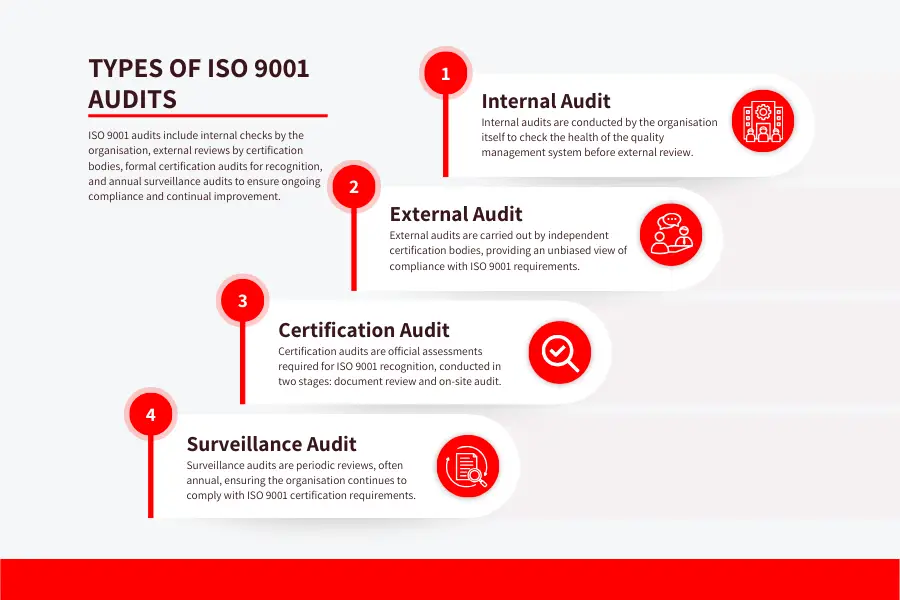
Types of ISO 9001 Audits
ISO 9001 Internal Audits (First-Party)
Internal audits are the foundation of compliance. They are designed to give organisations an honest view of how well their ISO 9001 quality management system (QMS) is functioning before any external auditors become involved.
By taking a proactive approach, organisations can identify gaps early and address them without the pressure of a certification deadline.
- Conducted by the organisation itself (or by someone acting on its behalf).
- Aim: to check the health of the QMS before an external review.
- Usually carried out by trained internal auditors who are impartial to the process they’re auditing.
When carried out properly, internal audits are not just a box-ticking exercise. They encourage teams to think critically about their processes, highlight areas for continual improvement, and build confidence across the organisation ahead of third-party certification audits.
💡 Tip: Master ISO 9001 internal audits with our 16-step guide.
ISO 9001 External Audits (Third-Party)
While internal audits help an organisation self-check its quality management system, external audits bring an additional level of credibility. These are conducted by independent certification bodies that have no direct connection to the organisation. Their role is to provide an impartial assessment of whether ISO 9001 requirements are being met.
- Performed by independent certification bodies.
- Provide an unbiased view of compliance.
- Required for achieving or maintaining ISO 9001 certification.
Because of their independence, external audits carry significant weight with customers, regulators, and stakeholders. A successful external audit demonstrates that the organisation’s processes are not only in place but are effective in practice. It also builds trust by showing that quality claims have been verified by a recognised third party.
💡 Tip: Master ISO 9001 external audits with our in depth guide, including how to prepare.
ISO 9001 Surveillance Audits
Achieving ISO 9001 certification is not a one-time event. To maintain certification, organisations must demonstrate that their quality management system continues to meet requirements over time.
This is where surveillance audits come in – they act as periodic check-ups to ensure that quality processes remain effective and improvements are sustained.
- Conducted at regular intervals (often annually) after certification.
- Ensure the organisation continues to comply with ISO 9001 requirements.
Surveillance audits provide reassurance to both the organisation and its customers that quality standards are not only met during the initial certification audit but also consistently upheld.
They encourage a culture of continual improvement and accountability, helping businesses avoid slipping into complacency once certification has been achieved.
💡 Tip: Master ISO 9001 surveillance audits with our in depth guide, including how to prepare.
Preparing for an ISO 9001 Audit
Preparing for an ISO 9001 audit involves more than simply gathering paperwork — it’s about building confidence that your quality management system is both effective and compliant. Careful preparation ensures that the audit process runs smoothly, reduces the risk of unexpected findings, and helps staff feel ready to engage with auditors. One of the most practical ways to begin this preparation is by working with a structured audit checklist.
Using an Audit Checklist

One of the best ways to prepare for an ISO 9001 audit is to work with a checklist. This ensures that no key requirement is overlooked and that the quality management system is ready for detailed scrutiny.
A checklist also gives staff a practical tool to track progress and spot gaps ahead of time.
- Quality policy and objectives
- Document control and record-keeping
- Evidence of training and competence
- Internal audit reports and corrective actions
- Management review minutes
- Customer satisfaction data and complaints handling
By systematically reviewing these areas, organisations can approach the audit with confidence. A well-prepared checklist not only makes the process more efficient but also shows auditors that the organisation is proactive and committed to maintaining a strong quality culture.
Documentation and Records

One of the most common pitfalls in ISO 9001 audits is missing or incomplete documentation. Even if processes are followed correctly, a lack of supporting evidence can lead to nonconformities.
Auditors need to see proof that policies and procedures are properly documented and consistently maintained. To prepare, organisations should:
- Ensure all controlled documents are up-to-date and accessible
- Keep clear records of procedures and policies
- Make sure staff know where to find relevant documents
Strong documentation not only supports compliance but also helps staff work more effectively.
When records are accurate and easy to access, it reduces confusion, improves accountability, and gives auditors confidence that the quality management system is well-managed and reliable.
ISO 9001 Gap Analysis and Readiness Review
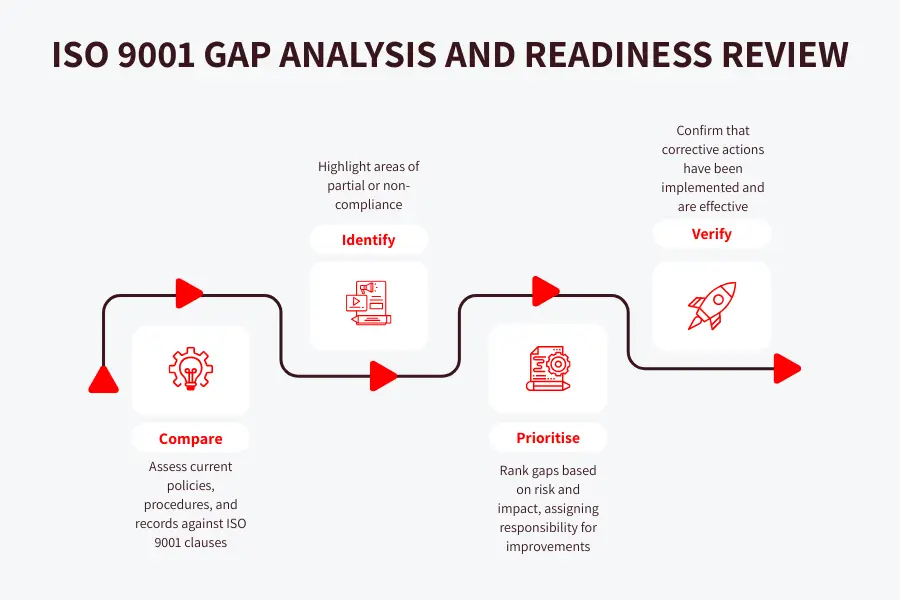
Before undergoing a certification or surveillance audit, it’s wise to conduct a gap analysis. This process highlights any differences between your existing quality management system and the requirements of ISO 9001.
By identifying weaknesses early, organisations can take corrective action in advance and avoid surprises during the official audit.
A readiness review typically involves:
- Comparing current policies, procedures, and records against ISO 9001 clauses
- Identifying areas of partial or non-compliance
- Prioritising corrective actions and assigning responsibility
- Verifying that improvements have been implemented and are effective
Completing a gap analysis and readiness review gives the organisation a realistic picture of how prepared it is for the audit.
More importantly, it builds confidence among staff and management that the QMS is not only compliant on paper but functioning effectively in practice.
The ISO 9001 Audit Process

ISO 9001 Planning and Scope
Every successful audit starts with clear planning. Before auditors begin reviewing records or interviewing staff, it’s important to set boundaries and define exactly what the audit will cover.
Establishing the scope ensures the process is structured, efficient, and focused on the right areas.
- Define what areas, sites, or departments will be audited.
- Identify which processes and clauses of ISO 9001 will be reviewed.
By clarifying the scope in advance, organisations avoid confusion and ensure that the audit provides meaningful results.
It also helps staff understand what to expect, reduces wasted time, and ensures that no critical elements of the quality management system are overlooked.
Conducting the ISO 9001 Audit
Once the planning stage is complete, the audit moves into the practical phase. This is where auditors gather evidence to determine whether the organisation’s quality management system is working as intended.
Evidence is not just paperwork — it can also come from staff interviews, observations on the shop floor, and real-life examples of how processes are carried out.
- Auditors will interview staff, review documents, and observe operations.
- They look for objective evidence — proof that procedures are being followed, not just written down.
- Questions may include:
- “How do you ensure customer feedback is captured and reviewed?”
- “Show me how you record and control nonconforming products.”
This stage of the audit is often seen as the most intensive, but it doesn’t have to be intimidating. If employees are familiar with their processes and records are well maintained, the audit usually runs smoothly.
More than anything, this part of the audit offers an opportunity for organisations to showcase good practices and identify areas where further improvements can be made.
Reporting ISO 9001 Audit Findings
At the end of the audit, the auditor will bring together all observations and evidence into a structured report.
This step is essential, as it provides management with a clear picture of how well the quality management system aligns with ISO 9001 requirements and where improvements may be needed.
- Conformities: areas where the system meets or exceeds requirements.
- Observations: opportunities for improvement that are not formal nonconformities.
- Nonconformities: failures to meet requirements, which may be classified as major or minor.
The audit report is usually presented during a closing meeting, giving the organisation a chance to ask questions and clarify points.
Rather than treating findings as criticism, successful organisations use them as constructive feedback. This approach turns the audit into a powerful tool for strengthening processes, improving efficiency, and driving continual improvement.
Common Audit Findings and How to Resolve Them

Even well-prepared organisations may receive findings during an ISO 9001 audit. These are not necessarily failures, but rather opportunities to strengthen the quality management system. Some of the most frequently observed issues include:
- Incomplete records (e.g., training records not signed)
- Unclear processes (procedures not followed as written)
- Weak corrective action tracking
- Inconsistent customer feedback handling
While these issues may seem minor, they can affect how consistently the organisation delivers quality.
The key is not to fear findings, but to treat them as constructive feedback. Addressing them promptly helps build a stronger QMS and demonstrates a genuine commitment to continual improvement.
How to Address Findings
The way an organisation responds to audit findings has a big impact on its long-term success with ISO 9001.
Auditors are less concerned with perfection and more interested in whether issues are dealt with systematically and improvements are sustained.
- For minor nonconformities: Correct the issue and provide evidence (e.g., updated training record).
- For major nonconformities: A deeper corrective action plan is required, often followed by a re-audit.
In addition, auditors expect to see evidence of continuous improvement — not just fixing problems as they arise, but putting measures in place to stop them from happening again.
Organisations that take this approach show maturity in their quality management and are more likely to gain lasting value from the audit process.
Roles and Responsibilities in an ISO 9001 Audit
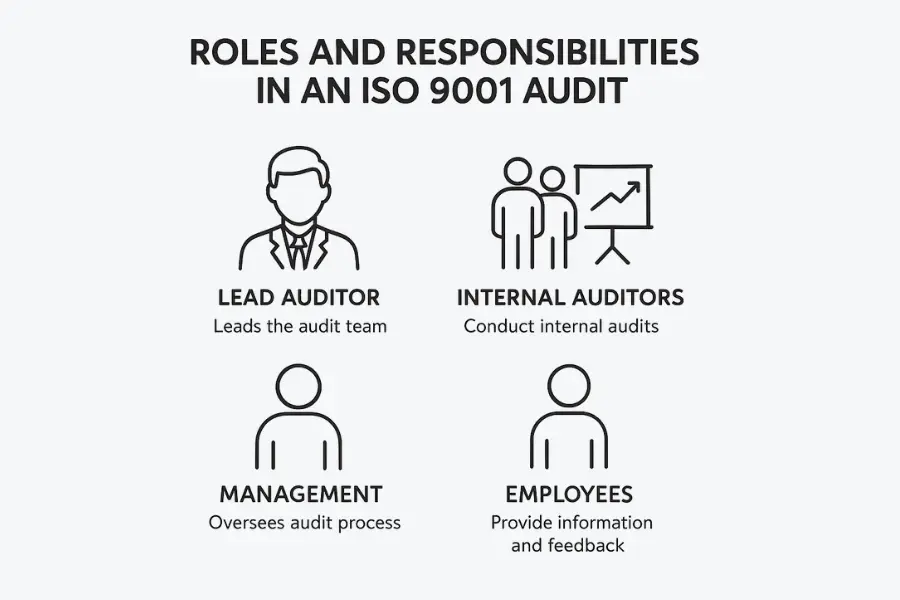
Successful audits rely on people just as much as they rely on processes. While documented procedures and systems provide the framework, it is the individuals within the organisation who bring those systems to life. Their knowledge, attitude, and engagement often determine whether an audit runs smoothly or exposes gaps. In short, the human element is every bit as important as the technical one.
ISO 9001 Lead Auditor
The lead auditor plays a central role in any ISO 9001 audit. Acting as the coordinator of the process, they ensure the audit is well-structured, efficient, and focused on the right areas.
Their expertise helps guide both the audit team and the organisation being audited.
- Plans the audit and leads the team
- Ensures findings are accurate and impartial
A skilled lead auditor not only checks compliance but also creates an environment where the organisation can learn from the process.
Their impartial approach builds trust and ensures the findings are constructive, reliable, and aligned with ISO 9001 requirements.
ISO 9001 Internal Auditors
Internal auditors are essential to maintaining the effectiveness of a quality management system. They provide an independent perspective from within the organisation, ensuring that day-to-day processes align with ISO 9001 requirements.
- Trained staff who carry out internal audits
- Must remain objective (they cannot audit their own work)
Because they understand the organisation’s culture and operations, internal auditors are well placed to spot issues early.
Their role isn’t about finding faults but about strengthening processes and supporting continual improvement.
Objectivity is key — when internal audits are fair and impartial, they help prepare the organisation for successful external and certification audits.
Top Management
The involvement of top management is critical to the success of an ISO 9001 audit. Leadership sets the tone for quality throughout the organisation and demonstrates commitment to the principles of the standard.
Without visible support from management, even the most well-designed systems can struggle to succeed.
- Demonstrates leadership commitment
- Ensures adequate resources and communication
When leaders are actively engaged, staff are more motivated to follow procedures and embrace improvements. Top management’s role goes beyond compliance — it’s about fostering a culture where quality is valued at every level of the organisation.
Employees
Employees play a vital part in the audit process, as they are the ones carrying out the organisation’s procedures on a daily basis.
Auditors often speak directly with staff to verify that processes are not only documented but also followed in practice.
- Provide information during interviews
- Show how they follow processes day-to-day
Their input gives auditors valuable insight into how well the quality management system works in real life. To support this, training is essential — particularly for internal auditors, but also for staff at every level.
ISO 9001 Audit vs Other ISO Standards
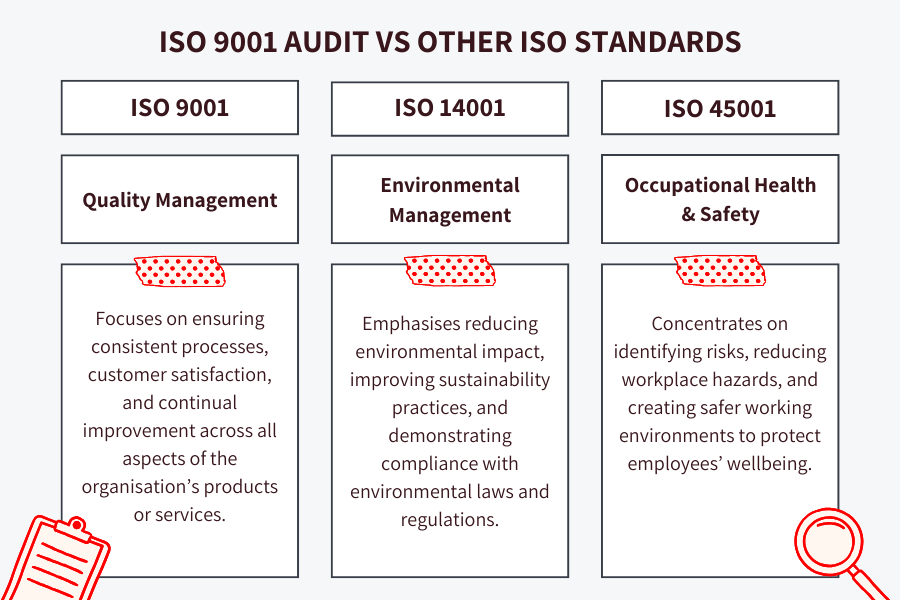
While ISO 9001 focuses on quality management, many organisations also adopt other ISO standards to strengthen their overall management systems.
These standards often complement one another, and audits can be integrated to save time and resources.
ISO 14001 Audit (Environmental Management)
ISO 14001 is the international standard for environmental management systems. Organisations that adopt it are committed to reducing their environmental impact and managing resources more responsibly. When combined with ISO 9001, it helps align quality and sustainability goals.
Focuses on environmental impacts and sustainability
Often integrated with ISO 9001 audits in larger organisations
Integrating ISO 14001 with ISO 9001 audits allows organisations to demonstrate both quality and environmental responsibility in one process. This not only saves time but also reinforces a commitment to sustainable business practices, which is increasingly important to customers, regulators, and stakeholders.
ISO 45001 Audit (Health & Safety Management)
ISO 45001 sets the international standard for occupational health and safety management. It provides a framework for organisations to identify risks, protect employees, and create safer workplaces. When combined with ISO 9001, it ensures that quality and safety are managed in a coordinated way.
Concentrates on employee safety and risk management
Can be combined with ISO 9001 for an integrated audit
Integrating ISO 45001 with ISO 9001 audits helps organisations streamline compliance and reduce duplication of effort. It also demonstrates a strong commitment to both product or service quality and the wellbeing of employees, strengthening reputation and trust with stakeholders.
Conclusion – Key Takeaways for a Successful ISO 9001 Audit

An ISO 9001 audit is more than a compliance exercise. It’s a chance to strengthen processes, improve efficiency, and build customer trust.
To succeed:
- Prepare thoroughly with a checklist and gap analysis
- Keep documentation accurate and up to date
- Engage staff at all levels
- Treat findings as opportunities for improvement
By approaching the audit as a learning experience rather than a test, organisations gain long-term value and strengthen their commitment to quality.
Key Takeaways
- ISO 9001 audits check whether a QMS meets international standards
- Types include internal, external, certification, and surveillance audits
- Preparation involves checklists, documentation, and gap analysis
- Findings may highlight nonconformities or opportunities for improvement
- Success relies on engaged staff, strong records, and continuous improvement
ISO 9001 Audit FAQs
How often are ISO 9001 audits required?
Organisations must undergo a certification audit every three years to maintain ISO 9001 certification. Between these, surveillance audits are usually conducted annually to check that the quality management system remains compliant and effective. Internal audits should also be carried out regularly, often at least once a year, depending on the size and complexity of the organisation.
What is the difference between an internal and external ISO 9001 audit?
An internal audit is performed by the organisation itself (or someone acting on its behalf) to check the health of the quality management system. An external audit is carried out by an independent certification body to provide an impartial assessment. External audits are required for achieving or renewing ISO 9001 certification.
What happens if nonconformities are found during an ISO 9001 audit?
If nonconformities are identified, the organisation must take corrective action to resolve them. Minor issues can often be addressed quickly with updated records or clarified procedures. Major nonconformities require a detailed action plan and may trigger a follow-up audit. In every case, auditors expect to see evidence of corrective action and continual improvement.
How should an organisation prepare for an ISO 9001 audit?
Preparation typically involves:
- Conducting a gap analysis against ISO 9001 requirements
- Using a detailed audit checklist
- Ensuring all documentation is accurate and accessible
- Training staff so they understand their roles and responsibilities
Good preparation reduces stress during the audit and increases the chances of a smooth outcome.
Do ISO 9001 audits apply to all industries?
Yes. ISO 9001 is a generic quality management standard, meaning it can be applied to organisations of any size, in any industry. From manufacturing and construction to healthcare and IT services, the principles of ISO 9001 help organisations deliver consistent quality and improve customer satisfaction.
How long does an ISO 9001 audit take?
The length of an audit depends on factors such as the size of the organisation, the number of sites, and the complexity of its processes. A small business may only need a few days, while a large multinational with multiple sites could require several weeks. Certification bodies usually provide an estimate based on scope and resources.
What are the benefits of passing an ISO 9001 audit?
Achieving certification offers multiple benefits:
- Increased credibility and customer trust
- Greater efficiency and reduced waste
- Improved staff engagement and accountability
- Stronger competitive advantage in tenders and contracts
Ultimately, an ISO 9001 audit is not just about compliance — it’s about building a culture of continual improvement.