Introduction

Achieving ISO 9001 certification is one of the most effective ways for organisations to demonstrate their commitment to quality and continuous improvement.
This internationally recognised standard sets out the framework for a robust Quality Management System (QMS) — one that ensures consistent performance, customer satisfaction, and continual enhancement of business processes.
Whether you’re a small enterprise or a large corporation, ISO 9001 certification can transform how you manage quality, engage employees, and meet customer needs.
In this guide, we explore the top benefits of ISO 9001 certification — from improved efficiency and compliance to stronger leadership and long-term business growth.
What Is ISO 9001 and Why It Matters

The purpose of ISO 9001 is to establish a consistent and structured approach to managing quality across an organisation.
It helps ensure that every process — from planning and production to delivery and aftercare — is carried out in a controlled, efficient, and accountable manner.
At its core, ISO 9001 aims to help organisations meet customer expectations while complying with all relevant legal and regulatory requirements.
It also fosters a culture of continuous improvement, encouraging teams to identify inefficiencies, manage risks, and refine performance over time.
By embedding these principles, ISO 9001 transforms quality management from a reactive process into a proactive strategy that supports long-term success.
Consistency
One of the fundamental objectives of ISO 9001 is to create consistency across all operations.
Consistent processes lead to predictable outcomes, which in turn improve reliability and customer satisfaction.
ISO 9001 helps organisations achieve this by:
- Establishing standardised procedures for all key activities
- Reducing variation in how products and services are delivered
- Ensuring that quality objectives are clearly defined and measurable
- Supporting repeatable outcomes through documented processes and training
Consistency ensures that quality is not dependent on individual performance but built into the organisation’s structure and culture.
This allows businesses to deliver dependable results regardless of changes in staff, demand, or market conditions.
Compliance
Another core purpose of ISO 9001 is to help organisations meet regulatory and statutory requirements relevant to their products or services. Compliance is critical for maintaining credibility, reducing legal risks, and operating responsibly within a given industry.
Through ISO 9001, organisations can:
- Identify and interpret all applicable legal and regulatory obligations
- Establish processes that ensure continuous compliance
- Maintain accurate records and traceability for auditing purposes
- Build confidence with regulators, customers, and stakeholders
Compliance within ISO 9001 is not simply about avoiding penalties. It’s about developing responsible, transparent operations that reflect integrity and professionalism.
Customer Satisfaction
At the heart of ISO 9001 lies customer satisfaction. The standard recognises that consistent quality, clear communication, and reliable delivery are essential for maintaining customer trust and loyalty.
ISO 9001 supports customer satisfaction by:
- Gathering and analysing customer feedback
- Monitoring performance metrics related to customer expectations
- Ensuring that complaints are handled promptly and effectively
- Aligning organisational goals with customer needs
By prioritising customers throughout every stage of the business process, organisations can build long-term relationships and strengthen their reputation in competitive markets.
Continuous Improvement
Continuous improvement is a defining feature of ISO 9001. It ensures that quality management is not static but evolves as the organisation grows, technologies change, and customer needs develop.
The standard promotes ongoing improvement through:
- Regular internal audits and management reviews
- Root-cause analysis of issues and nonconformities
- Implementation of corrective and preventive actions
- Encouragement of innovation and best-practice sharing
Continuous improvement ensures that the QMS remains effective and relevant over time, helping organisations adapt to new challenges while maintaining operational excellence.
In summary, the purpose of ISO 9001 extends well beyond compliance.
It builds a culture of quality that enhances consistency, strengthens customer relationships, ensures compliance, and drives sustained business growth through continuous improvement.
Why ISO 9001 Is Used

ISO 9001 is the world’s most widely adopted standard for quality management.
It provides a structured framework that helps businesses maintain consistency, reduce errors, and deliver products and services that meet or exceed customer expectations.
ISO 9001 matters because it creates a culture of quality that goes beyond individual performance. It embeds good practice into every part of the organisation — from leadership and planning to delivery and improvement.
- ISO 9001 is a globally recognised quality management standard.
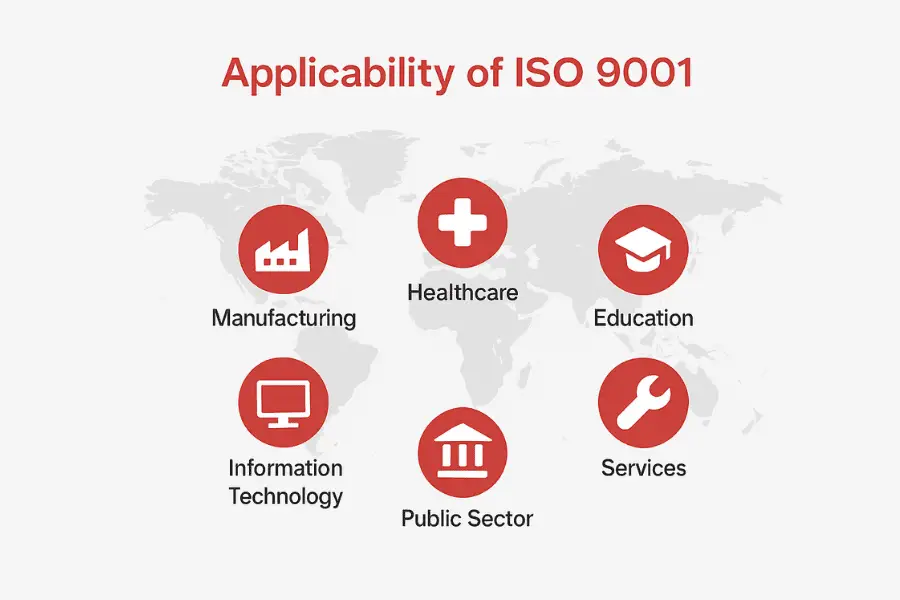
- It applies to any organisation, regardless of size or sector.
- Certification demonstrates that your business is serious about quality and continual improvement.
By implementing ISO 9001, you’re not just meeting compliance requirements — you’re building a foundation for long-term trust and operational excellence.
1. Improved Customer Satisfaction
Customer satisfaction sits at the heart of ISO 9001. The standard is built around the principle of understanding and meeting customer needs — consistently and effectively.
- Establishing processes to capture and analyse customer feedback.
- Ensuring that customer requirements are clearly defined and communicated.
- Reducing defects and rework that can harm customer trust.
- Promoting continuous improvement in service and product delivery.
When customers see that your organisation takes quality seriously, they are more likely to remain loyal and recommend your services — driving repeat business and positive reputation.
2. Enhanced Operational Efficiency

ISO 9001 focuses on streamlining operations and removing inefficiencies that slow progress or waste resources. Through clear procedures and documented workflows, teams know exactly what’s expected and how to deliver it.
- Standardise core processes to eliminate confusion and errors.
- Identify and address bottlenecks or non-value-adding activities.
- Improve coordination across departments and supply chains.
- Reduce waste, duplication, and costly rework.
The result is smoother operations, improved productivity, and reduced costs — all of which contribute directly to stronger profitability.
3. Stronger Leadership and Accountability

Leadership commitment is a core requirement of ISO 9001. The standard promotes accountability at every level, ensuring that senior management plays an active role in embedding quality objectives within business strategy.
- Defining clear roles and responsibilities across the organisation.
- Aligning quality goals with overall business direction.
- Encouraging leaders to lead by example and promote quality culture.
- Ensuring resources are available to meet QMS requirements.
This strong foundation of accountability ensures everyone understands their role in maintaining quality — leading to a more focused and motivated workforce.
4. Increased Market Opportunities

Holding ISO 9001 certification often opens doors to new markets and contracts, particularly where clients or tenders require it as a condition for participation.
- Satisfy pre-qualification requirements in both public and private tenders.
- Build confidence among prospective clients and partners.
- Enhance credibility when entering new markets or industries.
- Differentiate your organisation from non-certified competitors.
Being able to demonstrate ISO 9001 compliance can be the deciding factor that secures new business and expands your customer base.
5. Data-Driven Decision Making

ISO 9001 encourages evidence-based management — making decisions founded on accurate data rather than assumptions. This leads to better performance monitoring and more informed strategic planning.
- Setting measurable quality objectives and performance indicators.
- Collecting and analysing data to identify trends and root causes.
- Using findings from audits, customer feedback, and reviews to guide improvement.
- Reducing risk by basing actions on facts rather than opinions.
When organisations make decisions using reliable data, they not only avoid costly errors but also identify opportunities for continuous improvement and innovation.
6. Greater Employee Engagement

A well-implemented quality management system gives employees clarity, empowerment, and purpose. ISO 9001 encourages collaboration, ownership, and pride in quality outcomes.
- Clear definition of roles and processes.
- Regular communication about quality goals and performance.
- Opportunities for training and professional development.
- Recognition of employee contributions to quality improvement.
When staff feel part of the quality journey, motivation and retention rise — creating a stronger, more cohesive team culture.
7. Better Risk Management
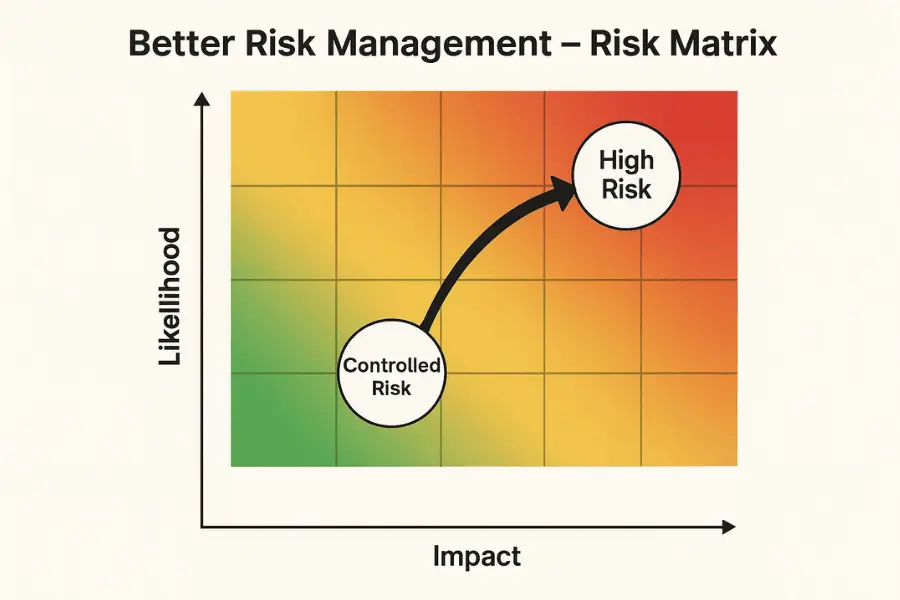
ISO 9001 takes a proactive approach to identifying and managing risks that could impact quality, operations, or customer satisfaction.
- Requiring businesses to assess risks and opportunities systematically.
- Implementing controls to prevent issues before they arise.
- Encouraging contingency planning and resilience.
- Driving continual review and improvement of risk-based processes.
By addressing risks early, businesses reduce the likelihood of disruptions, improve reliability, and strengthen long-term sustainability.
8. Easier Integration with Other Standards
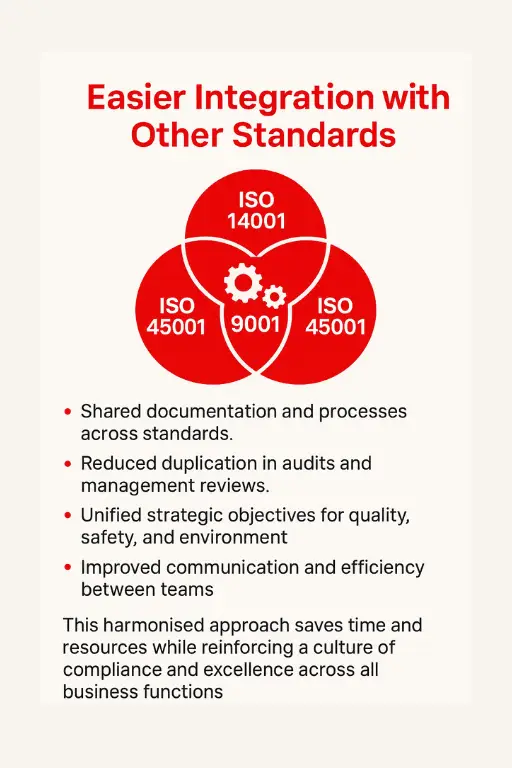
Many organisations operate under multiple management systems, such as ISO 14001 (environmental) or ISO 45001 (health and safety). ISO 9001’s structure makes it easy to align with these and create an integrated management system.
- Shared documentation and processes across standards.
- Reduced duplication in audits and management reviews.
- Unified strategic objectives for quality, safety, and environment.
- Improved communication and efficiency between teams.
This harmonised approach saves time and resources while reinforcing a culture of compliance and excellence across all business functions.
9. Continuous Improvement Culture
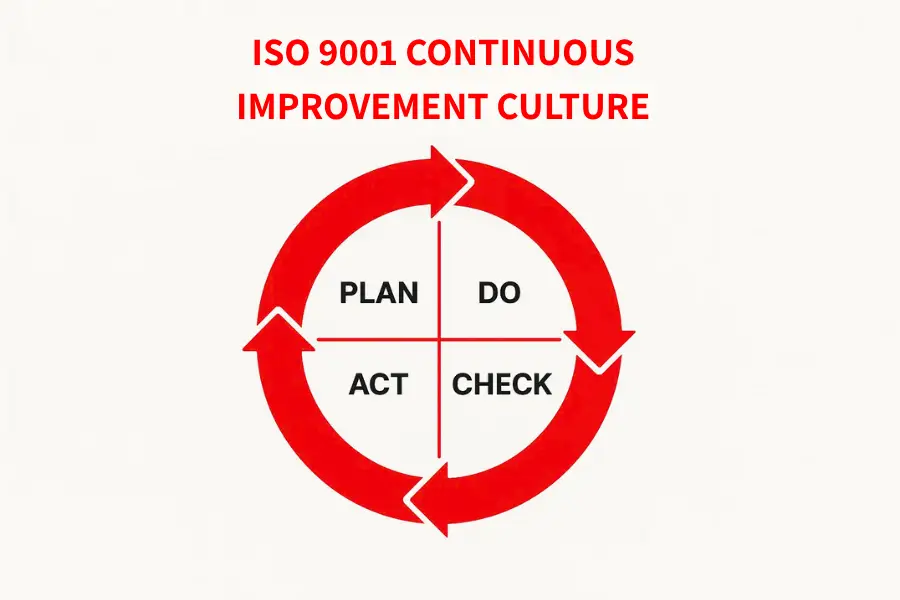
One of ISO 9001’s greatest strengths is its emphasis on continuous improvement — ensuring organisations never become complacent.
- Applying the Plan–Do–Check–Act (PDCA) cycle to all processes.
- Regularly reviewing performance against objectives.
- Encouraging feedback and innovation from employees and customers.
- Making improvement an ongoing, measurable activity.
A culture of continual improvement helps organisations stay competitive, adaptable, and resilient in the face of changing market demands.
10. Global Recognition and Credibility
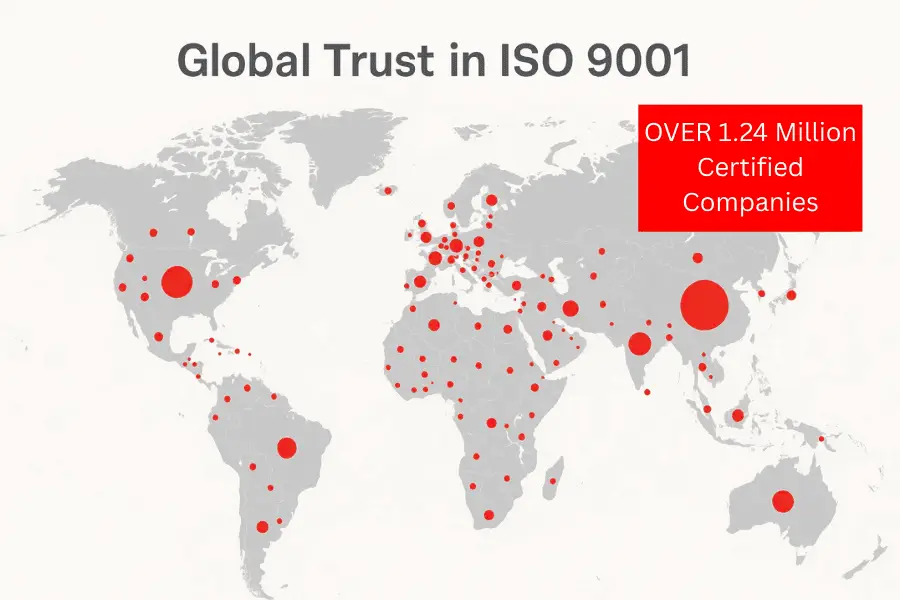
ISO 9001 is an internationally recognised symbol of quality and reliability. Certification instantly signals to customers, regulators, and partners that your organisation meets rigorous quality standards.
- Universal acceptance across industries and countries.
- Enhanced brand reputation and customer confidence.
- Easier access to international supply chains and partnerships.
- Competitive advantage in export and tender markets.
ISO 9001 certification demonstrates professionalism and consistency, strengthening your position both domestically and globally.
How ISO 9001 Benefits Your Bottom Line
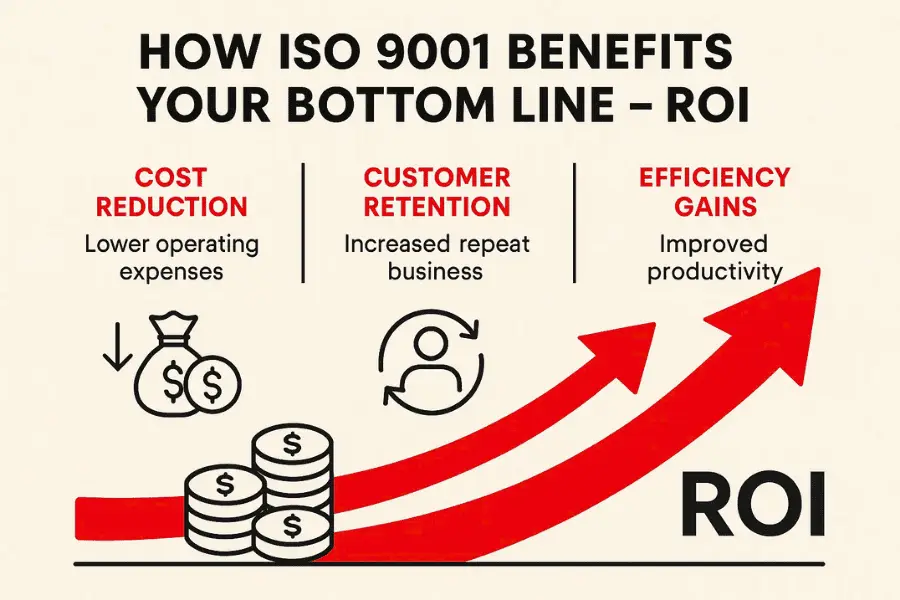
While ISO 9001 is about quality, its impact is deeply financial. By improving efficiency, reducing waste, and increasing customer loyalty, certified businesses often see tangible returns on investment.
- Lower operating costs through process optimisation.
- Fewer product failures, complaints, and returns.
- Higher customer retention and repeat sales.
- Stronger reputation that attracts new clients.
Ultimately, ISO 9001 helps turn quality into a measurable business advantage — delivering dependable results and long-term profitability.
How to Start Your ISO 9001 Journey
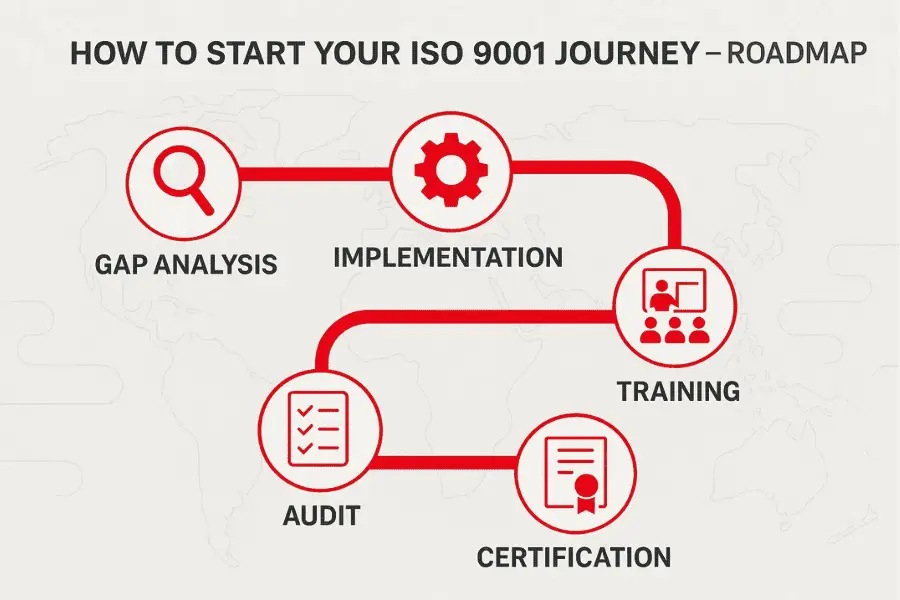
If you’re considering ISO 9001 certification, preparation is key. A structured approach will make implementation smoother and ensure lasting results.
- Conduct a gap analysis to compare current practices with ISO 9001 requirements.
- Develop an implementation plan and timeline.
- Train staff and communicate objectives.
- Select a UKAS-accredited certification body for assessment.
By taking a strategic approach, you’ll build a management system that’s not just compliant but genuinely valuable to your business.
Final Thoughts: Why ISO 9001 Is Worth It

ISO 9001 is more than a certificate on the wall — it’s a framework for excellence that transforms how your organisation operates.
From improved customer satisfaction to enhanced efficiency and market credibility, the benefits are wide-ranging and long-lasting.
By embedding quality into every aspect of your business, you create a culture of reliability, trust, and continuous improvement — one that drives growth, innovation, and lasting success.