Introduction: ISO 9001 Surveillance Audit

An ISO 9001 surveillance audit is a periodic review of an organisation’s quality management system (QMS) to confirm it continues to comply with the requirements of the ISO 9001 standard. Put simply, it asks: Are we still following our processes as planned, and do they continue to meet ISO 9001’s quality requirements?
Surveillance audits are essential because they:
- Verify that processes remain consistent and effective
- Identify opportunities for improvement
- Provide assurance to customers and stakeholders
- Support the ongoing maintenance of ISO 9001 certification and compliance
For organisations, successfully completing an ISO 9001 surveillance audit demonstrates commitment to quality, efficiency, and continual improvement throughout the certification cycle.
What is an ISO 9001 Surveillance Audit?
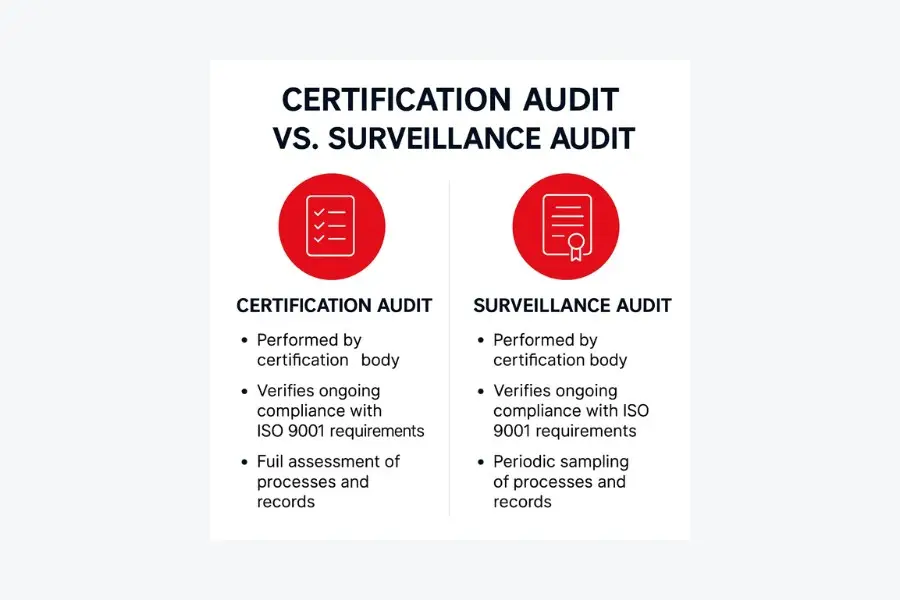
In simple terms, a surveillance audit is an independent review of your organisation’s ISO 9001 QMS, carried out by a UKAS-accredited certification body.
The purpose is to check whether your system continues to comply with ISO 9001:2015 requirements and whether your certification can be maintained.
An ISO 9001 surveillance audit will typically:
- Confirm ongoing compliance with ISO 9001 requirements
- Ensure processes are still being followed consistently
- Assess the effectiveness of your QMS in achieving quality objectives
- Highlight any nonconformities that must be corrected to keep certification valid
- Provide assurance to customers and stakeholders that your commitment to quality remains strong
Unlike an internal audit, a surveillance audit does not issue certification but ensures that your organisation retains its ISO 9001 approval throughout the three-year certification cycle.
Why are ISO 9001 Surveillance Audits Important?
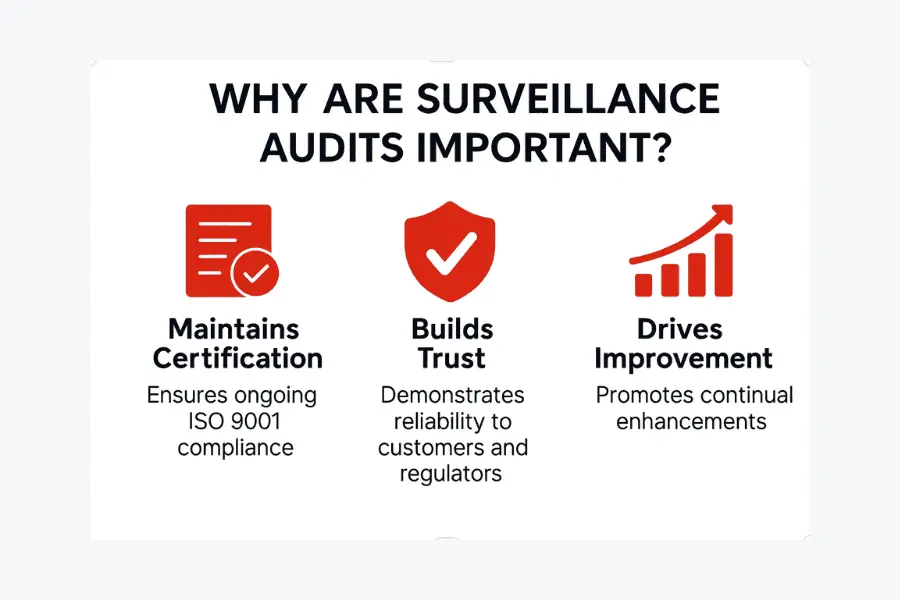
Surveillance audits provide far more than a routine check—they confirm that your QMS is still effective, consistent, and aligned with international best practice throughout the certification cycle.
Key benefits include:
- Maintaining ISO 9001:2015 certification year after year – Certification is only valid if your organisation passes its regular surveillance audits. These checks prove that your QMS continues to meet requirements and ensures there is no risk of suspension or withdrawal.
- Independent verification of ongoing compliance for customers and regulators – A UKAS-accredited certification body provides impartial assurance that your organisation is meeting ISO 9001 standards, which can be important when demonstrating compliance to regulators or industry bodies.
- Identifying risks, weaknesses, and opportunities for improvement – Auditors review your processes and may highlight nonconformities or improvement opportunities that internal teams might miss. This helps you proactively strengthen your QMS before small issues become bigger problems.
- Strengthening customer and stakeholder confidence – Being able to show that your QMS has been independently verified through surveillance audits reassures customers, suppliers, and stakeholders of your ongoing commitment to quality.
- Demonstrating a continuing commitment to quality and continual improvement – Surveillance audits provide evidence that your organisation is not standing still, but is actively monitoring performance, addressing issues, and pursuing continuous improvement.
- Preserving eligibility for tenders and contracts that require ISO 9001 certification – Many clients and public sector contracts mandate ISO 9001 certification. Passing surveillance audits ensures your organisation remains eligible to compete for these opportunities without disruption.
In short, a surveillance audit acts as reassurance that your ISO 9001 QMS remains fit for purpose, sustaining both credibility and market reputation.
The ISO 9001 Surveillance Audit Process

To maintain ISO 9001 certification, your organisation will undergo surveillance audits as part of the three-year certification cycle. These are not one-off checks, but scheduled reviews that ensure your QMS continues to meet ISO 9001:2015 requirements.
Certification bodies conduct surveillance audits in line with ISO/IEC 17021, which sets out how management system audits must be performed to guarantee consistency, impartiality, and credibility.
Typical stages of the surveillance audit process include:
- Audit planning – The certification body agrees the audit scope, dates, and sites to be visited. This stage confirms which processes and functions will be reviewed and ensures resources are in place for the audit to run smoothly.
- Opening meeting – The auditor explains the purpose, scope, and approach of the audit, confirming logistics and answering any initial questions.
- On-site or remote assessment – The auditor reviews documented information, samples processes, and interviews staff to check whether your QMS is still effective and compliant. Evidence is gathered against key ISO 9001 clauses.
- Audit findings – Any nonconformities are identified, along with observations or opportunities for improvement. These findings are discussed with your team so that corrective actions can be agreed.
- Closing meeting and report – The auditor summarises their conclusions and issues a formal report. This document confirms compliance or outlines any required corrective actions that must be closed within a set timeframe to maintain certification.
Surveillance audits are generally shorter than initial certification or recertification audits, but they play a crucial role in demonstrating that your QMS remains robust, compliant, and continually improving.
ISO 9001 Roles and Responsibilities in Surveillance Auditing
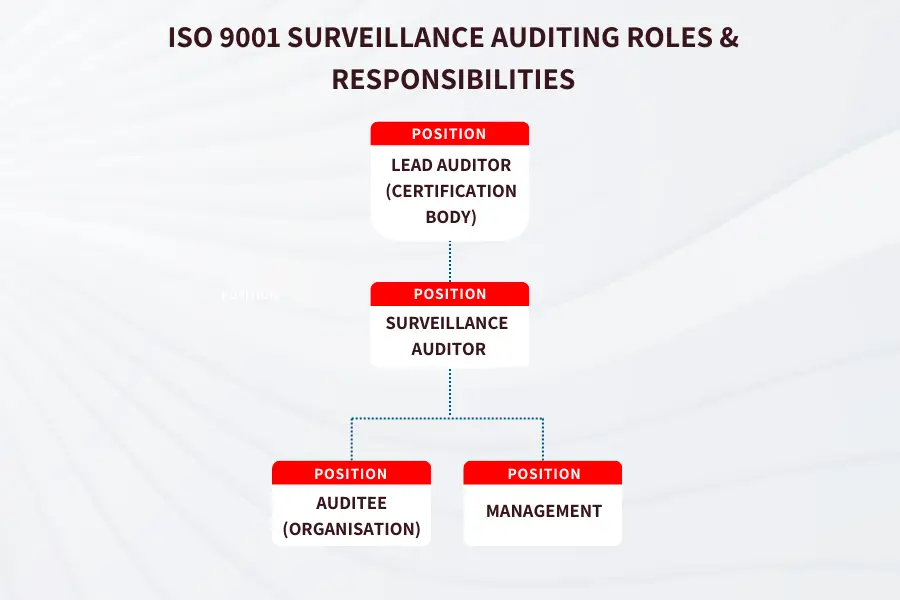
An ISO 9001 surveillance audit involves several parties, each with clearly defined responsibilities.
The process is most effective when everyone understands their role — from the certification body auditors who conduct the independent review, to the organisation’s staff and leadership who provide evidence and demonstrate commitment.
Together, these roles ensure the surveillance audit remains fair, objective, and adds real value.
Key roles include:
- Surveillance Auditor (Certification Body Auditor) – carries out the audit on behalf of the certification body, reviewing records, observing processes, and documenting findings.
- Lead Auditor – oversees the audit team, ensures consistency across assessments, and makes the final recommendation on compliance.
- Auditee (Organisation) – provides access to relevant documentation, processes, and personnel to demonstrate that the QMS is operating effectively.
- Top Management – plays a crucial part by showing leadership, engaging in the closing meeting, and ensuring that any corrective actions identified are addressed.
Because surveillance audits must remain impartial, the certification body operates independently of your organisation. Their role is to provide an objective assessment of your QMS against ISO 9001 requirements, ensuring certification is maintained with integrity.
How to Prepare for an ISO 9001 Surveillance Audit

A surveillance audit can be far less stressful when your organisation is well prepared. Think of it as an opportunity to showcase what you already do well, rather than a test designed to “catch you out”. The following steps will help ensure readiness:
- Review your QMS documentation – Make sure policies, procedures, work instructions, and records are current, controlled, and easily accessible. Surveillance auditors will expect clear document control and evidence of ongoing compliance.
- Conduct regular internal audits – Treat ISO 9001 internal audits as rehearsals for the surveillance audit. Identify and resolve issues in advance so that the certification body sees a well-functioning QMS, not unresolved nonconformities.
- Perform a management review – Ensure leadership remains engaged, aware of performance indicators, and ready to discuss risks, opportunities, and quality objectives. This demonstrates that top management is actively driving continual improvement.
- Check corrective actions – Confirm that any nonconformities raised in previous internal or external audit have been closed out effectively, with evidence of root cause analysis and corrective action.
- Prepare your team – Employees don’t need to know the ISO standard word-for-word, but they should understand their roles, follow documented procedures, and confidently describe their day-to-day responsibilities if asked.
- Organise records and evidence – Keep training records, calibration certificates, monitoring logs, and customer feedback well organised. Easy access to evidence ensures the audit progresses smoothly.
- Check facilities and housekeeping – Auditors often look at the work environment. A safe, clean, and well-organised workplace demonstrates professionalism and supports compliance with health, safety, and quality requirements.
- Plan logistics – Make sure meeting rooms are booked, key staff are available, and an audit agenda is agreed with the certification body. Good planning helps avoid last-minute issues.
- Foster a positive mindset – Remind staff that surveillance audits are about assurance and improvement, not blame. A cooperative, open approach helps build trust and keeps the process constructive.
By following these steps, your organisation can approach the ISO 9001 surveillance audit with confidence, reduce the likelihood of nonconformities, and demonstrate its ongoing commitment to quality.
Common Surveillance Audit Findings & Corrective Actions

During an ISO 9001 surveillance audit, auditors may identify findings that require attention. These are usually categorised as:
- Major nonconformities – serious failures that could threaten certification if not resolved quickly. These require urgent corrective action and may trigger a follow-up audit.
- Minor nonconformities – isolated issues that must be corrected but do not immediately risk certification.
- Observations – potential weaknesses or risks highlighted by the auditor that could lead to nonconformities in the future if not addressed.
- Opportunities for improvement – recommendations to strengthen your QMS or improve efficiency, even where no nonconformity exists.
Examples include:
- Missing calibration records (minor nonconformity)
- Ineffective customer complaint handling (major nonconformity)
- Outdated procedures (observation)
Corrective actions should aim for long-term prevention, not just quick fixes. Certification bodies will typically require evidence that the root cause has been addressed and that effective corrective action has been implemented before a finding can be formally closed.
Tools and Documentation for Surveillance Audits

Having the right documentation and tools in place makes a surveillance audit far smoother and more efficient. Auditors rely on objective evidence, not verbal assurances, so being able to produce accurate, well-organised records is essential.
Certification bodies will expect to see proof that your QMS is being applied in practice — not only that documented procedures exist, but that they are consistently followed and effective across the organisation.
Essential documents and tools include:
- QMS manual and documented procedures
- Records of management reviews
- Internal audit reports
- Corrective action logs and nonconformity tracking
- Training and competence records
- Process monitoring results and performance data
These records provide the evidence auditors need to confirm ongoing compliance with ISO 9001 requirements. Well-maintained documentation not only demonstrates conformity, but also shows that your organisation is in control of its processes and committed to continual improvement.
Supporting Standards & Guidelines
While ISO 9001 provides the framework for quality management, it is supported by several other international standards and guidelines that strengthen the surveillance audit process. These ensure that audits are conducted consistently, fairly, and with credibility:
- ISO/IEC 17021 – Defines the requirements for organisations that carry out audit and certification of management systems. It ensures certification bodies operate impartially, competently, and consistently during surveillance audits.
- ISO 19011 – Provides detailed guidance on auditing management systems, including audit principles, auditor competence, and programme management. It underpins both internal audits and third-party surveillance audits.
- ISO 9001:2015 Clause 9.2 & 9.3 – Set out the requirements for internal audits and management reviews, which provide essential inputs into surveillance audits and demonstrate leadership involvement in the QMS.
Together, these standards and guidelines ensure that surveillance audits are fair, transparent, and internationally recognised. They give customers and stakeholders confidence that certification is being maintained in line with global best practice.
Best Practices for a Successful Surveillance Audit
Preparing well for a surveillance audit helps your organisation demonstrate not only compliance, but also a culture of continual improvement. Following best practices ensures the audit runs smoothly and strengthens confidence in your QMS.
Key best practices include:
- Embed compliance into daily operations – Make ISO 9001 requirements part of normal business activities, rather than something prepared only for the audit. This makes evidence easier to provide and reduces stress.
- Keep documentation up to date – Ensure policies, procedures, and records are maintained regularly so they accurately reflect how your organisation operates.
- Engage leadership – Demonstrate active involvement from top management through management reviews, clear objectives, and visible commitment to quality.
- Encourage staff awareness – Train and brief employees so they understand their responsibilities and can confidently explain their role in the QMS.
- Track and close corrective actions – Address any previous nonconformities promptly and provide evidence of effective resolution to show auditors that lessons are being learned.
- Promote continual improvement – Use customer feedback, risk assessments, and performance data to drive improvements and demonstrate that your QMS evolves with business needs.
By embedding these practices, your organisation can approach surveillance audits with confidence, making the process constructive and ensuring certification is maintained without difficulty.
Conclusion
An ISO 9001 surveillance audit is not just a compliance exercise — it’s an opportunity to confirm that your quality management system remains effective, consistent, and aligned with best practice. By preparing well, engaging your team, and focusing on continual improvement, your organisation can approach surveillance audits with confidence.
Successfully maintaining ISO 9001 certification through surveillance audits strengthens credibility, builds customer trust, and demonstrates your ongoing commitment to quality.