In today’s fast-paced, globally competitive marketplace, quality has become a non-negotiable business imperative. That’s where the ISO 9001 quality management system comes into play. As the world’s most recognised quality management standard, ISO 9001 offers a proven framework for consistent performance, customer satisfaction, and continual improvement. For UK businesses striving to maintain compliance, boost credibility, and streamline operations, understanding and implementing ISO 9001 is more relevant than ever.

What is the ISO 9001 Quality Management System?
At its core, the ISO 9001 quality management system is an internationally recognised standard developed by the International Organization for Standardization. It provides a set of principles and requirements that guide organisations in ensuring consistent quality in products and services.
The framework fosters a culture of risk-based thinking, documentation requirements, performance evaluation, and continual improvement. Applicable across industries and business sizes, it’s more than a certificate—it’s a roadmap to excellence.
What Is the Main Purpose of ISO 9001?
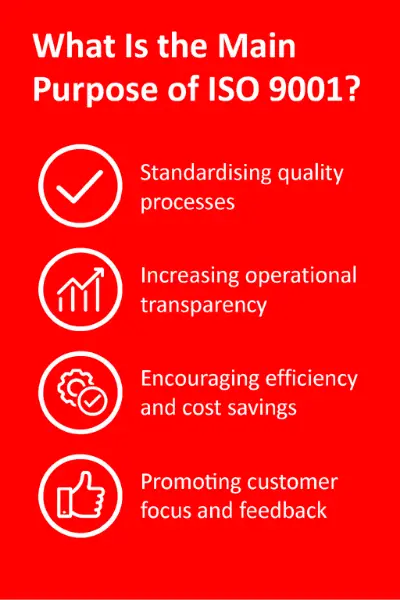
The ultimate aim of ISO 9001 is to ensure organisations meet customer and regulatory requirements while enhancing customer satisfaction through effective process management.
Key Purposes Include:
- Standardising quality processes across departments
Ensures uniformity in practices, reduces variability, and improves overall workflow consistency throughout the organisation. - Increasing transparency in operations
Enhances visibility across processes and decision-making, enabling better accountability and traceability. - Encouraging efficiency and cost savings
Streamlines procedures, reduces waste, and optimises resource utilisation, ultimately lowering operational expenses. - Promoting customer focus and feedback
Prioritises understanding customer needs and encourages continual dialogue to strengthen satisfaction and loyalty.
By aligning internal processes, companies not only reduce errors but also improve performance and customer trust.
What Are the Main Requirements of ISO 9001?
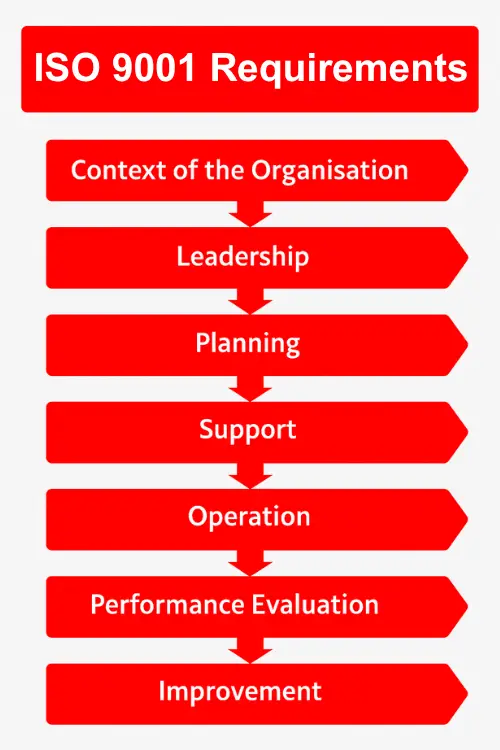
ISO 9001 outlines several core components under its high-level structure. Each plays a vital role in shaping an organisation’s quality management strategy.
Context of the Organisation
The “Context of the Organisation” clause helps businesses identify the internal and external factors that influence their quality management system. These could include market competition, regulatory pressures, or internal capabilities like resources and skills.
It also involves understanding the needs and expectations of interested parties such as customers, regulators, suppliers, and employees. This ensures the QMS is tailored to real-world conditions and stakeholder priorities.
- Identify internal and external issues
Evaluate factors such as technological changes, economic shifts, and organisational strengths and weaknesses. - Define interested parties and their expectations
Determine who has a vested interest in the QMS and document their requirements and concerns. - Align quality objectives with business strategy
Ensure that quality goals are not isolated but contribute directly to overall business direction and growth. - Monitor and review context regularly
Periodically reassess the organisational context to adapt to evolving circumstances or stakeholder expectations.
By addressing these factors, businesses can create a responsive and robust QMS that supports both compliance and continuous improvement.
- Conduct a thorough gap analysis
- Define the organisation’s mission, vision, and risks
Leadership
In ISO 9001, leadership plays a critical role in shaping the direction and success of the quality management system. Top management must show active involvement by aligning the quality policy with business strategy and promoting a culture focused on customer satisfaction and continual improvement.
- Establish and communicate a clear quality policy
Create a quality statement that supports strategic goals and is understood across the organisation. - Assign roles and responsibilities effectively
Ensure leadership defines and supports roles that promote accountability for quality objectives. - Lead regular management reviews
Conduct formal assessments to track QMS performance and align it with business priorities. - Foster a quality-driven culture
Inspire teams by integrating quality into decision-making and daily operations.
Effective leadership ensures that quality is embedded into the organisation’s fabric, making it a shared responsibility and a driver of long-term success.
Checklist for Leaders:
- Establish and communicate a quality policy
- Assign roles and responsibilities
- Conduct regular management reviews
Planning
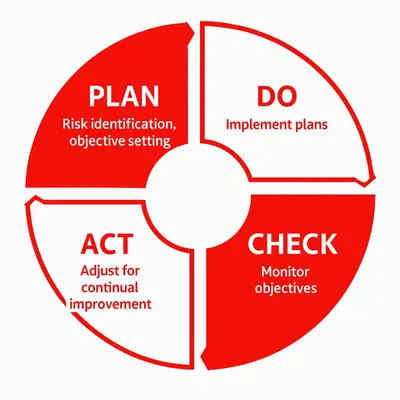
Planning within ISO 9001 centres on taking a proactive approach to quality management. It encourages organisations to apply risk-based thinking, set measurable quality objectives, and develop strategies to manage potential challenges and capitalise on opportunities.
- Incorporate risk-based thinking into processes
Identify risks and opportunities that could affect product or service quality and plan responses accordingly. - Set and review quality objectives
Define specific, measurable goals aligned with business strategy and customer expectations. - Develop action plans for improvement
Create documented plans to achieve objectives and address identified risks. - Integrate planning into daily operations
Ensure quality planning is not isolated but embedded across departments and functions.
This structured approach to planning helps ensure consistency, supports continual improvement, and prepares the business to respond effectively to change.
Key Tools:
- SWOT analysis
- PDCA cycle
- Strategic planning documents
Support
The support clause of ISO 9001 ensures that organisations have the necessary resources, people, infrastructure, and communication processes in place to maintain and improve their quality management system. It also focuses on ensuring staff competence, awareness, and proper management of documented information.
- Provide adequate resources and infrastructure
Ensure the organisation has suitable facilities, tools, and technology to support quality objectives. - Maintain employee competence through training
Identify skill gaps and deliver targeted training to ensure staff are competent in their roles. - Promote awareness of the QMS and objectives
Keep employees informed about the quality policy, goals, and their roles in achieving them. - Manage documented information effectively
Control the creation, review, and updating of documents to maintain accuracy and accessibility.
Proper support builds a strong foundation for a successful quality management system and promotes a culture where quality becomes part of daily business practices.
Checklist:
- Ensure employee training and competency
- Maintain quality manuals and SOPs
Operation

In ISO 9001, the operation clause ensures that organisations plan, implement, and control their processes to consistently deliver products and services that meet customer and regulatory requirements. This includes managing production, delivery, and interactions with external providers.
- Define and control operational processes
Establish clear procedures to manage key activities, from planning to final delivery. - Implement process mapping and SOPs
Use documented procedures and visual workflows to standardise operations and reduce errors. - Coordinate with external providers
Ensure suppliers and subcontractors meet agreed quality standards through evaluation and monitoring. - Manage changes and unforeseen issues
Develop procedures to handle operational changes and address any nonconformities swiftly.
Effective operational planning not only ensures compliance but also enhances efficiency, reliability, and customer satisfaction.
Operational Must-Haves:
- Process mapping
- Standard operating procedures (SOPs)
- Supplier evaluations
Performance Evaluation
The performance evaluation clause in ISO 9001 focuses on how an organisation monitors and assesses its quality management system. Through regular measurement, internal audits, and management reviews, businesses can identify areas for improvement and ensure that objectives are being met.
- Monitor and measure performance indicators
Track key metrics related to customer satisfaction, product quality, and process efficiency. - Conduct ISO 9001 internal audits regularly
Evaluate compliance with the QMS and identify gaps or areas requiring corrective action. - Analyse data for decision-making
Use trends, reports, and audit findings to make informed strategic decisions. - Carry out management reviews
Hold periodic reviews to assess QMS performance and align it with business goals.
This systematic approach helps maintain high standards, promotes transparency, and supports continual improvement throughout the organisation.
Tools:
- Audit checklist
- Key performance indicators (KPIs)
- Internal audits
Improvement
ISO 9001 places strong emphasis on continual improvement to enhance overall performance. Organisations are expected to take a structured approach to identifying nonconformities, implementing corrective and preventive actions (CAPA), and using insights to drive sustainable progress.
- Identify and address nonconformities
Detect deviations from quality standards and take prompt action to prevent recurrence. - Implement corrective and preventive actions (CAPA)
Use a formal system to investigate root causes and ensure lasting solutions are applied. - Encourage feedback and innovation
Gather input from employees, customers, and ISO 9001 audits to find opportunities for enhancement. - Track and review improvement initiatives
Monitor the effectiveness of changes and integrate successful practices into the QMS.
By embedding improvement into everyday activities, businesses can stay competitive, reduce inefficiencies, and respond effectively to evolving customer and regulatory demands.
Recommendations:
- Implement a CAPA system
- Schedule pre-assessment audits
What Are the 7 Principles of ISO 9001?
Understanding and applying the 7 quality management principles can lead to consistent success.

Customer Focus
Customer focus is the first and foremost principle of ISO 9001. It requires organisations to understand, meet, and strive to exceed customer needs and expectations, ensuring long-term satisfaction and loyalty.
- Understand customer requirements clearly
Engage with clients to gain a full picture of their needs, specifications, and expectations. - Deliver consistent value
Ensure that products and services reliably meet agreed standards and create meaningful benefit. - Collect and act on customer feedback
Use surveys, reviews, and complaints to improve offerings and resolve issues promptly. - Build trust through communication
Maintain clear, honest, and proactive communication throughout the customer journey.
Focusing on the customer not only strengthens relationships but also drives business growth by encouraging repeat business, referrals, and a positive reputation.
Actionable Tip: Regularly collect and review customer feedback.
Leadership
Leadership is essential for embedding a culture of quality within the organisation. ISO 9001 emphasises that strong leadership should provide direction, create alignment with strategic objectives, and foster a sense of purpose and unity among employees.
- Establish a clear vision for quality
Define and communicate how quality supports the organisation’s mission and long-term goals. - Demonstrate commitment at all levels
Show visible support for the QMS through active involvement and resource allocation. - Promote accountability and empowerment
Encourage decision-making at appropriate levels and ensure individuals understand their roles. - Lead by example in quality practices
Model desired behaviours by integrating quality principles into leadership decisions and actions.
Effective leadership inspires confidence, motivates teams, and ensures that the quality management system becomes an integral part of the business strategy.
Leadership Strategy: Involve leadership in QMS planning and reviews.
Engagement of People
ISO 9001 recognises that an organisation’s strength lies in its people. When individuals at all levels are engaged, motivated, and aware of their contributions to quality, the business is better equipped to achieve its objectives and adapt to change.
- Foster a culture of inclusion and collaboration
Encourage teamwork and shared ownership of quality outcomes across departments. - Provide training and development opportunities
Support employees in building the skills and knowledge needed to perform effectively. - Recognise contributions and achievements
Acknowledge efforts that enhance quality and reward continuous improvement initiatives. - Encourage open communication and feedback
Create safe channels for employees to share ideas, raise concerns, and suggest improvements.
By actively involving people, organisations can unlock innovation, improve morale, and drive the continuous improvement necessary for long-term success.
Tip: Empower employees through training and open communication.
Process Approach
The process approach is a key principle in ISO 9001, focusing on managing activities as interconnected processes that work together to deliver consistent, efficient, and high-quality outcomes. It encourages organisations to optimise workflows and understand how each part contributes to the whole.
- Identify and define core processes
Map out critical operations from input to output, including interactions and dependencies. - Assign clear responsibilities and authorities
Ensure each process has accountable owners and defined roles to maintain control and oversight. - Measure and monitor process performance
Use key indicators to assess efficiency, identify issues, and guide improvements. - Continuously improve process effectiveness
Apply data, audits, and feedback to refine processes and eliminate inefficiencies.
Adopting a process approach promotes greater clarity, consistency, and control, ultimately leading to improved productivity and customer satisfaction.
Best Practice: Use process mapping to identify bottlenecks.
Improvement
In a rapidly changing business environment, maintaining competitiveness requires continuous enhancement of processes, products, and services. ISO 9001 embeds a culture of ongoing improvement, ensuring that organisations remain agile, innovative, and efficient.
- Encourage a proactive improvement mindset
Motivate teams to seek better ways of working and suggest practical innovations. - Set clear improvement goals
Define targets linked to business strategy, customer needs, and operational performance. - Utilise data and feedback effectively
Analyse information from audits, complaints, and performance reviews to identify opportunities. - Monitor progress and refine actions
Track the outcomes of improvement initiatives and adjust approaches as necessary.
Focusing on improvement not only enhances quality but also builds resilience, enabling organisations to thrive amidst challenges and meet evolving stakeholder expectations.
Tip: Encourage innovation and reward performance excellence.
Evidence-Based Decision Making
ISO 9001 stresses that reliable, fact-based decisions are essential for effective management. Organisations should use accurate data and objective analysis to guide actions, reduce uncertainty, and support continual improvement.
- Collect relevant and reliable data
Gather information from audits, customer feedback, performance indicators, and operational records. - Analyse trends and performance results
Use data analysis tools to understand patterns, pinpoint issues, and predict future outcomes. - Make decisions supported by evidence
Base strategic and operational choices on solid data rather than assumptions or intuition. - Evaluate the impact of decisions
Monitor outcomes to confirm effectiveness and adjust strategies as needed.
This approach increases confidence in decision-making, improves resource allocation, and strengthens the overall performance of the quality management system.
Tools: Use metrics, dashboards, and data reviews.
Relationship Management
ISO 9001 highlights the importance of managing relationships with relevant stakeholders—especially suppliers—to ensure consistent quality and mutual benefit. Strong, collaborative partnerships can lead to improved performance, reduced risk, and long-term success.
- Identify key stakeholders and suppliers
Determine which external parties impact quality and prioritise relationship-building efforts accordingly. - Set clear expectations and agreements
Define roles, responsibilities, and quality requirements through contracts or service level agreements. - Evaluate supplier performance regularly
Monitor delivery times, product quality, and responsiveness to maintain high standards. - Foster open communication and collaboration
Encourage dialogue, feedback, and joint problem-solving to strengthen trust and efficiency.
By nurturing strategic relationships, organisations can enhance supply chain stability, boost customer satisfaction, and drive continuous improvement across the value chain.
Key Focus: Develop a supplier evaluation and feedback system.
What Is the Latest Version of ISO 9001?
The most current and widely adopted version of the standard is ISO 9001:2015. It reflects the evolving needs of modern organisations and places a greater focus on strategic alignment, risk management, and organisational context.
- A stronger emphasis on leadership
Encourages active involvement from top management to align quality with strategic goals. - Risk-based thinking
Promotes proactive identification and management of potential issues and opportunities. - Contextual analysis of the organisation
Requires understanding of internal and external factors that affect quality objectives.
ISO 9001:2015 also introduced the High-Level Structure (HLS), enabling easier integration with other ISO management standards, such as ISO 14001 and ISO 45001, for streamlined and cohesive system management.
Why Is ISO 9001 Important for Businesses?
For UK enterprises, the ISO 9001 quality management system provides a significant competitive advantage. It reinforces credibility, supports compliance with regulatory and industry standards, and encourages a proactive approach to improving operations and meeting customer expectations.
- Increased operational efficiency
Streamlines processes and reduces waste, leading to cost savings and improved productivity. - Enhanced customer satisfaction
Ensures consistent delivery of quality products and services that meet or exceed customer needs. - Better decision-making through data
Encourages the use of accurate information to guide strategies and improve business outcomes. - Stronger risk management
Helps identify and mitigate risks early, reducing disruptions and enhancing resilience.
Implementing ISO 9001 not only strengthens internal performance but also signals a commitment to excellence that resonates with customers, partners, and stakeholders alike.
ISO 9001 Costs and Certification Details
How Much Does ISO 9001 Cost?
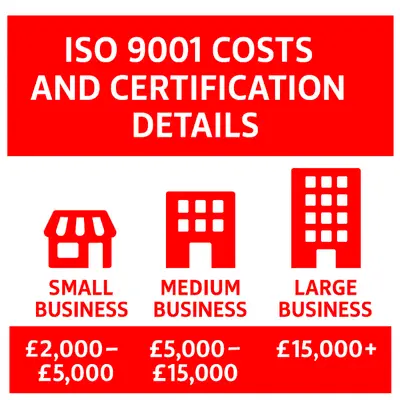
Costs vary based on company size, scope, and existing quality systems. On average:
- Small businesses: £2,000–£5,000
- Medium businesses: £5,000–£15,000
- Large organisations: £15,000 and above
Factors include consultancy fees, training, documentation, and audits.
Who Certifies ISO 9001?
Certification is issued by an accredited certification body after a third-party audit.
Accredited Bodies in the UK Include:
- Simply Certification
- SGS UK
- NQA
How Long Does ISO 9001 Certification Last?
ISO 9001 certification is not indefinite—it operates on a defined cycle to ensure organisations continually meet the standard’s requirements. Once achieved, certification must be maintained through regular evaluations and improvement efforts.
- Valid for three years
The certification remains in effect for a three-year period, provided ongoing compliance is demonstrated. - Annual ISO 9001 surveillance audits are required
Accredited certification bodies conduct yearly audits to verify the QMS is being maintained and improved. - Full recertification at the end of the cycle
After three years, a comprehensive reassessment is conducted to renew the certification for another term.
This structured timeline encourages organisations to sustain high standards, remain accountable, and keep the quality management system effective and relevant over time.
ISO 9001 Compliance and Relevance
Is ISO 9001 Still Relevant?
Absolutely. Despite evolving business landscapes and technological advancements, ISO 9001 remains a vital standard for ensuring effective compliance management, robust quality assurance, and lasting customer satisfaction.
- Applicable across all industries
ISO 9001’s flexible framework allows it to suit organisations of any size or sector. - Supports modern business practices
The 2015 version incorporates risk-based thinking and strategic planning aligned with current needs. - Encourages continual improvement
Keeps organisations responsive and competitive by fostering innovation and adaptability. - Builds stakeholder trust
Demonstrates a commitment to quality, increasing credibility with customers, suppliers, and regulators.
In today’s competitive environment, ISO 9001 continues to provide a solid foundation for growth, consistency, and business excellence.
Is ISO 9001 Mandatory?
ISO 9001 certification is not a legal requirement, but it is often considered essential in many sectors. While no legislation mandates compliance, industry expectations and competitive pressures frequently make certification a practical necessity.
- Required in supplier and tender agreements
Many public and private sector clients expect or demand certification as part of their procurement criteria. - Demonstrates commitment to quality
Signals to customers and stakeholders that the organisation prioritises consistent, high-quality outcomes. - Improves market access and reputation
Certification opens doors to new opportunities, partnerships, and markets where quality standards are critical. - Builds confidence among regulators and clients
Reassures external parties that the organisation adheres to internationally recognised standards.
So, while it’s not compulsory by law, ISO 9001 has effectively become a benchmark for quality and credibility across industries.
Who Needs to Comply with ISO 9001 Standards?
The ISO 9001 quality management system is designed to be universally applicable. Any organisation—regardless of size, sector, or complexity—can benefit from implementing its principles. It’s especially valuable for businesses seeking to enhance performance, demonstrate reliability, and meet customer and regulatory expectations.
- Small and medium-sized enterprises (SMEs)
Gain credibility, structure, and process efficiency without excessive bureaucracy. - Large and multinational corporations
Standardise operations across locations and maintain consistent quality worldwide. - Public sector organisations
Improve service delivery and meet transparency and accountability standards. - Manufacturers and service providers
Ensure product or service quality aligns with customer requirements and industry benchmarks.
Whether you’re a start-up or an established enterprise, ISO 9001 provides a practical, scalable framework to support growth, consistency, and long-term success.
ISO 9001 Compared to Other Standards
ISO 9001 is the foundational quality standard, while others like ISO 14001 focus on the environment and ISO 45001 on health and safety.
Comparison Table:
Standard | Focus | Common in |
ISO 9001 | Quality | All industries |
ISO 14001 | Environment | Manufacturing, logistics |
ISO 45001 | Health & Safety | Construction, healthcare |
How to Implement ISO 9001
Steps to Implement an ISO 9001 Quality Management System
Implementing ISO 9001 requires a systematic, well-planned approach. Organisations should tailor the process to their unique context while following recognised best practices to ensure the QMS is effective and certification-ready.
- Conduct a gap analysis
Assess current practices against ISO 9001 requirements to identify areas needing improvement. - Define the scope and objectives
Establish what parts of the organisation the QMS will cover and set clear, measurable goals. - Develop a quality manual and SOPs
Document policies, procedures, and responsibilities to create a consistent framework. - Train staff on QMS
Ensure all employees understand the QMS, their roles, and how to contribute to quality objectives. - Conduct an internal audit
Review processes and practices internally to identify nonconformities and opportunities for improvement. - Hire a certification body
Choose an accredited third-party organisation to conduct the official certification audit.
By following these steps, businesses can establish a solid foundation for ISO 9001 compliance, paving the way for certification and sustained quality performance.
Common Challenges in ISO 9001 Implementation

While the benefits of ISO 9001 are substantial, the path to implementation can present a few hurdles. Being aware of these common challenges allows organisations to prepare effectively and mitigate potential setbacks.
- Resistance to change
Employees may be hesitant to adopt new processes or shift from established habits, especially if the benefits aren’t clearly communicated. - Documentation overload
Developing and managing the necessary documentation—such as SOPs and records—can feel overwhelming without proper planning and delegation. - Underestimating training needs
Failing to equip staff with the right knowledge and skills can lead to misunderstandings, nonconformities, and disengagement from the quality system.
Recognising these issues early enables organisations to address them proactively, ensuring a smoother transition and more successful ISO 9001 implementation.
Tip: Engage an experienced ISO 9001 consultant for smoother transitions.
Frequently Asked Questions
What is a quality manual in ISO 9001?
A documented guide outlining the QMS structure, policies, and procedures.
What is an internal audit?
A self-assessment process to ensure QMS compliance before certification.
What is the PDCA cycle in ISO 9001?
Plan-Do-Check-Act: a method for continuous process improvement.
Is ISO 9001 certification valid internationally?
Yes. ISO 9001 is a globally recognised standard.
Can a small business get ISO 9001 certified?
Absolutely. It’s scalable for businesses of all sizes.
How long does ISO 9001 implementation take?
Typically 3–12 months depending on organisational readiness.
Conclusion
Implementing the ISO 9001 quality management system is a strategic decision that delivers real results. From increasing operational efficiency to securing stakeholder confidence, ISO 9001 sets the standard for quality worldwide. By following its structured framework, UK businesses can navigate compliance, promote continual improvement, and thrive in competitive landscapes. Don’t wait—begin your ISO journey today.