

Introduction: PAS 2038 Accreditation
PAS 2038, formally known as Publicly Available Specification 2038, is a framework developed by the British Standards Institution (BSI). Published to guide the energy-efficient retrofit of non-domestic buildings, this standard takes a comprehensive approach that integrates long-term sustainability, occupant health, and responsible construction practices in commercial and industrial environments.
Unlike previous retrofit standards, PAS 2038 adopts a whole-building approach, ensuring retrofit activities are not treated in isolation. Instead, the specification ties energy improvements to a building’s operational usage, physical condition, and future potential. It supports the UK’s mission to decarbonise its building stock and reach Net Zero by 2050.
In essence, PAS 2038 is more than a checklist—it is a strategic blueprint for smart, resilient, and sustainable non-domestic retrofits.

Why Was PAS 2038 Introduced?
Prior to PAS 2038, non-domestic retrofits often lacked consistent planning, oversight, and long-term thinking. Projects were typically isolated, ignoring the broader operational and structural context of the building.
- Isolated interventions sometimes led to unintended consequences (e.g., poor indoor air quality post-upgrades)
- No central accountability for outcomes
- Inconsistent project quality and performance
To address these issues, PAS 2038 was introduced as a counterpart to PAS 2035, bringing structure, clarity, and accountability to commercial retrofit projects.
Key Aims of PAS 2038 Accreditation:
- Place building stakeholders and end-users at the core of retrofit strategies
- Apply data-led insights to inform retrofit planning
- Establish clear professional roles and responsibilities throughout the process
Together, these aims drive technical rigour while supporting organisational goals such as compliance, energy savings, and decarbonisation.
When Did PAS 2038 Start?
PAS 2038 was formally released to meet growing demand for a robust, standardised approach to non-domestic energy retrofits. Though it builds on the momentum created by PAS 2035 in domestic contexts, PAS 2038 specifically targets commercial, public, and industrial buildings.
PAS 2038 Timeline:
- 2021–2022: Industry consultations and pilot integrations
- 2023: Public release of PAS 2038 standard by BSI
- 2024 onwards: Increasing alignment with government and private sector decarbonisation funding programmes
As with PAS 2035, PAS 2038 is expected to evolve alongside updates in policy, Net Zero strategy, and digital compliance systems.
Understanding the PAS 2038 Retrofit Revolution
PAS 2038 has redefined how non-domestic buildings are upgraded. The standard moves away from reactive fixes and one-off energy measures. Instead, it introduces a systemic, strategic view:
- Fabric-first thinking: Prioritise building envelope improvements before investing in technology
- Ventilation and health: Ensure retrofits improve—not compromise—indoor environmental quality
- Stakeholder alignment: Incorporate KSI (Key Stakeholder Involvement) to align outcomes with business operations and tenant needs
- Ongoing performance tracking: Emphasise long-term energy savings and adaptation
This integrated approach ensures that retrofits are not only technically sound but tailored for operational continuity, user comfort, and future energy regulations.
What is the Difference Between PAS 2030 and PAS 2038?
Although PAS 2030 and PAS 2038 are frequently mentioned together, they serve distinct but complementary functions within the commercial retrofit process. Understanding their differences is key to delivering fully compliant, high-performing retrofit projects.
Feature | PAS 2030 | PAS 2038 |
Focus | Installation Quality | Whole-Retrofit Process |
Applies to | Installers | Lead Professionals, Consultants, Designers |
Requirements | Compliance with specific measures | Retrofit planning, design, assessment, and evaluation |
Mandatory Roles | None specifically | Defined (e.g., Lead Professional, Commissioning Manager) |
Retrofit Plan | Not required | Mandatory |
Stakeholder Input | Limited | Integral (KSI at all phases) |
Together, they form an integrated, dual-standard framework ensuring that retrofit works are not only delivered to a high technical standard but also aligned with strategic and operational building needs.
Is PAS 2038 Mandatory?
PAS 2038 is mandatory for non-domestic retrofit projects that are publicly funded or part of schemes such as the Public Sector Decarbonisation Scheme (PSDS). In these cases, compliance is essential to meet funding and regulatory requirements. For privately funded commercial buildings, PAS 2038 is not legally required but is widely recognised as best practice—ensuring quality, accountability, and long-term energy performance.
What Does PAS 2038 Accreditation Involve?
PAS 2038 Accreditation is a formal recognition that a professional or organisation can competently deliver non-domestic retrofit projects in line with PAS 2038 standards. It requires both technical capability and practical understanding of energy performance, health and safety, stakeholder management, and regulatory alignment.
Requirements typically include:
- Completion of certified training by recognised bodies
- Accreditation tied to professional role (e.g., Lead Professional, Designer, Energy Assessor)
- Real-world project experience, including assessments and technical documentation
- Ongoing CPD (Continuing Professional Development) to stay current with standards and innovations
Accreditation under PAS 2038 not only unlocks access to publicly funded retrofit projects but also validates your credibility in delivering long-term, sustainable building improvements.
Who Needs PAS 2038 Accreditation?
PAS 2038 Accreditation is vital for professionals involved in the assessment, planning, coordination, and delivery of retrofit projects in commercial and non-domestic environments.
This includes:
- Energy Consultants
- Building Services Engineers
- Project Managers
- Architects
- Commissioning Managers
- Construction Consultants
Whether you lead retrofit programmes or operate as a specialist, PAS 2038 Accreditation establishes your role within a regulated, high-quality delivery ecosystem. It is also a prerequisite for engaging with frameworks and funding aligned with Net Zero and ESG targets.
How to Get PAS 2038 Accreditation: Step-by-Step
Becoming accredited under PAS 2038 isn’t about ticking boxes—it’s about gaining the competence, credibility, and confidence to deliver non-domestic retrofit projects that are safe, efficient, and future-ready. Here’s how the process unfolds:
- Choose Your Role: Core Roles in Non-Domestic Retrofit Projects
PAS 2038 identifies clear professional roles to ensure accountability and technical rigour throughout a retrofit project. These roles span the lifecycle of a project and ensure critical oversight at each phase:

- Lead Professional Oversees the overall retrofit strategy, ensuring project alignment with PAS 2038. Manages risk, compliance, and stakeholder coordination.
- Energy Consultant Conducts baseline energy analysis and develops modelling scenarios to inform retrofit decisions.
- Designer Prepares technical retrofit plans tailored to a building’s condition, use, and long-term potential. Coordinates with KSI to balance energy performance with operational needs.
- Project Manager Manages workflows, timelines, and multi-disciplinary teams. Ensures integration between design, implementation, and quality assurance.
- Commissioning Manager Validates installed systems for performance, compliance, and operational integration. Key to ensuring end-user needs are met.
These roles are collaborative, and effective teamwork among them supports optimal project outcomes.
📝 Tip: Choose a role that aligns with your qualifications and career goals. Strategic roles like Lead Professional require holistic oversight, while technical roles like Designer or Energy Consultant demand specialist skills.
- Complete a Certified Training Course
Once your role is selected, you must undertake accredited training aligned with PAS 2038. Options may include:
- CIBSE or BRE Academy – Suitable for Lead Professionals and Energy Consultants
- The Retrofit Academy – Advanced commercial retrofit courses
- BSI Training – CPD-certified PAS 2038 implementation training
Courses typically combine theory, case studies, and real-world simulations to build robust, applied knowledge.
🎓 Duration: From short courses (2–5 days) to full diplomas (up to 6 months), depending on role and provider.
- Submit CPD Evidence and Assessments
To become accredited, you’ll need to demonstrate:
- Completed training and assessment results
- Project documentation samples
- CPD logs (webinars, site visits, workshops)
- Reflective reports or case study analysis
📌 Remember: CPD is an ongoing requirement to maintain certification and stay up to date with evolving best practices.
- Join a TrustMark-Approved Certification Body
Formal recognition requires joining a certification scheme backed by TrustMark. These providers assess your qualifications, conduct audits, and list you as a certified retrofit professional.
Examples include:
- BRE Global
- Elmhurst Energy
- Simply Certification
Being TrustMark certified is crucial for publicly funded or ESG-compliant retrofit programmes, as it verifies that you meet the PAS 2038 and government quality frameworks.
🔒 Tip: Choose a provider offering audit support, compliance tools, and continuing education.
- Start Delivering PAS 2038-Compliant Projects
Once certified, you can begin working on PAS 2038 retrofit projects within your role. Ensure that:
- A clear retrofit strategy is in place
- Stakeholder engagement is documented (KSI)
- Performance targets and risk pathways are established
- Designs align with best practice
- Post-retrofit evaluations are carried out
🛠️ Pro Tip: Gain experience with low-complexity retrofits before scaling to large or multi-site projects.
Benefits of PAS 2038 Accreditation for Professionals
Achieving PAS 2038 Accreditation unlocks a wide range of benefits for individuals and organisations involved in the retrofit of non-domestic buildings. These advantages extend beyond compliance—they support strategic growth, operational excellence, and environmental leadership.
- Career growth in the expanding commercial retrofit industry
The demand for skilled professionals in commercial retrofitting is growing rapidly. Accreditation sets you apart in a competitive market and opens doors to high-value, long-term projects. - Access to public sector decarbonisation funding
Many funding streams, such as the Public Sector Decarbonisation Scheme (PSDS), prioritise or require PAS 2038 compliance. Accreditation ensures eligibility and boosts application credibility. - Enhanced credibility with clients, peers, and regulators
Accredited status demonstrates a high standard of professional competence. Clients and stakeholders gain confidence in your ability to deliver safe, efficient, and compliant retrofit outcomes. - Support for Net Zero and ESG alignment
As organisations increasingly pursue Net Zero targets and ESG goals, PAS 2038 Accreditation aligns your work with recognised standards for sustainability, energy reduction, and governance. - Improved project delivery outcomes
By applying the PAS 2038 framework, accredited professionals benefit from clear guidance, standardised processes, and better coordination. This leads to smoother delivery, fewer errors, and measurable performance improvements. - Stronger procurement opportunities
Many large organisations, local authorities, and frameworks now require or prefer PAS-accredited professionals. Accreditation improves your positioning in competitive bids. - Contribution to national and global climate goals
Accredited professionals directly contribute to the UK’s commitment to reduce emissions from the built environment, helping to mitigate climate change through practical, scalable action.
These benefits are both professional and personal. With PAS 2038 Accreditation, you help shape the future of the UK’s building stock—delivering work that is not only technically excellent, but socially and environmentally meaningful.
PAS 2038 Compliance: What You Must Know
Staying compliant with PAS 2038 isn’t optional—it’s critical for delivering retrofit projects that are high-quality, low-risk, and eligible for decarbonisation funding. PAS 2038 outlines a structured methodology that ensures every project stage—from initial scoping to evaluation—follows industry best practices.
PAS 2038 Compliance requires:
- Initial building assessment
Includes baseline energy use, asset condition, and operational usage profiling. This assessment sets the foundation for all retrofit decisions. - Risk pathway determination (A, B, or C)
The complexity of the building determines the required level of oversight. Higher risk buildings require more detailed design and review protocols. - A comprehensive whole-building retrofit plan
This plan must be tailored, data-driven, and integrated—ensuring each intervention complements others in sequence and impact. - Design and implementation compliance
All work must meet the technical standards set in PAS 2038. If installations are involved, coordination with PAS 2030-certified professionals may be required. - Post-retrofit evaluation
Final outcomes must be assessed against projected improvements. Stakeholder feedback (KSI) is also essential to confirm performance and usability.
📌 Tip: Maintain organised, detailed records across every project phase. TrustMark audits often require this documentation to verify compliance and funding eligibility.
The PAS 2038 Retrofit Process: A Phased Approach
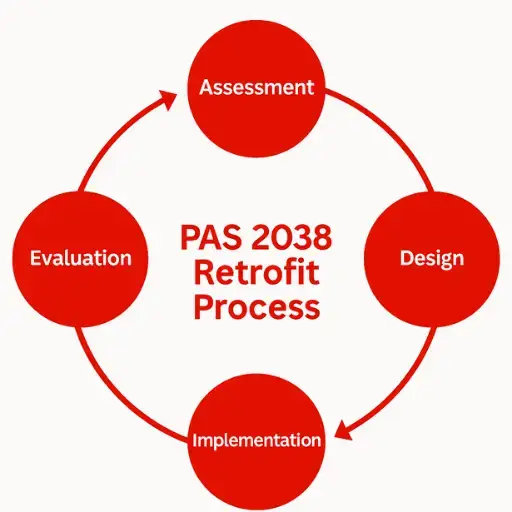
PAS 2038 breaks the retrofit journey into clearly defined phases that build upon one another. Here’s a simplified overview:
- Assessment Phase
The Lead Professional or Energy Consultant assesses energy performance, usage patterns, and asset conditions. - Design Phase
The Designer develops integrated measures, working with KSIs to ensure feasibility and alignment with operational goals. - Coordination Phase
The Project Manager oversees sequencing, team collaboration, and risk mitigation strategies. - Implementation Phase
Approved contractors carry out upgrades in line with PAS 2038 plans and, where relevant, PAS 2030 installation standards. - Evaluation Phase
Commissioning Managers validate system performance and occupant comfort. Final reports and data are submitted to stakeholders and TrustMark.
📌 Hint: Effective collaboration between roles and proactive communication with KSIs ensures better results and fewer delays.
Common PAS 2038 Pitfalls and How to Avoid Them
Even experienced teams can encounter challenges. These common pitfalls typically arise from shortcuts, missed steps, or inadequate planning:
- Incomplete assessments
Skipping technical or operational surveys undermines the entire retrofit strategy. - Siloed project teams
Ensure shared documentation and integrated timelines to avoid costly overlaps or mismatched decisions. - Ignoring stakeholder needs (KSI)
Failing to align with operational or user requirements can result in inefficient or rejected solutions. - Poor ventilation design
Over-tightening building envelopes without airflow strategies leads to comfort and health issues. - No maintenance roadmap
Every retrofit should include a forward-looking maintenance plan to protect investment and performance.
✅ Pro Tip: Conduct a stakeholder onboarding session before implementation begins—this builds trust, clarifies expectations, and boosts engagement.
PAS 2038 Checklist: Your Free Compliance Tool
To support your compliance process, use a tailored PAS 2038 checklist to track every key task across project stages:
- Pre-assessment data collection
- Role designation and competency validation
- Risk pathway identification
- Integrated design and implementation sign-offs
- Commissioning and evaluation review
- CPD and TrustMark record logging
📌 Download the FREE PAS 2038 Checklist
This practical tool helps teams coordinate actions, stay audit-ready, and deliver retrofit projects that are robust, compliant, and efficient.
Key Standards Linked to PAS 2038
PAS 2038 operates within a wider framework of industry standards that collectively ensure the technical rigour, compliance, and long-term success of non-domestic retrofit projects. Familiarity and alignment with these standards is crucial for anyone pursuing PAS 2038 Accreditation.
- PAS 2030:2023 – Specifies requirements for installers of energy efficiency measures to ensure delivery aligns with retrofit design standards and outcomes.
- BS 7913 – Offers guidance on the conservation of historic buildings, which is essential when upgrading heritage or listed commercial properties without compromising their architectural integrity.
- BS EN 12831 – Outlines heat load calculation methodologies to ensure systems are appropriately sized and energy models are accurate.
- TrustMark Framework Operating Requirements – Defines how certified businesses must operate, including protocols for quality assurance, documentation, and client engagement.
These standards form an integrated compliance structure, supporting consistent quality across all retrofit phases—from assessment and design to implementation and post-occupancy evaluation.
Aligning your work with these benchmarks not only reinforces delivery excellence but also signals your commitment to upholding the highest standards in sustainable building practice.
PAS 2038 and TrustMark: How They Connect
TrustMark is the UK Government-endorsed quality assurance scheme for retrofit professionals. For those working under PAS 2038, TrustMark certification isn’t just a benefit—it’s often a requirement for eligibility on government-backed or ESG-driven projects.
Why This Matters:
- Mandatory for publicly funded work
TrustMark registration is a prerequisite for accessing decarbonisation grants, such as PSDS and other funding initiatives. - Professional and stakeholder assurance
TrustMark protects building owners and clients through warranties, transparent dispute resolution, and insurance-backed guarantees. - Ongoing compliance verification
TrustMark’s platform captures evidence of project quality, including photos, KPIs, and KSI feedback—ensuring ongoing adherence to PAS 2038.
🛠️ Hint: Post-project documentation must be submitted, including commissioning data and user training records. Plan time for this in your workflow.
Gaining TrustMark certification alongside PAS 2038 Accreditation strengthens your reputation, expands your project access, and reinforces your commitment to quality, transparency, and sustainability.
Understanding the Whole-Building Retrofit Plan
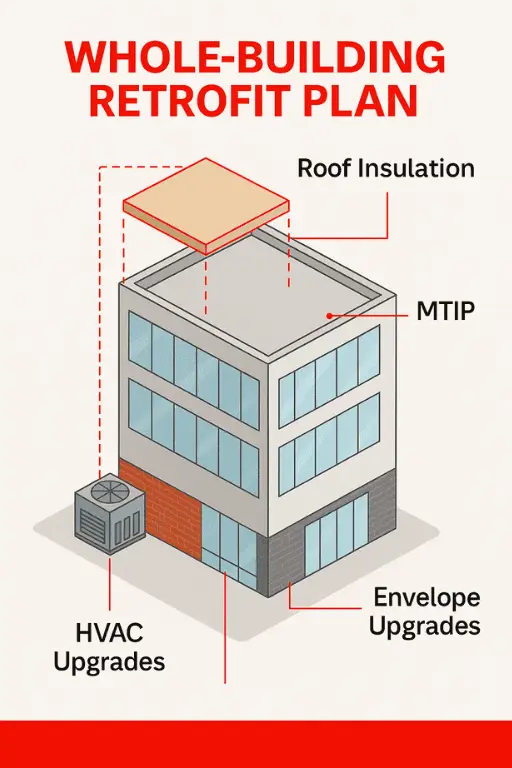
At the core of PAS 2038 is the Whole-Building Retrofit Plan—a tailored, strategic document that ensures retrofits are technically coordinated, operationally sound, and economically viable over time.
Key elements of the plan include:
- Risk assessment
Determines the applicable compliance pathway (A, B, or C) based on complexity and building type. - Condition and context reports
Identify existing system limitations, performance gaps, and operational constraints. - Energy modelling
Uses tools like TM54 or PHPP to predict savings, inform decisions, and validate design intent. - Recommended interventions
Specifies integrated upgrades that meet compliance standards and stakeholder expectations. - Upgrade sequencing
Schedules works in an efficient, non-disruptive order—minimising downtime or conflicts with operational demands. - Medium-term planning
Lays out a 20–30 year roadmap for progressive, staged improvements aligned with Net Zero goals.
📌 Bonus: A well-executed Whole-Building Retrofit Plan becomes a living document—guiding future adaptations and investment strategies.
This plan transforms retrofit delivery from reactive fixes into a proactive framework for environmental stewardship and cost management.
What is a Medium-Term Improvement Plan?
A Medium-Term Improvement Plan (MTIP) is a defining feature of PAS 2038. It extends retrofit thinking beyond immediate upgrades to incorporate a structured, long-term transformation pathway.
An MTIP:
- Covers a 20–30 year horizon
Envisions staged improvements that align with operational schedules and available budgets. - Coordinates sequential interventions
Ensures one measure doesn’t compromise another—minimising rework and inefficiencies. - Anticipates funding and technology changes
Builds flexibility into the retrofit path, enabling adaptation to new grants, regulations, or innovations.
MTIPs offer strategic foresight for building owners and professional teams alike. They ensure improvements are scalable, aligned with performance goals, and positioned to benefit from emerging solutions and incentives.
Hints and Tips for Easier PAS 2038 Compliance
Navigating PAS 2038 may seem complex initially, but with the right strategies and tools, it can become an integrated and efficient part of your retrofit delivery process. The key is to prioritise collaboration, consistency, and structured documentation. Here are practical ways to streamline your PAS 2038 journey:
- Train your team collectively
Ensure all roles—from Lead Professional to Commissioning Manager—understand their duties under PAS 2038. Cohesive training fosters shared accountability and reduces gaps in implementation. - Document everything
From early surveys to final commissioning data, comprehensive documentation is essential. Include site photos, meeting notes, stakeholder approvals, and design iterations. - Engage stakeholders early (KSI)
Building occupants, owners, and facilities managers should be consulted from the outset. Their input reduces resistance, supports behavioural change, and ensures compatibility with operational needs. - Standardise your processes
Use templates for assessments, retrofit strategies, MTIPs, risk logs, and evaluation forms. This reduces admin workload and helps maintain compliance across multiple projects. - Schedule TrustMark audits in advance
Pre-booking your audit demonstrates professionalism and avoids last-minute stress. Use audit checklists and mock reviews to prepare your team.
✅ These small adjustments yield significant returns—in time savings, project reliability, and client confidence.
Training Options for PAS 2038 Accreditation
To gain PAS 2038 Accreditation, professionals must complete targeted training tailored to their role in the retrofit process. Fortunately, a range of providers offer programmes that combine technical theory with practical, project-based learning.
Training Body | Course Name | Roles Targeted |
The Retrofit Academy | Commercial Retrofit Masterclass | Lead Professionals, Designers |
BRE Academy | Whole Building Retrofit Training | Energy Consultants, Project Managers |
CIBSE Training | PAS 2038 Implementation & Compliance CPD | All PAS 2038 Professional Roles |
Elmhurst Energy | Energy Assessment for Non-Domestic Retrofits | Energy Consultants |
🎓 Tip: Choose training providers that offer hands-on simulations, mentorship, and support for post-course accreditation.
Investing in the right training not only strengthens your technical skills but also enhances your ability to manage complex projects and engage stakeholders confidently.
Funding and Government Grants Linked to PAS 2038
Becoming PAS 2038 accredited enables access to several public and private funding programmes aimed at decarbonising the UK’s non-domestic building stock.
Key schemes include:
- Public Sector Decarbonisation Scheme (PSDS)
Provides capital grants to public sector bodies for energy efficiency and low carbon heating. - Salix Finance
Supports energy-saving projects in schools, NHS trusts, and local authorities. - Industrial Energy Transformation Fund (IETF)
Targets manufacturing and industrial facilities aiming to reduce energy use and emissions. - Green Heat Network Fund (GHNF)
Provides support for the development of low-carbon heat networks for commercial zones.
🧾 Pro Tip: Funding criteria and application timelines vary. Subscribe to DESNZ updates and partner with consultants experienced in bid preparation.
PAS 2038 and Net Zero 2050
PAS 2038 is a cornerstone in the UK’s broader effort to achieve Net Zero carbon emissions by 2050. Non-domestic buildings represent a significant portion of national energy use and emissions. By aligning with PAS 2038, organisations ensure their retrofit work actively contributes to climate goals.
PAS 2038 helps:
- Decarbonise public and commercial buildings
Through energy efficiency upgrades, renewable integration, and low-carbon systems. - Reduce operational costs and environmental impact
Improved performance translates to lower bills and smaller carbon footprints. - Demonstrate ESG performance
Retrofit investments aligned with PAS 2038 are increasingly valuable to investors seeking credible sustainability action. - Create healthier workplaces
Ventilation and comfort strategies improve occupant well-being and productivity. - Establish a roadmap to long-term Net Zero alignment
With tools like MTIPs, PAS 2038 enables strategic, phased progress that builds resilience.
By adopting PAS 2038 today, professionals and organisations become leaders in the low-carbon transition of the UK’s built environment.
FAQs on PAS 2038 Accreditation
What is PAS 2038 in simple terms?
It’s a UK standard that ensures commercial retrofit projects are assessed, designed, implemented, and evaluated to deliver lasting energy efficiency and operational performance.
What roles are essential under PAS 2038?
Lead Professional, Energy Consultant, Designer, Project Manager, and Commissioning Manager.
Is PAS 2038 mandatory for all projects?
Not universally. It is essential for publicly funded or ESG-regulated schemes, but it’s strongly recommended as best practice across the sector.
How long does accreditation take?
Typically 3–6 months depending on the role, training provider, and your existing experience.
Can one person take on multiple roles?
In some cases, yes—especially in smaller projects—but potential conflicts of interest must be documented and managed.
What happens if I don’t comply with PAS 2038?
You may risk disqualification from funding, loss of TrustMark registration, or reputational damage in procurement frameworks.

Conclusion: Why PAS 2038 Matters More Than Ever
In an era of heightened energy costs, climate urgency, and business accountability, PAS 2038 is more than a compliance framework—it’s a strategic transformation in how we approach non-domestic retrofit.
PAS 2038 ensures quality, safety, and sustainability at every level of project delivery. It brings rigour through defined roles, structure through standardised methods, and assurance through stakeholder engagement and post-implementation validation.
Whether you’re an Energy Consultant building retrofit strategies, a Project Manager overseeing multi-site delivery, or a building owner seeking cost-effective upgrades, aligning with PAS 2038 places you at the forefront of commercial energy transformation.
Don’t just aim for compliance—lead with purpose. The journey to Net Zero begins with the buildings we improve today.
For help on your PAS 2038 journey, get in touch with one of our friendly team members today.

