

The Complete Guide to UK Tender Accreditations
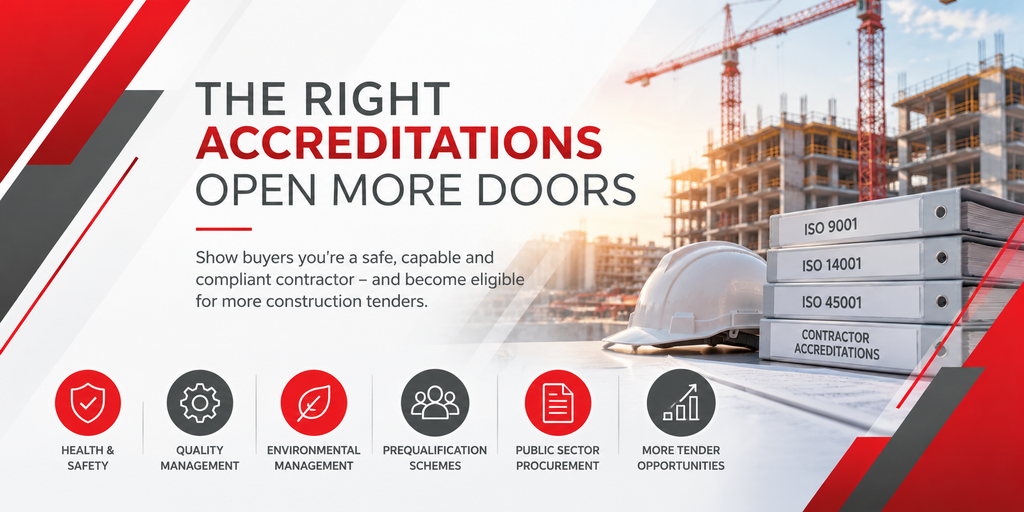
For UK construction companies, having the right certifications and accreditations can make the difference between being eligible to tender for a contract and missing out before your bid is even considered.
Which certifications does your construction company actually need to win more work?
Whether you’re bidding for local authority frameworks, housing association contracts, commercial developments or larger construction projects, buyers want reassurance that your business can deliver work safely, consistently and to the required standards.
But with so many UK construction company certifications, ISO standards and contractor prequalification schemes available, knowing where to start isn’t always straightforward.
Do you need ISO 9001? Is CHAS enough? What’s the difference between Constructionline and SSIP? And which accreditations are genuinely worth investing in?
In this guide, we break down the key construction tender requirements, explain what each certification means and help you prioritise the accreditations that could open the door to more opportunities.
Why Do Construction Companies Need Accreditations?
Construction tenders are competitive, and buyers need confidence that the contractors they appoint are capable, competent and compliant.
Certifications and accreditations provide independent evidence of how your business manages important areas such as:
- Health and safety procedures
- Quality management
- Environmental responsibilities
- Workforce competence and training
- Financial stability and business processes
- Regulatory and contractual compliance
For many contractors, these requirements become particularly important when bidding for public sector contracts, joining approved supplier lists or working with larger principal contractors.
The important thing to understand is that not every certification is compulsory. Requirements vary depending on the buyer, the project and the type of work involved.
The goal isn’t to collect as many certificates as possible. It’s to obtain the right ones for the contracts your business wants to win.
Which UK Construction Company Certifications Are Most Important?
There are several widely recognised certifications and prequalification schemes that regularly appear in construction tender requirements.
Here’s how they compare.
| Certification or scheme | What it demonstrates | When it’s useful |
|---|---|---|
| ISO 9001 | Quality management systems | Construction frameworks, larger contracts and quality-focused buyers |
| ISO 14001 | Environmental management | Public sector, infrastructure and sustainability-focused projects |
| ISO 45001 | Occupational health and safety management | Higher-risk construction activities and larger contractor supply chains |
| CHAS | Health and safety assessment and wider compliance options | Contractor approval and supply-chain prequalification |
| Constructionline | Supplier prequalification and verification | Public sector and principal contractor opportunities |
| SafeContractor | Contractor health and safety and compliance assessment | Facilities management, maintenance and contractor supply chains |
| SMAS Worksafe | Health and safety prequalification | Construction and property maintenance contracts |
| Common Assessment Standard | Standardised supplier prequalification | Buyers adopting the construction industry standard |
The most suitable combination depends on your target market, existing certifications and the specific requirements of each tender.
1. ISO 9001 – Quality Management Certification
ISO 9001 is one of the most widely recognised quality management standards and is particularly valuable for construction businesses looking to secure larger or more complex contracts.
It demonstrates that your organisation has structured processes for delivering consistent services, managing customer requirements and improving performance.
For construction companies, this might include:
- Documented quality control procedures
- Supplier and subcontractor management
- Managing defects and corrective actions
- Project delivery and customer satisfaction
- Internal audits and continual improvement
If you’re considering certification, our ISO certification support can help you develop the right management systems, prepare for audits and work towards recognised standards.
Why does ISO 9001 matter for tenders?
Buyers want confidence that your business has reliable systems in place, rather than relying solely on individual experience.
ISO 9001 certification can provide that reassurance and may be requested as part of a tender’s quality management requirements.
It’s particularly useful for contractors looking to move from smaller private projects into larger commercial or public sector opportunities.
2. ISO 14001 – Environmental Management Certification
Environmental performance is an increasingly important consideration in construction procurement.
ISO 14001 demonstrates that your business has an environmental management system designed to identify, manage and reduce its environmental impacts.
For construction contractors, this can include managing:
- Waste disposal and recycling
- Energy and resource consumption
- Pollution prevention
- Environmental risks on site
- Environmental objectives and improvement plans
Why does ISO 14001 matter for tenders?
Public sector organisations, developers and principal contractors frequently assess environmental management as part of their procurement processes.
Having ISO 14001 certification can help demonstrate that your environmental responsibilities are being managed systematically.
It may also support your responses to sustainability and environmental questions within tender submissions.
3. ISO 45001 – Occupational Health and Safety Certification
Health and safety is a fundamental consideration across the construction industry.
ISO 45001 is an internationally recognised occupational health and safety management standard that helps organisations identify hazards, manage risks and improve workplace safety.
For construction businesses, it provides a structured approach to:
- Risk assessments and hazard identification
- Employee consultation and participation
- Incident reporting and investigation
- Health and safety responsibilities
- Monitoring and improving safety performance
Alongside certification, having the right day-to-day procedures in place is essential. Our health and safety support helps construction businesses manage risks, maintain compliance and demonstrate their commitment to workplace safety.
Why does ISO 45001 matter for tenders?
Contractors working on higher-risk projects or within larger supply chains may be asked to demonstrate a formal health and safety management system.
ISO 45001 can provide strong evidence of this.
However, it’s important to recognise that ISO 45001 is not the same as SSIP approval, and buyers may request specific prequalification evidence alongside an ISO certificate.

4. CHAS, SafeContractor and SMAS – Health and Safety Prequalification
Not every construction tender requires full ISO certification.
Many buyers instead ask contractors to demonstrate their health and safety arrangements through recognised prequalification schemes.
Three commonly encountered schemes are:
CHAS
CHAS provides contractor assessment services, including health and safety assessment and wider compliance packages.
It is commonly used by organisations looking to assess contractors before appointing them to projects or approved supplier lists.
SafeContractor
SafeContractor assesses contractors against health and safety and other relevant compliance requirements depending on the assessment selected.
It is frequently encountered across construction, facilities management and property maintenance supply chains.
SMAS Worksafe
SMAS Worksafe provides health and safety assessment services and is commonly used by contractors seeking to demonstrate their arrangements to potential clients.
What is SSIP?
SSIP stands for Safety Schemes in Procurement.
It provides a framework for recognising assessments undertaken by registered member schemes, helping reduce unnecessary duplication in health and safety prequalification.
Rather than automatically paying for several different assessments, contractors should check whether an existing SSIP assessment is accepted by their intended buyer or whether recognition arrangements are available.
This can save time and reduce unnecessary administration.
5. Constructionline and the Common Assessment Standard
Constructionline is a supplier prequalification and verification platform used across the construction industry.
It helps buyers assess potential suppliers using information about their business, capabilities and compliance arrangements.
Depending on the membership and assessment level, contractors may be asked to provide evidence relating to:
- Business and financial information
- Health and safety
- Environmental management
- Quality procedures
- Insurance and workforce competence
- Relevant policies and organisational processes
What is the Common Assessment Standard?
The Common Assessment Standard (CAS) is an industry-developed approach to construction prequalification, designed to create greater consistency in the information contractors provide to buyers.
It covers a broad range of organisational requirements and can help reduce repeated questionnaires across different procurement processes.
Constructionline and other recognised assessment providers offer routes to CAS assessment.
However, Constructionline membership and CAS certification are not automatically interchangeable. Contractors should check the specific assessment level requested and whether the buyer recognises their existing evidence.
For businesses bidding regularly for construction frameworks, CAS may be a particularly worthwhile investment.
6. Specialist Certifications for Construction Contractors
Depending on your services, additional qualifications, certifications or registrations may be required.
For example:
PAS 2030
Relevant to businesses installing energy efficiency measures under schemes or contracts requiring PAS 2030 certification.
MCS Certification
Relevant to installers of certain small-scale renewable energy technologies, particularly where contracts or funding arrangements specify MCS requirements.
Trade-specific competence and registrations
Electrical, gas, fire safety and other specialist construction activities may involve additional registration, competence or legal requirements.
Before applying for specialist certifications, check the scope of work, applicable regulations and the exact buyer requirements.
Public Sector Procurement: What Has Changed?
Public sector procurement is a major opportunity for UK construction companies, but contractors need to understand how buyers assess supplier eligibility.
The Procurement Act 2023 came into force on 24 February 2025 and introduced a new framework for many public procurement processes in England, Wales and Northern Ireland.
Under the Act, contracting authorities can set proportionate conditions of participation relating to a supplier’s legal and financial capacity or technical ability.
For construction contractors, this means buyers may assess relevant experience, competence, financial standing and supporting management systems.
The Common Assessment Standard can continue to be used for works contracts where it meets the applicable procurement requirements.
Contractors should also be prepared to provide core supplier information through the central digital platform, where required.
Not every procurement follows the same rules. Scotland has its own procurement legislation, and transitional arrangements may apply to procurements started under earlier regulations.
The key takeaway: Always review the actual tender documents rather than assuming that one set of accreditations will qualify your business for every public sector opportunity.

How to Prioritise Your Construction Accreditations
One of the biggest mistakes contractors make is investing in certifications without first understanding which contracts they want to pursue.
A more effective approach is to work backwards from your target opportunities.
Step 1: Identify the contracts you want to win
Are you targeting local authorities, housing associations, commercial developments, facilities management contracts or major infrastructure projects?
Different buyers will have different expectations.
Step 2: Review the tender requirements
Look at recent tenders and framework specifications to identify which certifications and prequalification schemes are requested most frequently.
Pay particular attention to mandatory conditions, accepted equivalents and requirements that contribute to the evaluation score.
Not sure where to find relevant opportunities? Our TenderHub platform helps businesses discover UK tenders, making it easier to identify potential contracts and understand the accreditations buyers are looking for.
Step 3: Assess your existing compliance
Your business may already have many of the required policies, procedures and management systems in place.
A gap assessment can help identify what needs improving before applying for certification.
Step 4: Prioritise the biggest opportunities
Focus first on accreditations that address mandatory requirements for your most valuable target contracts.
For example, an SSIP assessment may be a practical starting point for a smaller contractor, while ISO 9001, ISO 14001 and ISO 45001 may become more relevant when targeting larger frameworks.
Step 5: Keep your certifications up to date
Achieving certification is only the beginning.
Ongoing internal audits, policy reviews, surveillance assessments and evidence management help ensure your business remains compliant and ready for future tenders.
Common Accreditation Mistakes That Can Cost Contractors Work
Even experienced construction businesses can encounter problems when preparing tender submissions.
Some of the most common mistakes include:
1. Applying for certifications without checking buyer requirements
This can lead to unnecessary costs without improving your eligibility for the work you want.
2. Allowing certificates or assessments to expire
An expired certificate can create problems during supplier verification or tender evaluation.
3. Confusing different accreditation schemes
ISO certification, SSIP assessment and supplier prequalification schemes serve different purposes. One does not automatically replace another.
4. Leaving compliance preparation until the tender deadline
Some certifications require system development, assessment and corrective actions. They cannot always be achieved at short notice.
5. Having certificates but insufficient supporting evidence
Buyers may still ask for policies, training records, RAMS, case studies, competence records and examples of previous work.
Being certified is valuable, but being able to demonstrate how your systems operate is just as important.
Having the right accreditations is only one part of a successful submission. Our bid writing and tender support helps contractors present their experience, compliance evidence and capabilities more effectively when competing for new contracts.
How Brighter Compliance Can Help You Get Tender Ready
At Brighter Compliance, we help construction businesses take a more practical approach to certification, compliance and tendering.
Rather than treating these as separate challenges, we help you bring everything together so your business is prepared for the opportunities you want to pursue.
Get Certified
We support contractors working towards recognised standards and accreditations, including ISO 9001, ISO 14001, ISO 45001 and relevant PAS and specialist certification requirements.
From identifying gaps and developing management systems to preparing for audits, we help make the certification process more manageable.
Stay Compliant
Certification alone doesn’t guarantee ongoing compliance.
Our team provides practical health and safety, risk assessment, auditing and wider compliance support to help keep your business and projects on track.
Win Work
Having the right accreditations is only part of the process.
Our bid writing and tender support services help businesses identify suitable opportunities, understand buyer requirements and prepare stronger submissions.
By connecting certification, compliance and tender support, we help businesses become eligible for more of the work they want to win.
Frequently Asked Questions
Ready to Get Certified and Win More Work?
The right certifications can help open doors to new contracts, strengthen your credibility and give buyers greater confidence in your business.
But knowing which accreditations to prioritise is just as important as achieving them.
Not sure which accreditations your business needs? Whether you’re preparing for your first certification or looking to qualify for larger construction tenders, our team can help you identify the next steps. Speak to Brighter Compliance and let’s get your business tender ready.
Make compliance simple. Get certified. Win work. Stay compliant.


