Understanding Corrective and Preventive Action in ISO 9001

Corrective and preventive action are central to the effectiveness of an ISO 9001 Quality Management System (QMS). Together, they help organisations control problems, learn from mistakes, and reduce the likelihood of issues affecting customers, compliance, or performance.
While the terminology has evolved under ISO 9001:2015, the underlying intent remains the same: identify weaknesses, address their causes, and build more resilient processes.
Understanding the difference between corrective action and preventive thinking is essential for meeting ISO 9001 requirements, satisfying auditors, and achieving continual improvement. Many nonconformities arise not because issues occur, but because organisations fail to demonstrate a structured and effective response.
Why corrective action matters in a Quality Management System
Corrective action focuses on eliminating the root cause of a nonconformity to prevent it from happening again. It goes beyond fixing the immediate problem and instead addresses why the issue occurred in the first place. In ISO 9001, corrective action is a key mechanism for learning from failures and strengthening processes.
An effective corrective action process helps organisations maintain control, improve consistency, and demonstrate accountability when things go wrong.
- Ensures recurring issues are properly addressed, not repeatedly corrected
- Demonstrates compliance with ISO 9001 Clause 10.2
- Improves process reliability and customer satisfaction
- Provides evidence of continual improvement during audits
When implemented well, corrective action becomes a valuable management tool rather than an administrative burden. It enables organisations to turn nonconformities, complaints, and audit findings into opportunities for improvement, rather than isolated incidents.
Why preventive thinking is still essential under ISO 9001:2015
Although ISO 9001:2015 removed the standalone “preventive action” clause, prevention remains a core principle of the standard. Preventive thinking is now embedded through risk-based thinking, encouraging organisations to identify potential problems before they occur and take proportionate action.
This shift places greater emphasis on planning, foresight, and process control rather than reacting after failures happen.
- Encourages early identification of risks and opportunities
- Reduces the likelihood of nonconformities and corrective actions
- Supports consistent delivery of products and services
- Strengthens business resilience and decision-making
By embedding preventive thinking into everyday activities, organisations move from a reactive mindset to a proactive one. This approach not only supports ISO 9001 compliance but also leads to more stable operations, fewer disruptions, and improved long-term performance.
What Is Corrective Action in ISO 9001?
Corrective action in ISO 9001 is a structured process used to address nonconformities by eliminating their root causes. It is not simply about fixing what has gone wrong, but about understanding why the issue occurred and ensuring it does not happen again.
This distinction is critical for demonstrating effective control and continual improvement within a Quality Management System.
ISO 9001:2015 addresses corrective action under Clause 10.2, requiring organisations to react to nonconformities, evaluate their causes, implement appropriate actions, and review their effectiveness. Auditors will expect to see evidence that corrective action is proportionate, systematic, and effective.
Definition of corrective action
Corrective action is the action taken to eliminate the cause of a detected nonconformity or other undesirable situation. It differs from a correction, which only addresses the immediate problem without preventing recurrence.
Corrective action must be based on evidence and analysis rather than assumptions or quick fixes.
- Applies to actual, identified nonconformities
- Focuses on root cause, not symptoms
- Requires evaluation of effectiveness
- Must be documented where necessary
When clearly defined and consistently applied, corrective action becomes a powerful driver of improvement rather than a reactive compliance task.
When corrective action is required
Corrective action is required whenever a nonconformity occurs that could affect product quality, service delivery, customer satisfaction, or compliance with ISO 9001 requirements. These nonconformities can arise from many sources, both internal and external.
Organisations should not wait for an audit finding before taking corrective action.
- Internal audit findings
- External audit nonconformities
- Customer complaints or feedback
- Process failures or errors
- Supplier issues
Taking timely corrective action demonstrates control, accountability, and a commitment to improving the effectiveness of the Quality Management System.
Examples of corrective action in practice
Practical examples help demonstrate how corrective action should work in real-world situations. Effective corrective action always includes investigation, implementation, and follow-up.
- Revising a procedure after repeated process errors
- Retraining staff where competence gaps are identified
- Updating supplier controls following delivery failures
- Improving inspection or verification steps to prevent recurrence
These actions go beyond correcting the immediate issue and instead strengthen the system as a whole.
Common mistakes organisations make with corrective action
Many organisations struggle with corrective action because it is misunderstood or poorly implemented. These weaknesses are frequently identified during audits and can lead to repeat nonconformities.
- Confusing corrections with corrective actions
- Failing to identify the true root cause
- Implementing actions that are not proportionate to the risk
- Not reviewing or recording effectiveness
Avoiding these mistakes helps ensure corrective action delivers genuine improvement and meets ISO 9001 expectations.
What Is Preventive Action in ISO 9001?
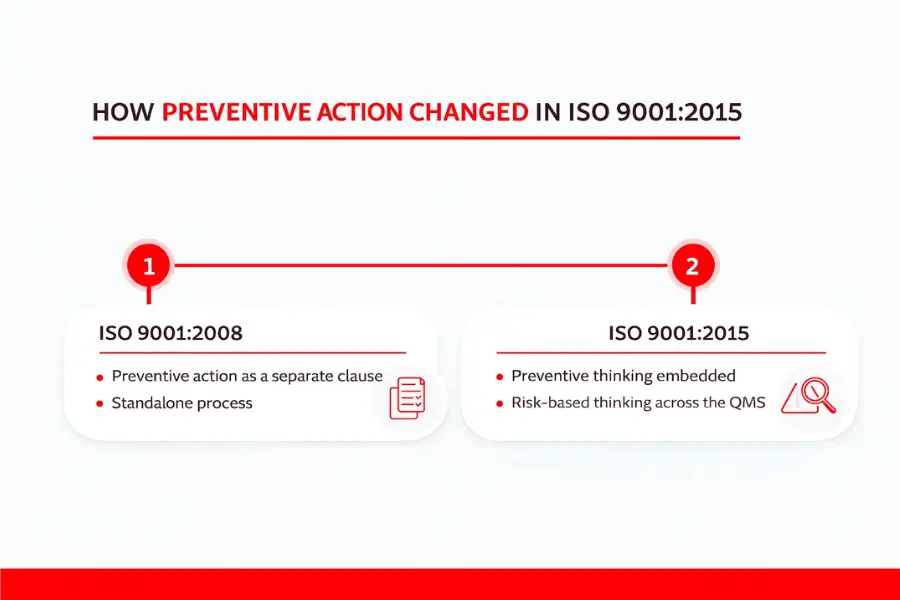
Preventive action in ISO 9001 refers to actions taken to eliminate the causes of potential nonconformities before they occur. While ISO 9001:2015 no longer includes preventive action as a standalone requirement, the concept remains fundamental to the standard through the introduction of risk-based thinking.
Rather than reacting to problems after they arise, organisations are expected to anticipate risks, plan controls, and take proactive steps to prevent issues from affecting quality or compliance.
Definition of preventive action
Preventive action is action taken to eliminate the cause of a potential nonconformity or undesirable situation. Unlike corrective action, it addresses what could go wrong, not what already has.
Preventive action relies on foresight, analysis, and planning rather than incident-driven responses.
- Applies to potential risks and issues
- Focuses on prevention rather than correction
- Embedded within planning and operational controls
- Supports long-term system stability
Although not a separate clause, preventive action remains an essential mindset within an effective Quality Management System.
Preventive action vs risk-based thinking
ISO 9001:2015 replaced the formal preventive action requirement with risk-based thinking, integrating prevention throughout the standard. This approach ensures that prevention is not treated as an isolated activity but as part of everyday management and decision-making.
Risk-based thinking encourages organisations to consider both risks and opportunities when planning processes and changes.
- Identifying risks during planning and review
- Implementing controls proportionate to potential impact
- Monitoring trends and performance data
- Taking action before issues materialise
This integrated approach strengthens the QMS by embedding prevention into its structure rather than relying on reactive measures.
Examples of preventive action in practice
Preventive action is often less visible than corrective action but equally important. It is typically identified through planning, analysis, and review activities.
- Introducing additional checks to reduce the risk of errors
- Providing training before new processes are implemented
- Strengthening supplier approval criteria
- Reviewing trends in complaints or defects to prevent escalation
These actions help reduce the likelihood of nonconformities and support consistent delivery.
Why preventive action is no longer a separate clause
The removal of a dedicated preventive action clause reflects ISO 9001’s shift towards a more holistic and proactive management approach. Prevention is now expected to be embedded across all clauses, particularly planning, operations, and performance evaluation.
This change encourages organisations to move away from form-driven compliance towards meaningful risk management and continual improvement.
By integrating preventive thinking into everyday processes, organisations achieve better outcomes, fewer disruptions, and stronger long-term performance.
Corrective Action vs Preventive Action – Key Differences

While corrective action and preventive action share the same objective of improving performance and reducing risk, they differ in timing, focus, and application. Understanding these differences helps organisations apply the right approach in the right situation and demonstrate effective control of their Quality Management System.
Auditors frequently assess whether organisations understand and correctly apply these concepts, particularly in relation to nonconformities, risk management, and continual improvement.
Reactive vs proactive approaches
The most fundamental difference between corrective and preventive action lies in whether the organisation is reacting to an issue or acting in advance to prevent one.
Corrective action is reactive, responding to problems that have already occurred, while preventive action is proactive, aiming to stop problems before they happen.
- Corrective action responds to actual nonconformities
- Preventive action addresses potential risks
- One focuses on learning from failures
- The other focuses on avoiding failures altogether
Both approaches are necessary to maintain a robust and resilient QMS.
Triggers for action
Corrective and preventive actions are initiated by different types of events or information. Recognising the correct trigger ensures the appropriate process is followed and documented.
- Corrective action is triggered by audit findings, complaints, errors, or incidents
- Preventive action is triggered by risk assessments, trend analysis, and planning activities
- Corrective action requires evidence of a nonconformity
- Preventive action relies on risk identification and evaluation
Using the correct trigger helps ensure actions are proportionate and aligned with ISO 9001 expectations.
Documentation and evidence requirements
Both corrective and preventive actions require evidence, but the type and level of documentation may differ. ISO 9001 expects organisations to retain documented information where necessary to demonstrate effective implementation.
Documentation should support control and learning, not create unnecessary bureaucracy.
- Corrective action records typically include root cause analysis and effectiveness review
- Preventive action evidence may include risk registers, action plans, or meeting minutes
- Documentation must be appropriate to the size and complexity of the organisation
- Records should demonstrate logical decision-making
Clear, relevant documentation supports audit confidence and internal understanding.
How auditors assess each approach
Auditors assess corrective and preventive actions by reviewing both the process and its outcomes. They will look for evidence that actions are appropriate, effective, and aligned with the organisation’s risks and objectives.
- Evidence of systematic root cause analysis
- Actions implemented and completed as planned
- Effectiveness reviews showing reduced recurrence or risk
- Integration of prevention through risk-based thinking
Demonstrating a clear understanding of both approaches helps organisations avoid repeat nonconformities and strengthen overall QMS performance.
How ISO 9001:2015 Addresses Preventive Action

ISO 9001:2015 takes a proactive approach by embedding prevention throughout the standard rather than treating it as a standalone activity. This is achieved through risk-based thinking, which requires organisations to consider potential issues when planning, implementing, and reviewing their processes.
By integrating preventive thinking into the structure of the Quality Management System, organisations are better equipped to manage uncertainty, reduce disruptions, and achieve consistent outcomes.
Risk-based thinking explained
Risk-based thinking is the foundation of prevention in ISO 9001:2015. It requires organisations to identify, assess, and address risks and opportunities that could affect the conformity of products and services.
This approach ensures that prevention is part of everyday decision-making rather than an occasional exercise.
- Identifying risks during process design and planning
- Considering internal and external issues
- Evaluating potential impacts on quality and compliance
- Implementing controls proportionate to risk
Risk-based thinking helps organisations focus resources where they are most needed.
Identifying risks and opportunities
ISO 9001 expects organisations to identify both risks that could negatively impact performance and opportunities that could enhance results. This balanced approach supports continual improvement while maintaining control.
Risk identification should be practical, relevant, and aligned with business objectives.
- Reviewing processes and activities
- Analysing customer feedback and complaints
- Monitoring supplier performance
- Considering changes in technology, regulations, or resources
By systematically identifying risks and opportunities, organisations strengthen their ability to prevent issues before they occur.
Embedding prevention into everyday processes
Preventive action becomes most effective when it is built into normal operations rather than managed as a separate task. ISO 9001 encourages organisations to integrate prevention across planning, operations, and performance evaluation.
This integration ensures consistency and sustainability.
- Incorporating risk assessment into planning activities
- Using data and trends to inform decisions
- Reviewing risks during management reviews
- Updating controls when changes occur
Embedding prevention into everyday processes reduces reliance on corrective action and supports long-term system effectiveness.
Corrective Action Process Under ISO 9001

The corrective action process under ISO 9001 provides a structured method for dealing with nonconformities in a consistent and effective way. It ensures that issues are not only corrected but fully investigated, addressed at their root cause, and reviewed for effectiveness.
A well-defined corrective action process supports compliance with Clause 10.2 and demonstrates an organisation’s commitment to continual improvement.
Identifying nonconformities
The corrective action process begins with the identification of a nonconformity. A nonconformity is any failure to meet a requirement, whether internal, customer-specific, or related to ISO 9001 itself.
Nonconformities can be identified through a variety of sources.
- Internal audits
- External audits
- Customer complaints
- Process monitoring and inspection
- Employee feedback
Prompt identification ensures issues are controlled before they escalate or recur.
Root cause analysis methods
Root cause analysis is essential to effective corrective action. Without identifying the true cause of a nonconformity, actions are unlikely to prevent recurrence.
ISO 9001 does not prescribe a specific method, allowing organisations to choose tools appropriate to their size and complexity.
- 5 Whys
- Fishbone (Ishikawa) diagrams
- Process mapping
- Data and trend analysis
The chosen method should provide clear, evidence-based conclusions rather than assumptions.
Implementing corrective actions
Once the root cause is identified, corrective actions must be planned and implemented. Actions should be proportionate to the risk and impact of the nonconformity.
Clear ownership and realistic timescales are essential for effective implementation.
- Defining responsibilities
- Allocating resources
- Updating procedures or controls
- Providing training where needed
Effective implementation ensures the corrective action addresses the root cause and supports system improvement.
Reviewing effectiveness
ISO 9001 requires organisations to review the effectiveness of corrective actions taken. This step confirms whether the action has successfully prevented recurrence.
Effectiveness reviews should be evidence-based and timely.
- Monitoring repeat occurrences
- Reviewing performance data
- Conducting follow-up audits or checks
- Confirming objectives have been met
Failure to review effectiveness is a common audit finding and should be avoided.
Documenting corrective action
Documented information is required where necessary to demonstrate compliance and control. Documentation should support understanding, accountability, and learning.
Records should be clear, accurate, and proportionate.
- Description of the nonconformity
- Root cause analysis
- Actions taken
- Effectiveness review
Well-maintained records provide confidence during audits and support continual improvement activities.
Preventive Approaches That Support ISO 9001 Compliance

Preventive approaches play a vital role in reducing the likelihood of nonconformities and minimising the need for corrective action. By proactively identifying and managing risks, organisations can maintain consistent performance and strengthen their Quality Management System.
ISO 9001 encourages prevention through planning, monitoring, and continual improvement activities that are embedded across the organisation.
Risk assessments and process controls
Risk assessments help organisations identify potential failures within processes and apply appropriate controls before issues occur. These assessments should be practical and proportionate to the level of risk involved.
Process controls provide consistency and reduce variability in outputs.
- Identifying critical process steps
- Assessing likelihood and impact of failures
- Implementing controls such as checks or approvals
- Reviewing risks when changes occur
Effective risk assessments support stable and predictable process performance.
Management review and trend analysis
Management review is a key mechanism for prevention under ISO 9001. By reviewing performance data, trends, and risks, leadership can make informed decisions that prevent future issues.
Trend analysis allows organisations to identify early warning signs.
- Monitoring nonconformities and complaints
- Analysing audit results
- Reviewing process performance metrics
- Identifying recurring or emerging issues
Using data in this way supports proactive decision-making and continual improvement.
Training, competence and awareness
Competent and well-informed employees are essential to preventing errors and nonconformities. ISO 9001 places strong emphasis on ensuring people have the appropriate skills, knowledge, and awareness.
Training should be aligned with roles, responsibilities, and identified risks.
- Identifying competence requirements
- Providing initial and refresher training
- Raising awareness of quality objectives
- Evaluating training effectiveness
Investing in competence reduces reliance on corrective action and improves overall performance.
Continual improvement activities
Continual improvement under ISO 9001 is not limited to reacting to problems. Preventive improvement activities help organisations refine processes and reduce risks over time.
These activities should be planned, monitored, and aligned with business objectives.
- Process improvement initiatives
- Lessons learned from audits and reviews
- Implementing best practice
- Reviewing and updating objectives
By embedding continual improvement into everyday operations, organisations strengthen prevention and long-term QMS effectiveness.
What Auditors Look For

During ISO 9001 audits, auditors closely examine how organisations manage corrective and preventive actions. Their focus is not only on documentation, but on whether actions are effective, proportionate, and embedded within the Quality Management System.
Understanding what auditors expect helps organisations prepare confidently and avoid common nonconformities.
Evidence of effective corrective action
Auditors expect to see clear evidence that corrective actions have addressed the root cause of nonconformities and prevented recurrence. This evidence should demonstrate a logical and structured approach rather than superficial fixes.
Corrective action records should clearly tell the story of what happened, why it happened, and what was done to prevent it happening again.
- Clear identification of the nonconformity
- Root cause analysis supported by evidence
- Actions implemented and completed
- Confirmation that the issue has not recurred
Strong evidence gives auditors confidence in the effectiveness of the QMS.
Demonstrating prevention through risk-based planning
Auditors also assess how well preventive thinking is embedded through risk-based planning. They will look for evidence that risks are identified, assessed, and addressed as part of normal operations.
Prevention does not require extensive paperwork, but it must be visible and effective.
- Risk considerations within planning activities
- Actions taken to address identified risks
- Integration of prevention into processes
- Review of risks during management review
Demonstrating proactive risk management shows maturity and control.
Common audit findings related to corrective action
Many audit nonconformities arise from weaknesses in corrective action processes rather than from the original issue itself. Understanding these common findings helps organisations avoid repeat issues.
- Treating corrections as corrective actions
- Incomplete or ineffective root cause analysis
- Corrective actions not implemented as planned
- No evidence of effectiveness review
Addressing these weaknesses strengthens audit outcomes and supports continual improvement.
Common Nonconformities Related to Corrective Action
Nonconformities related to corrective action are among the most frequently raised issues during ISO 9001 audits. In many cases, the original problem is not the main concern for auditors; instead, it is how the organisation responded to it. Weak corrective action processes can indicate a lack of control, learning, or continual improvement within the Quality Management System.
By understanding the most common corrective action-related nonconformities, organisations can strengthen their processes, reduce repeat findings, and improve overall QMS effectiveness.
Treating corrections as corrective actions
One of the most common nonconformities occurs when organisations confuse a correction with a corrective action. A correction fixes the immediate issue, but it does not address why the issue occurred in the first place.
Auditors expect to see evidence that the underlying cause has been identified and eliminated.
- Fixing an error without investigating its cause
- Repeating the same issue across audits or incidents
- Lack of analysis beyond the immediate problem
When corrections are presented as corrective actions, organisations miss valuable improvement opportunities and increase the risk of recurrence.
Poor root cause analysis
Ineffective root cause analysis is another frequent audit finding. This often occurs when causes are assumed rather than investigated, or when analysis stops too early.
Auditors look for logical, evidence-based reasoning that links the identified cause to the nonconformity.
- Causes that describe symptoms, not underlying issues
- Over-reliance on generic causes such as “human error”
- No supporting evidence for conclusions
- Inconsistent use of analysis methods
Improving root cause analysis leads to more effective corrective actions and stronger long-term results.
Failure to review effectiveness
ISO 9001 requires organisations to review the effectiveness of corrective actions taken. Failure to do so is a common and avoidable nonconformity.
Without an effectiveness review, there is no assurance that the action has worked or that the issue will not recur.
- No follow-up checks or monitoring
- Effectiveness reviews completed too early or not at all
- No evidence that recurrence has been prevented
By consistently reviewing effectiveness, organisations demonstrate learning, accountability, and commitment to continual improvement. This step also provides confidence to auditors that corrective actions deliver real and lasting value, rather than being treated as a one-off administrative exercise.
How to Improve Your Corrective and Preventive Processes

Improving corrective and preventive processes helps organisations move beyond basic compliance and achieve a more effective, resilient Quality Management System. Strong processes reduce repeat issues, support risk-based thinking, and demonstrate genuine continual improvement to auditors and stakeholders.
Small, practical improvements can make a significant difference when applied consistently across the organisation.
Practical tips for UK organisations
UK organisations can strengthen their corrective and preventive processes by keeping them simple, proportionate, and aligned with everyday operations. Overly complex systems often lead to poor engagement and inconsistent application.
Focusing on practicality improves both effectiveness and audit outcomes.
- Use clear, plain language in records and procedures
- Assign ownership and accountability for actions
- Set realistic timescales for completion
- Encourage staff involvement in identifying causes and risks
These steps help embed corrective and preventive thinking into the organisational culture.
Using simple tools and templates
Simple tools and templates can support consistency and clarity without creating unnecessary bureaucracy. The key is to use tools that fit the size and complexity of the organisation.
Templates should guide thinking, not replace it.
- Corrective action forms with clear prompts
- Risk registers aligned to key processes
- Root cause analysis tools such as the 5 Whys
- Action trackers to monitor progress
Well-designed tools help ensure actions are logical, traceable, and effective.
Aligning corrective action with continual improvement
Corrective action should not be viewed as a standalone or reactive activity. When aligned with continual improvement, it becomes a driver for positive change across the organisation.
Linking corrective actions to objectives, risks, and performance data strengthens the overall QMS.
- Using corrective action data to identify trends
- Feeding lessons learned into planning and reviews
- Updating processes and controls based on outcomes
- Reinforcing preventive thinking through improvement initiatives
By integrating corrective and preventive processes into continual improvement, organisations reduce risk, improve performance, and demonstrate a mature, well-controlled Quality Management System that supports long-term success.
Summary: Corrective Action vs Preventive Action in ISO 9001
Corrective action and preventive action are both essential to maintaining an effective ISO 9001 Quality Management System, even though they are applied in different ways. Corrective action ensures that nonconformities are properly investigated, addressed at their root cause, and prevented from recurring.
Preventive thinking, embedded through risk-based thinking, focuses on identifying and managing potential issues before they impact quality or compliance.
Understanding the distinction between reacting to problems and preventing them is critical for meeting ISO 9001 requirements and satisfying audit expectations.
Organisations that rely solely on corrective action often find themselves dealing with repeat issues, while those that embed prevention into planning and operations achieve more consistent and reliable outcomes.
By applying corrective action systematically and integrating preventive thinking across processes, organisations demonstrate control, learning, and continual improvement. This balanced approach not only supports ISO 9001 compliance but also strengthens resilience, improves performance, and builds confidence with customers, auditors, and stakeholders alike.