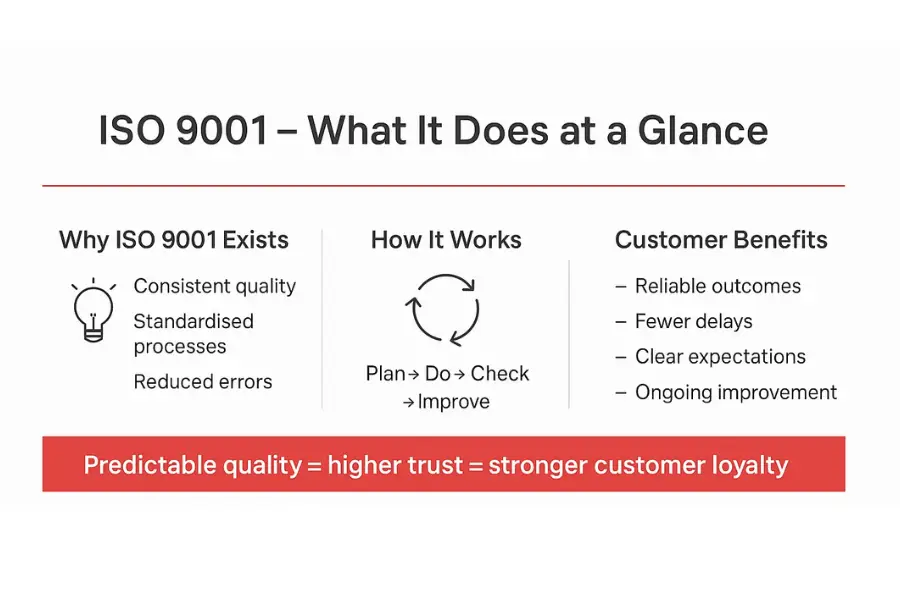
ISO 9001 is an internationally recognised standard for quality management systems, designed to help organisations consistently meet customer expectations. Rather than focusing on a single product or service, ISO 9001 sets out a framework for how a business should operate — ensuring processes are well-defined, measurable, and continuously improving.
When implemented correctly, it creates a structured environment where quality becomes everyone’s responsibility, not just the job of one team.
From a customer perspective, ISO 9001 translates into a more reliable experience. Buyers know they are dealing with a company that prioritises excellence, consistency, and accountability. Whether the organisation provides services, manufactures goods, or handles complex supply chains, ISO 9001 ensures customers receive what they were promised, when they were promised it — and to the standard they expect.
Core principles of ISO 9001 focused on quality

The strength of ISO 9001 lies in the principles that underpin it. These principles shape how businesses operate, align teams around customers, and ensure quality is built into every stage of the product or service lifecycle.
The standard encourages businesses not only to fix problems when they occur, but also to understand their root causes and prevent them from happening again.
The principles include:
- A strong customer focus across the entire organisation
- Leadership that promotes a clear vision and shared goals
- Involving and empowering employees at all levels
- A process-based approach to operations
- Commitment to continual improvement
- Decisions driven by accurate data and evidence
- Structured supplier and partner management
Together, these principles create a quality-focused culture that supports customer satisfaction at every touchpoint. Instead of relying on ad-hoc solutions or individual expertise, organisations guided by ISO 9001 have repeatable processes that deliver predictable results — which is exactly what customers value.
How ISO 9001 Builds Trust and Confidence with Customers

Trust is a crucial driver of customer loyalty, and ISO 9001 plays a direct role in strengthening it. When customers know an organisation is certified, they can feel confident that its services or products are delivered through controlled, monitored, and continually improving processes. ISO 9001 sets clear expectations — both internally and externally — which reduces uncertainty and builds credibility from the outset.
For customers, trust is often built not only on results but on the predictability of those results. ISO 9001 supports this by ensuring that business activities are consistent and repeatable, even when people, workloads, or market conditions change. Customers are reassured that quality is not down to chance.
Transparency in processes and service delivery
ISO 9001 requires organisations to document key processes, responsibilities, and performance measures. This transparency ensures that both internal teams and customers have clarity on how services are delivered and what the expected outcomes should be.
When processes are transparent:
- Customers understand how the organisation operates and what they can expect
- Service delivery becomes more consistent regardless of the staff involved
- It becomes easier to set accurate timeframes, cost estimates, and quality levels
- Misunderstandings and unmet expectations are significantly reduced
By removing ambiguity and making quality visible, ISO 9001 helps organisations present themselves as trustworthy partners rather than simply suppliers.
Improving Customer Retention Through Continuous Improvement
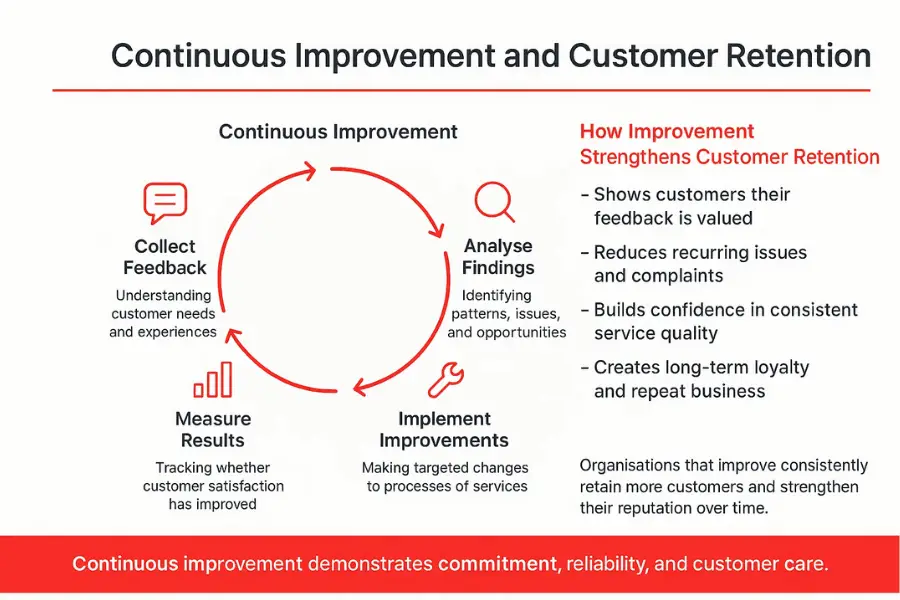
Retention is often more valuable than acquisition, and ISO 9001 directly supports organisations in keeping their customers over the long term. The standard embeds a mindset of continuous improvement, ensuring that processes don’t stagnate and that customer satisfaction remains a priority as the business evolves.
A company that continuously improves demonstrates that it listens, adapts, and grows — behaviours that customers value highly. It shows commitment beyond a single transaction and prioritises long-lasting relationships.
Using customer feedback to drive enhancements
Feedback becomes more than an afterthought under ISO 9001; it becomes a strategic mechanism for growth. Organisations certified to the standard are expected to collect, analyse, and act on customer feedback in a structured way.
This approach allows:
- More responsive development of products and services
- Identification of trends in customer needs or complaints
- Early detection of potential dissatisfaction before it escalates
- Evidence-led decision-making rather than reactive guesswork
When customers can see their input influencing improvements, loyalty comes naturally.
Enhancing Communication and Customer Relationships

Strong communication is one of the most important factors behind customer satisfaction. ISO 9001 supports clear communication by ensuring that customer interactions are managed through structured and standardised processes rather than informal, inconsistent approaches.
When communication becomes reliable, customers feel valued and informed — not left guessing about the status of their order, service request, or support issue.
Clear expectations at every stage of the customer journey
ISO 9001 helps organisations map out the customer journey and identify where communication is needed to prevent misunderstandings or frustration.
Structured communication ensures:
- Customers know what will happen and when
- Costs and deliverables are presented clearly from the beginning
- Updates and changes are communicated promptly
- Handover between departments does not impact the customer negatively
By maintaining transparent communication throughout the customer lifecycle, organisations create stronger, more positive relationships.
How ISO 9001 Helps Organisations Measure Customer Satisfaction
You can’t improve what you don’t measure — which is why ISO 9001 places strong emphasis on performance evaluation. Rather than guessing how customers feel, ISO-certified organisations rely on structured tools and data to assess whether satisfaction goals are being achieved.
This evidence-led approach ensures that customer experience becomes quantifiable, comparable, and trackable over time.
KPIs and performance tracking

To measure satisfaction effectively, ISO 9001 encourages the use of meaningful performance indicators and metrics. These measures help identify what is working well and what needs improvement.
Examples of customer-focused KPIs include:
- Complaint volume and response time
- On-time delivery rate or service completion rate
- Net Promoter Score (NPS) or satisfaction ratings
- Repeat purchase or contract renewal rates
- Accuracy of order fulfilment
By consistently monitoring these KPIs and acting on the results, organisations can proactively protect customer satisfaction rather than react to problems after they arise.
Business Benefits Beyond Customer Satisfaction
Although ISO 9001 is heavily centred around the customer, it also provides significant internal advantages. Many of these ISO 9001 benefits indirectly contribute to customer satisfaction by improving workforce performance, efficiency, and organisational resilience.
A business with stable, streamlined processes is in a much better position to deliver a high-quality customer experience repeatedly.
Increased efficiency and reduced operational waste
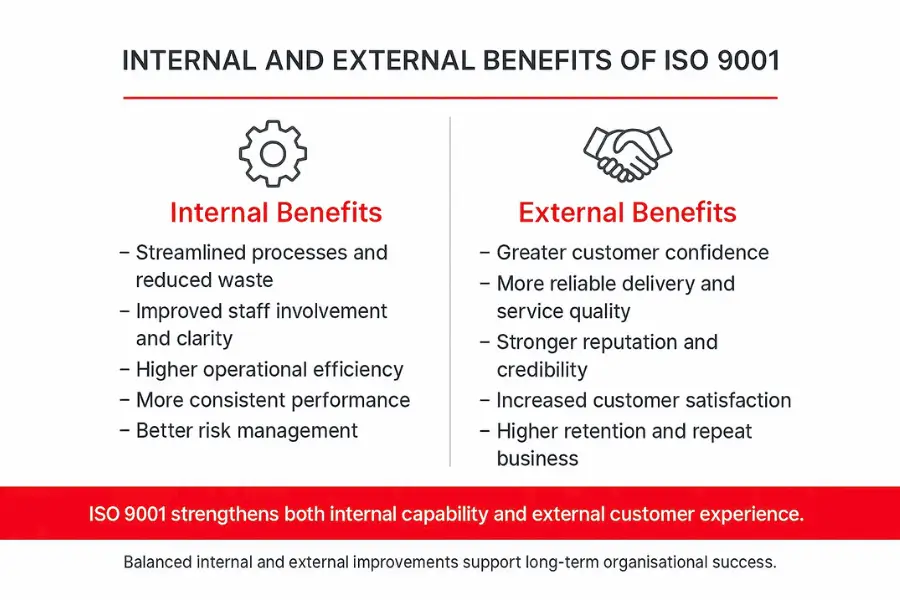
Process optimisation is a major outcome of ISO 9001. When inefficiencies are removed, customers benefit from faster turnaround times, fewer errors, and more competitive pricing.
Typical improvements include:
- Fewer reworks and returns
- Reduced downtime and delays
- Less duplication of work between teams
- Smoother resource planning and scheduling
With waste minimised and workflows running smoothly, the business becomes more responsive and capable of exceeding customer expectations consistently.
Real-World Examples of ISO 9001 Driving Customer Loyalty
Across industries, organisations that embrace ISO 9001 often see notable increases in customer loyalty. Whether the business is large or small, private or public sector, the underlying result is the same: reliable quality builds repeat business.
Customers tend to stay with organisations they trust — and ISO 9001 creates the environment for that trust to flourish.
SME success stories
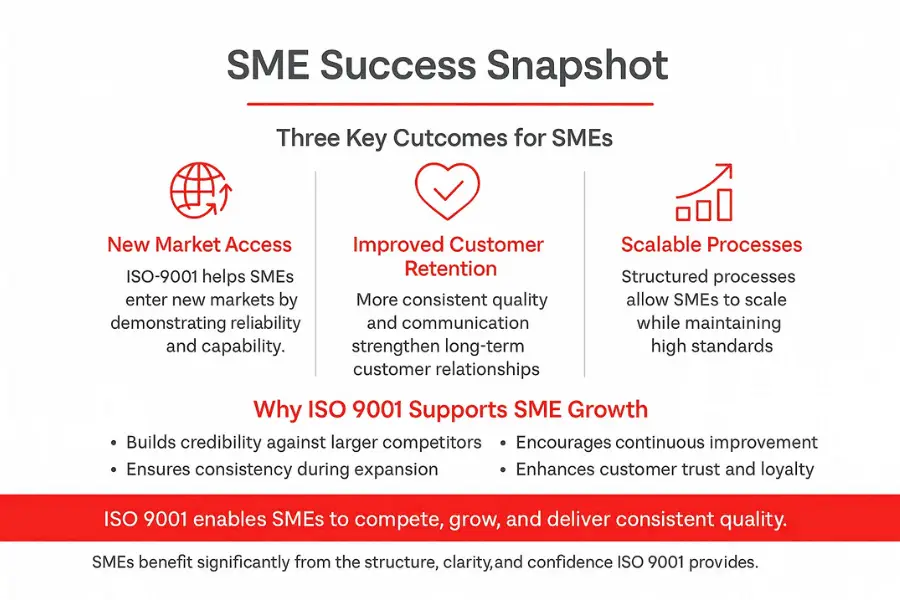
Small and medium-sized enterprises benefit from ISO 9001 by levelling the playing field against larger competitors. Certification gives smaller businesses the credibility and structure needed to reassure customers that they can deliver at scale.
Common outcomes include:
- Access to new markets and contracts
- Improved customer service performance
- Higher account retention and referral rates
- More consistent quality even during periods of growth
These results demonstrate that ISO 9001 is not just for large corporations — it can transform smaller businesses too.
Steps to Implement ISO 9001 for Improved Customer Experience

ISO 9001 certification is a journey, not a one-off project. Implementing the standard requires planning, commitment, and involvement across departments. When carried out effectively, the outcome is a quality management system that truly supports exceptional customer experience.
The transition should feel like the organisation is becoming more efficient — not adding unnecessary bureaucracy.
Preparing the organisation for certification
Before certification begins, it’s important to assess where the organisation currently stands and what needs to change. This lays the groundwork for a smooth transition and long-term success.
Typical preparation steps include:
- Reviewing existing processes and identifying inconsistencies
- Clarifying roles, responsibilities, and communication flows
- Conducting training to build awareness of ISO 9001 requirements
- Setting clear objectives and customer-focused performance targets
- Introducing internal audits to monitor progress
By building a strong foundation, organisations can maintain their quality management system with confidence long after certification.
Conclusion
ISO 9001 goes far beyond certification; it represents a commitment to excellence, consistency, and continual improvement. By placing customer satisfaction at the heart of the quality management system, organisations can build long-lasting relationships based on trust, transparency, and reliability.
Whether improving communication, reducing errors, or using feedback to drive innovation, ISO 9001 ensures that every part of the business contributes to a better customer experience. Ultimately, organisations that invest in ISO 9001 strengthen their reputation, increase retention, and gain a sustainable competitive advantage.
Key Points

- ISO 9001 creates structured processes that ensure consistent quality across all products and services.
- Transparency and reliability improve customer confidence and strengthen brand reputation.
- Continuous improvement supports long-term customer retention by addressing issues proactively.
- Feedback is used strategically to refine customer experience and prevent recurring problems.
- Strong communication and clear expectations reduce misunderstandings and increase satisfaction.
- Measuring customer outcomes through KPIs ensures that improvement decisions are driven by data, not assumptions.
- ISO 9001 benefits internal operations as well as customer experience, improving efficiency and morale.
Together, these elements make ISO 9001 one of the most effective frameworks for delivering exceptional, repeatable customer satisfaction.
FAQs
Is ISO 9001 only useful for large organisations?
No. ISO 9001 can be implemented by businesses of any size. In fact, many SMEs use it to stand out from competitors, enter new markets, and demonstrate reliability to customers.
Does certification guarantee higher customer satisfaction?
Certification alone is not enough — success comes from truly applying the principles of ISO 9001. When the system is used to drive continuous improvement and better communication, customer satisfaction almost always increases.
Is ISO 9001 difficult to maintain once achieved?
With good preparation and engagement from staff, maintaining ISO 9001 becomes part of normal business practice. Most organisations find that the improvements in efficiency outweigh the effort needed to maintain certification.
How long does it take to see customer benefits after implementation?
Many organisations notice improvements quickly, especially in communication, consistency, and customer confidence. Long-term benefits such as retention, referrals and improved brand reputation build over time.
Does ISO 9001 apply to both services and products?
Yes. ISO 9001 focuses on business processes rather than specific outputs. It is equally effective for service providers, manufacturers, public sector organisations and online businesses.