ISO 9001 Overview Introduction
ISO 9001 is one of the world’s most widely recognised and respected quality management standards. It offers a structured and measurable framework that organisations can use to develop, implement, and maintain an effective Quality Management System (QMS).
By following the standard’s guidelines, businesses of all sizes can demonstrate their commitment to delivering products and services that consistently meet customer expectations and comply with relevant regulatory requirements.
The standard helps organisations streamline their processes, reduce errors, and improve overall performance. ISO 9001 places a strong emphasis on customer satisfaction, risk-based thinking, and continual improvement—ensuring that organisations remain adaptable, competitive, and capable of responding to changing market demands.
For many companies, certification to ISO 9001 is not only a mark of operational excellence but also a valuable differentiator that enhances credibility and trust with clients, suppliers, and stakeholders.

ISO 9001 Overview
ISO 9001 forms part of the ISO 9000 family of internationally recognised quality management standards. It outlines the requirements for establishing, implementing, maintaining, and continually improving a Quality Management System (QMS). The standard is intentionally flexible, making it suitable for organisations of all sizes and industries—from small independent businesses to multinational corporations and public sector bodies. Its adaptable nature ensures that any organisation can use it to enhance its processes, improve quality, and demonstrate a commitment to delivering consistent results.
What ISO 9001 Is and Why It Matters
ISO 9001 provides a structured approach to improving the way an organisation operates. By adopting the standard, businesses can develop reliable, repeatable processes that lead to higher-quality outcomes. This not only helps reduce errors, waste, and inefficiencies but also supports better customer satisfaction. One of the core strengths of ISO 9001 is its emphasis on continuous improvement, encouraging organisations to regularly evaluate their performance and seek opportunities for enhancement. As a result, companies become more resilient, more competitive, and better equipped to adapt to changes in customer expectations or market conditions.
The Purpose of ISO 9001 Certification
Achieving certification to ISO 9001 offers more than simply meeting a set of requirements. It is a visible demonstration that an organisation has implemented a robust QMS aligned with internationally recognised best practices. Certification provides reassurance to customers, suppliers, and partners that quality is consistently controlled and monitored. This level of transparency builds confidence, reduces risk, and can often act as a key differentiator when competing for contracts or entering new markets—especially where certified management systems are a prerequisite.
Who Uses ISO 9001?
ISO 9001 is one of the most widely adopted management standards in the world, used across almost every sector. Organisations choose to adopt ISO 9001 for various reasons, such as improving internal systems, meeting tender requirements, or enhancing customer satisfaction. Common industries that rely on the standard include:
- Manufacturing – Ensuring consistent production quality and reducing defects.
- Construction – Managing complex projects and improving safety and reliability.
- Professional services – Enhancing client satisfaction through structured service delivery.
- Healthcare – Supporting safe, reliable patient care and operational efficiency.
- Transportation and logistics – Improving the accuracy and reliability of service delivery.
- Education and public services – Demonstrating accountability and effective service management.
With its universal applicability, ISO 9001 provides a solid foundation for any organisation seeking to improve performance, strengthen governance, and build lasting trust with stakeholders.
Key Principles of ISO 9001
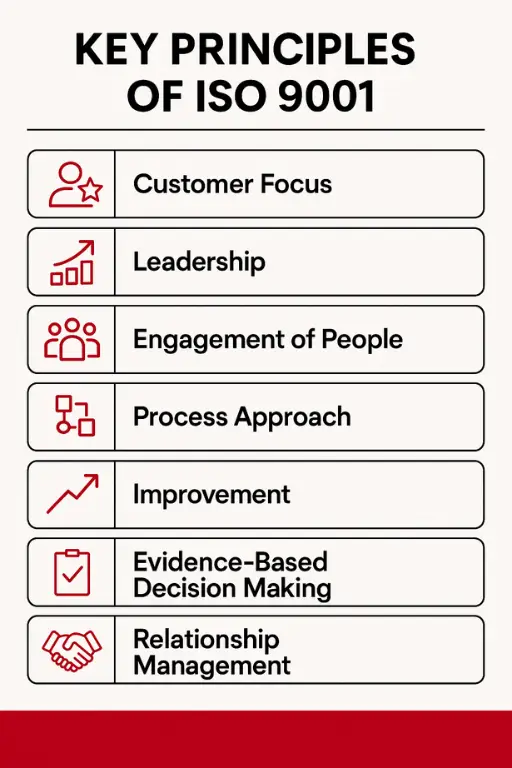
ISO 9001 is built on seven core quality management principles that act as the foundation for an effective, reliable, and improvement-focused Quality Management System (QMS). These principles help organisations operate more efficiently, make better decisions, and deliver consistent value to customers. Understanding and applying these principles ensures that quality becomes an integral part of everyday operations rather than a standalone requirement.
Customer Focus
Customer satisfaction sits at the heart of ISO 9001. Organisations are encouraged to take time to understand their customers’ needs, expectations, and preferences—both stated and implied. By doing so, they can design and deliver products and services that consistently meet or exceed expectations.
Maintaining a strong customer focus can lead to:
- Improved customer loyalty
- Increased repeat business
- A stronger market reputation
- Products and services that better align with customer requirements
Leadership and Commitment
Effective leadership is essential for ensuring that the QMS adds real value rather than becoming a “tick-box” exercise. ISO 9001 highlights the need for leaders to establish a clear vision, set achievable quality objectives, and create a supportive culture where quality is prioritised.
Strong leadership helps:
- Align the organisation’s strategic goals with its quality objectives
- Ensure resources and support are available for the QMS
- Foster accountability and shared responsibility
- Encourage engagement across all levels of the organisation
Engagement of People
People are one of an organisation’s most valuable assets. ISO 9001 emphasises the importance of involving employees at every level, ensuring they are trained, knowledgeable, and empowered to contribute to quality improvements.
When employees are engaged, organisations benefit from:
- Improved problem-solving and creativity
- Higher productivity and morale
- Stronger ownership of processes and outcomes
- A proactive approach to identifying opportunities for improvement
Process Approach
The standard encourages organisations to view activities as interconnected processes that work together to achieve consistent results. By understanding how processes link and influence one another, organisations can improve flow, reduce inefficiencies, and enhance overall performance.
A strong process approach helps:
- Reduce duplication and wasted effort
- Improve consistency and repeatability
- Support better control and monitoring
- Align operational activities with organisational goals
Evidence-Based Decision Making
Sound decisions are crucial for maintaining an effective QMS. ISO 9001 promotes the use of accurate data, analysis, and factual information to guide decisions rather than relying on assumptions or opinions.
Using evidence to guide decisions enables organisations to:
- Reduce risk and uncertainty
- Identify root causes more effectively
- Monitor performance accurately
- Make changes confidently and responsibly
Relationship Management
Successful organisations recognise the importance of building strong relationships with suppliers, partners, and other stakeholders. ISO 9001 encourages organisations to manage these relationships strategically to enhance performance and create long-term value.
Effective relationship management can:
- Improve supply chain reliability
- Reduce operational risks
- Strengthen collaboration and efficiency
- Enhance the organisation’s overall ability to meet customer needs
Continual Improvement
Continual improvement is a core element of ISO 9001, encouraging organisations to regularly review their processes, performance, and systems to identify areas for enhancement. This ensures that the organisation remains competitive, resilient, and capable of meeting evolving customer expectations.
A commitment to continual improvement leads to:
- Enhanced efficiency and effectiveness
- Better use of resources
- Increased innovation and adaptability
- Stronger long-term organisational success
ISO 9001 Structure and Requirements
ISO 9001 is built around the Annex SL high-level structure, a standardised framework used across multiple ISO management system standards. This structure makes it easier for organisations to integrate ISO 9001 with other systems—such as ISO 14001 (environmental management) or ISO 45001 (health and safety management)—creating a streamlined, unified approach to governance and operations.
Annex SL provides a consistent layout, terminology, and set of core clauses, helping organisations implement a management system that is logical, cohesive, and easy to maintain.
The High-Level Structure (Annex SL)
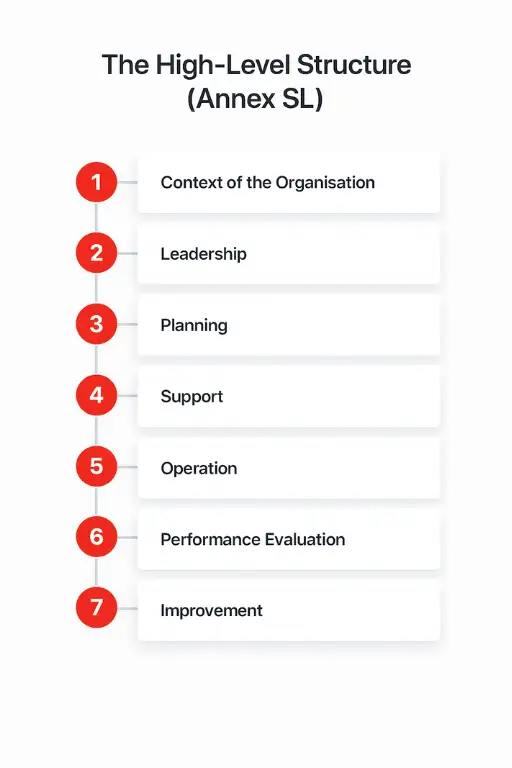
The Annex SL structure ensures that all ISO management standards follow the same core layout, consisting of the following key clauses:
- Context of the organisation
- Leadership
- Planning
- Support
- Operation
- Performance evaluation
- Improvement
These clauses guide organisations through a logical journey—from understanding their environment and planning their approach, through implementing operational controls, to evaluating performance and pursuing continual improvement.
Context of the Organisation
To establish an effective QMS, organisations must understand the internal and external factors that could affect their ability to achieve their intended results. This includes:
- Market conditions and industry trends
- Regulatory and legal requirements
- Internal culture, capabilities, and resources
- Stakeholder needs and expectations
By analysing these factors, organisations can design a QMS that is relevant, robust, and aligned with strategic objectives.
Planning and Risk-Based Thinking
ISO 9001 places significant emphasis on proactive planning and the identification of risks and opportunities. Organisations must determine potential issues that could impact product or service quality and develop actions to prevent or mitigate them.
Risk-based thinking helps organisations:
- Anticipate problems before they occur
- Reduce nonconformities and costly errors
- Improve planning and decision-making
- Capitalise on opportunities to enhance performance
This forward-looking approach ensures that the QMS remains stable, effective, and adaptable.
Support and Resources
Effective implementation of ISO 9001 requires adequate resources and organisational support. This includes:
- Competent and trained staff with the necessary skills
- Appropriate infrastructure, such as equipment, facilities, and technology
- Documented information, including procedures, records, policies, and evidence of compliance
- Communication processes to ensure clarity and consistency
- Monitoring and measuring equipment that is properly calibrated and maintained
These elements ensure the QMS is fully supported and capable of achieving its intended outcomes.
Operational Control and Processes
Organisations must plan, implement, and control their operational processes to deliver consistent and high-quality results. This includes:
- Defining process inputs and outputs
- Establishing clear responsibilities and workflows
- Controlling outsourced processes and supplier performance
- Ensuring that products and services meet specified criteria
- Managing production, service delivery, and post-delivery activities
By standardising operations, organisations reduce variability, minimise errors, and increase efficiency.
Performance Evaluation
ISO 9001 requires organisations to monitor, measure, and analyse the performance of their QMS. This ensures that leaders have the information needed to make informed decisions and drive improvements.
Performance evaluation includes:
- Internal audits to assess compliance and identify issues
- Customer satisfaction monitoring to understand needs and feedback
- Management reviews to evaluate overall system effectiveness
- Data analysis to identify trends, risks, and opportunities
Regular performance evaluation provides a clear picture of how well the QMS is functioning and where improvements may be required.
Improvement Requirements
Continual improvement is a fundamental requirement of ISO 9001. Organisations must:
- Identify nonconformities when they occur
- Take corrective action to prevent recurrence
- Identify improvement opportunities throughout the QMS
- Enhance processes, services, and performance over time
This ensures the QMS remains effective, relevant, and capable of evolving with changing business and customer needs.
Benefits of ISO 9001 Certification
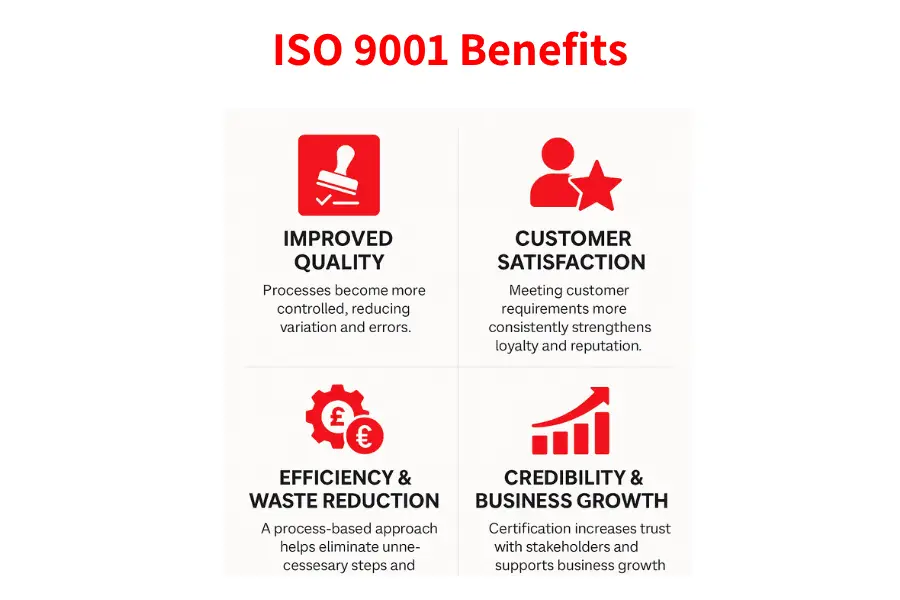
Implementing ISO 9001 offers a wide range of organisational benefits that go beyond simply meeting a set of requirements. A well-established Quality Management System (QMS) can transform the way an organisation operates, helping to build consistency, improve customer satisfaction, and drive long-term growth.
Improved Quality and Consistency
ISO 9001 requires organisations to establish clear, repeatable processes that are monitored and controlled. This reduces variability, minimises errors, and ensures that products and services are delivered to a consistently high standard.
Key outcomes include:
- Fewer defects and nonconformities
- More predictable results
- Better alignment between processes and organisational goals
Enhanced Customer Satisfaction
By consistently meeting customer requirements and responding effectively to feedback, organisations strengthen their reputation and build long-lasting trust. Satisfied customers are more likely to remain loyal, recommend the organisation to others, and engage in repeat business.
Benefits include:
- Stronger customer relationships
- Improved brand reputation
- Increased competitive advantage
Increased Efficiency and Reduced Waste
The process-based approach of ISO 9001 helps organisations identify inefficiencies, streamline workflows, and remove unnecessary steps. This leads to more effective use of resources, cost savings, and better overall performance.
Typical improvements include:
- Reduced waste and rework
- Optimised use of staff, materials, and equipment
- Faster, more efficient delivery of products and services
Stronger Business Performance and Credibility
ISO 9001 certification is widely recognised as a symbol of reliability and professionalism. It reassures stakeholders that an organisation is committed to quality and continuous improvement, which can open the door to new opportunities.
Advantages include:
- Increased trust from customers, partners, and suppliers
- Improved success in tenders and procurement processes
- Stronger foundation for sustainable business growth
ISO 9001 Implementation Process
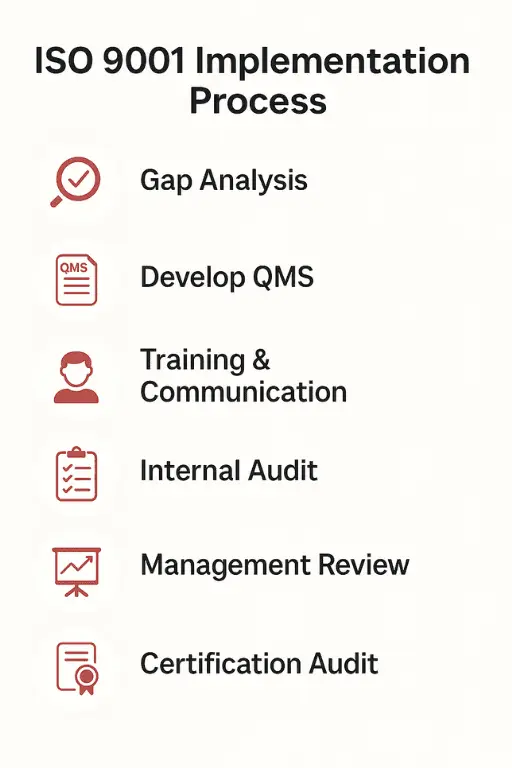
Achieving ISO 9001 certification requires a structured approach and careful planning. While each organisation’s journey is unique, the following steps form the core of a typical implementation pathway.
Conducting a Gap Analysis
A gap analysis assesses current practices against the requirements of ISO 9001. It helps organisations identify what they already do well, where changes are needed, and which areas require the most attention.
This step provides:
- A clear starting point
- Prioritisation of improvement areas
- An effective roadmap for implementation
Developing a Quality Management System (QMS)
Based on the gap analysis, organisations begin developing or updating their QMS. This includes:
- Documenting key processes and procedures
- Defining roles, responsibilities, and authorities
- Establishing measurable quality objectives
- Creating systems for monitoring and improvement
A well-designed QMS becomes the backbone of reliable, consistent operations.
Staff Training and Internal Communication
Employees must understand the QMS, how it affects their work, and what their responsibilities are. Effective communication and training ensure that everyone contributes to the system’s success.
This step helps:
- Build a shared culture of quality
- Reduce resistance to new processes
- Improve engagement and accountability
Internal Audits and Management Reviews
Before the external certification audit, organisations must carry out internal audits to check that the QMS is functioning correctly. Management reviews then assess the overall effectiveness of the system and ensure readiness for certification.
Benefits include:
- Early identification of issues
- Increased confidence before the external audit
- Clear evidence of leadership involvement
Certification and Auditing

Choosing a UKAS-Accredited Certification Body
Working with a UKAS-accredited certification body ensures that the organisation’s certificate is credible, recognised, and trusted across industries. Accreditation demonstrates impartiality and competence in certification activities.
The Stage 1 and Stage 2 Audit Process
The certification audit is carried out in two stages:
- Stage 1 Audit:
A review of documented information and an assessment of readiness for Stage 2.
This includes examining policies, procedures, and high-level processes. - Stage 2 Audit:
A detailed evaluation of the QMS in action.
Auditors check real activities, interview staff, and verify that processes are implemented effectively.
Maintaining Certification and Ongoing Compliance
ISO 9001 certification is issued for three years. During this period, organisations must undergo regular surveillance audits—typically once per year—to ensure ongoing compliance. Continuous improvement is essential to maintaining the certification and ensuring the QMS remains effective and up to date.
Common Challenges and Best Practices
Overcoming Resistance to Change
Change can be difficult, especially in long-established organisations. Clear communication, early involvement of employees, and visible leadership support help to build confidence and reduce resistance.
Ensuring Effective Documentation
Documentation should be clear, concise, and genuinely useful. Overly complex or excessive documentation can hinder performance rather than support it. ISO 9001 encourages organisations to document only what is needed to manage processes effectively.
Embedding a Continuous Improvement Culture
Encouraging feedback, promoting learning, and recognising improvements help embed a culture where quality becomes an ongoing priority rather than a one-off exercise.
ISO 9001 and Other Standards
How ISO 9001 Aligns with ISO 14001 and ISO 45001
ISO 9001 shares a common structure (Annex SL) with ISO 14001 (environmental management) and ISO 45001 (health and safety management). This alignment makes it easier to integrate multiple standards within a single management system. Common terminology and clause structures help reduce duplication and improve efficiency.
Integrating ISO 9001 into an IMS (Integrated Management System)
An Integrated Management System (IMS) allows organisations to manage quality, environment, and health & safety together, creating a more cohesive and efficient approach. Benefits of an IMS include:
- Reduced administrative burden
- Streamlined audits
- Stronger alignment across business functions
- Improved overall performance

Conclusion
ISO 9001 provides organisations with a proven framework for improving quality, strengthening customer satisfaction, and enhancing operational performance. By implementing a robust Quality Management System (QMS), organisations can create greater consistency, reduce risk, and foster a culture of continual improvement that supports sustainable growth.
Certification to ISO 9001 is more than a compliance exercise—it is a strategic investment that demonstrates a commitment to excellence. Whether an organisation is seeking to improve internal processes, meet customer expectations, or gain a competitive advantage, ISO 9001 offers a practical and effective pathway to achieving those goals. With strong leadership, engaged employees, and a structured approach to quality, any organisation can reap the long-term benefits of this globally recognised standard.
Frequently Asked Questions (FAQs)
1. What is ISO 9001?
ISO 9001 is an international standard for Quality Management Systems. It sets out the criteria organisations must meet to ensure they consistently deliver products and services that meet customer and regulatory requirements.
2. Who can benefit from ISO 9001 certification?
Any organisation—regardless of size, industry, or location—can benefit from ISO 9001. It is commonly used in manufacturing, construction, healthcare, professional services, logistics, and the public sector.
3. Is ISO 9001 mandatory?
No, ISO 9001 certification is voluntary. However, some industries, customers, or tender processes may require organisations to be certified as a condition of doing business.
4. How long does it take to achieve ISO 9001 certification?
The timeline varies depending on the size and complexity of an organisation, as well as its current level of process maturity. On average, implementation can take between 3 and 12 months.
5. What is a Quality Management System (QMS)?
A QMS is a structured set of policies, processes, and procedures used to ensure that an organisation can meet customer and regulatory quality requirements. ISO 9001 provides the framework for creating and maintaining an effective QMS.
6. What are the main costs involved in ISO 9001 certification?
Costs typically include consultancy (if used), staff training, internal resource time, and certification body fees. Costs vary depending on the organisation’s size and complexity.
7. What happens during an ISO 9001 audit?
During the audit, an external assessor reviews documentation, observes processes, and interviews staff to ensure the QMS meets ISO 9001 requirements. The audit is conducted in two stages: documentation review (Stage 1) and full assessment (Stage 2).
8. How long does ISO 9001 certification last?
Certification is valid for three years. Organisations must undergo annual surveillance audits to ensure ongoing compliance and continuous improvement.
9. Can ISO 9001 be integrated with other management standards?
Yes. ISO 9001 shares the Annex SL structure with ISO 14001 (environmental) and ISO 45001 (health & safety), making integration into an Integrated Management System (IMS) straightforward and efficient.
10. What are the biggest challenges in implementing ISO 9001?
Common challenges include resistance to change, lack of staff engagement, insufficient documentation, and misunderstanding the purpose of the QMS. Strong leadership and clear communication help overcome these issues.
11. Do we need a consultant to achieve ISO 9001 certification?
No, using a consultant is optional. Many organisations choose to manage implementation internally, while others use external support to accelerate the process and gain expert guidance.
12. What is “risk-based thinking” in ISO 9001?
Risk-based thinking encourages organisations to identify potential issues before they occur and implement preventive measures. It is central to maintaining consistent quality and improving long-term performance.