

Introduction
If you’re working in the commercial retrofit sector or managing non-domestic energy efficiency upgrades in the UK, understanding PAS 2038 is essential. Introduced as the commercial counterpart to PAS 2030, PAS 2038 provides a structured and evidence-based framework for retrofitting non-domestic buildings. While it may not be as widely publicised as its domestic-focused sibling, its impact on the commercial retrofit industry is significant and growing.
PAS 2038 ensures that building owners, facilities managers, and retrofit coordinators follow a systematic, transparent process in assessing and improving the energy performance of their properties. As energy costs rise and sustainability regulations tighten, compliance with PAS 2038 is rapidly becoming a strategic necessity for businesses aiming to remain competitive and future-proof their portfolios.
This guide dives deep into the real cost of PAS 2038 compliance—what to expect, what drives those costs, and how to optimise your approach. Whether you’re a property owner aiming to enhance your EPC rating, a consultant navigating compliance for your clients, or a project manager coordinating multiple upgrades, this resource will help you make sense of the financial and operational aspects involved.
We’ll explore typical certification fees, key cost factors, accreditation steps, challenges, and real-world benefits. If your organisation is committed to carbon reduction, ESG alignment, or accessing green finance, read on to discover how PAS 2038 can deliver both compliance and commercial advantage.

What Does PAS 2038 Cover?
PAS 2038 establishes a process for assessing and improving the energy performance of existing non-domestic buildings through retrofit. It outlines a structured, phased approach that integrates energy assessment, planning, implementation, and verification. This ensures that retrofits deliver measurable and long-term improvements to energy efficiency.
Key elements covered by PAS 2038 include:
- Building Assessment and Data Collection – Reviewing energy use, building fabric, and systems.
- Energy Performance Modelling – Using simulation tools to predict the impact of improvements.
- Risk Management – Identifying and mitigating technical and operational risks.
- Retrofit Strategy Development – Creating tailored improvement plans aligned with building use and occupancy.
- Installation and Project Oversight – Ensuring that the right measures are implemented effectively.
- Monitoring and Verification (M&V) – Tracking post-retrofit performance to confirm outcomes.
Unlike PAS 2030, which is installer-focused, PAS 2038 is aimed at design teams, building owners, and those responsible for managing non-domestic assets. It aligns closely with BS ISO 50005 and supports a holistic, lifecycle-based view of energy performance improvements.
PAS 2038 is relevant to a wide range of building types, including offices, retail units, schools, warehouses, hotels, and hospitals. Regardless of scale, the standard demands a robust quality assurance approach and an emphasis on documented evidence.
Why Is PAS 2038 Important for Energy Efficiency?
Aligns with Net-Zero Objectives
The UK’s legally binding commitment to achieving net-zero carbon emissions by 2050 places substantial pressure on both domestic and non-domestic property sectors. Commercial buildings account for nearly a fifth of total UK greenhouse gas emissions. PAS 2038 supports the structured decarbonisation of these buildings, helping asset owners contribute to the national target.
Applies a Whole-Building Performance Approach
Rather than promoting piecemeal upgrades, PAS 2038 takes a holistic approach. It ensures energy efficiency is addressed through a sequence of informed decisions:
- Baseline assessments
- Performance modelling
- Strategic interventions
- Long-term monitoring
This model avoids the inefficiencies and unintended consequences often associated with disjointed retrofit efforts.
Supports Funding and Finance Access
While PAS 2038 is not legally mandatory, it is increasingly being recognised by public bodies and green lenders as a benchmark for responsible retrofit planning. Demonstrating adherence to PAS 2038 can unlock:
- Public grants or local authority retrofit schemes
- Green loans and sustainability-linked financing
- Enhanced ratings in ESG assessments
Enhances Occupant Health, Safety and Comfort
Beyond carbon savings, PAS 2038-compliant retrofits often lead to healthier and more comfortable indoor environments. Measures like ventilation upgrades, thermal envelope improvements, and smarter controls can enhance air quality and thermal comfort while also reducing operational costs.
Builds Trust and Accountability
PAS 2038 introduces transparency and accountability through professional oversight and data-led reporting. Independent verification of results means building owners can:
- Demonstrate measurable improvements
- Ensure ROI on investments
- Build long-term credibility with tenants and stakeholders
By embedding these practices into retrofit projects, PAS 2038 becomes a practical tool for boosting asset value while reducing environmental impact.
Who Needs PAS 2038 Certification?
PAS 2038 is essential for a broad range of stakeholders involved in commercial property retrofit, energy management, and compliance-driven construction services. The certification is especially relevant for:
- Commercial Building Owners and Landlords – Those responsible for asset performance, EPC ratings, and tenant satisfaction.
- Facilities Management Firms – Teams managing day-to-day building operations and long-term energy strategies.
- Energy Consultants and Retrofit Professionals – Individuals who assess buildings, propose solutions, and oversee retrofits.
- Design Teams and Engineers – Professionals involved in HVAC design, envelope upgrades, and systems integration.
- Property Developers and Investment Trusts – Entities aiming to enhance asset value and align with sustainability frameworks.
As more emphasis is placed on ESG (Environmental, Social and Governance) reporting, many businesses now require PAS 2038 certification to validate their energy strategies. Likewise, public procurement and corporate leasing often stipulate PAS 2038-aligned standards for building works.
Even if not legally required, PAS 2038 is quickly becoming the recognised “gold standard” for non-domestic retrofit planning in the UK. From warehouse conversions to office refurbishments, it ensures energy performance is front and centre.
Many professionals involved in PAS 2038 projects—such as Retrofit Coordinators or energy consultants—may already be experienced with PAS 2035 in the domestic sector. While the scope differs, the underlying principles of coordinated, data-led retrofitting remain consistent across both standards.
What Is the Cost of PAS 2038 Certification?
Average Certification Fees in the UK
Certification under PAS 2038 involves professional oversight, technical assessments, data validation, and post-implementation verification. Costs vary significantly depending on building type, scale, and complexity. Below is a general breakdown:
|
Building Type |
Estimated PAS 2038 Cost |
|
Small Commercial Unit |
£2,000 – £4,000 |
|
Medium-Sized Facility |
£4,500 – £8,000 |
|
Large/Complex Properties |
£10,000 – £20,000+ |
These estimates usually cover the full scope:
- Pre-assessment and energy audits
- Retrofit strategy formulation
- Verification and reporting
- Certification submission to a recognised body
In some cases, additional charges may apply for:
- Site re-visits or failed verification stages
- Highly specialised simulations (e.g., dynamic thermal modelling)
- Travel to remote or multi-site locations
Hidden and Optional Costs to Budget For:
Beyond direct certification expenses, you should also account for:
- Consultant Fees: Ranges from £600 to £1,500 per day for PAS 2038-aligned professionals.
- Software Tools: Some modelling and monitoring software licenses are billed annually.
- Training Costs: Teams may need CPD-accredited courses or qualifications in retrofit coordination or energy assessment.
- Documentation and QMS Support: Firms with no in-house compliance team may need to hire external support for report preparation and QA reviews.
Overall, total project costs can range from £5,000 for a small single-site retrofit to over £30,000 for complex, multi-phase commercial retrofits when all professional and administrative services are included.
Factors Affecting the Cost of PAS 2038
The overall cost of PAS 2038 compliance can vary significantly depending on a range of technical, operational, and contextual factors. Below are the key drivers:
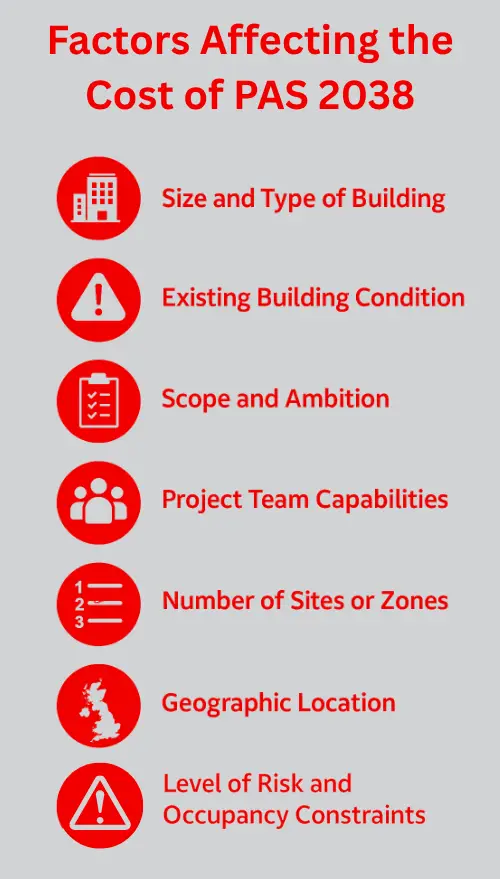
Size and Type of Building
Larger and more complex buildings inherently demand more time and resources for assessment, modelling, and verification. A multi-storey city-centre office will cost more to evaluate and retrofit than a single-floor warehouse.
Existing Building Condition
Older buildings with minimal or outdated documentation often require more investigation during the initial assessment phase. Poor access to existing building performance data will add hours of manual data collection and increase consultancy time.
Scope and Ambition of Retrofit
PAS 2038 can be applied to light upgrades (e.g. lighting and control systems) or deep retrofits involving HVAC, insulation, and renewables. A deeper scope means:
- More design input
- More verification work
- Greater consultant involvement
This significantly affects cost.
Project Team Capabilities
Businesses with in-house expertise in energy modelling, data analysis, and project management may reduce their need for external support. If all resources are outsourced, expect higher professional fees.
Number of Sites or Zones
Certifying multiple buildings or separate zones within one complex adds to cost due to the need for repeat assessments and custom reporting for each unit.
Geographic Location
Projects in rural or logistically difficult locations may incur additional travel and accommodation expenses for auditors, consultants, and engineers.
Level of Risk and Occupancy Constraints
If buildings must remain operational during retrofit or pose safety/access limitations, assessors must plan around these realities. More constraints usually equal more cost.
By understanding these variables in advance, building owners can better scope their projects and avoid underbudgeting during the early planning stages.
How to Get PAS 2038 Accreditation?
Achieving PAS 2038 compliance requires collaboration between building owners, retrofit professionals, and accredited certification bodies. The standard does not offer a license or singular “certification” in the traditional sense, but rather validates adherence to its methodology through independent assessment.
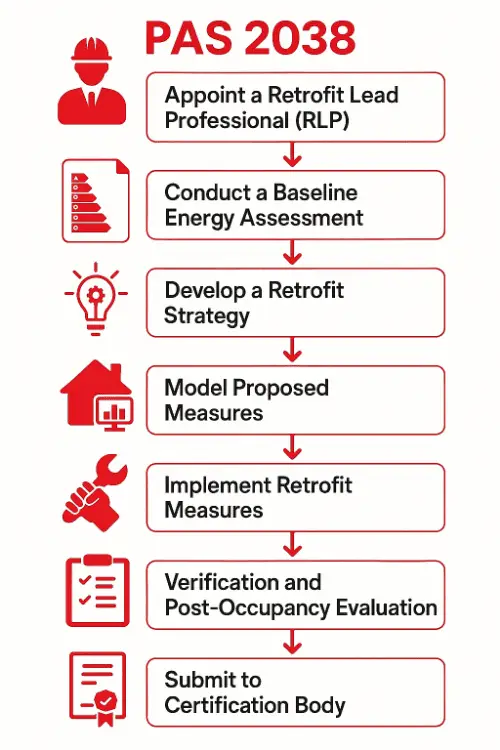
Here is a step-by-step outline of how to meet PAS 2038 requirements:
Achieving PAS 2038 compliance requires collaboration between building owners, retrofit professionals, and accredited certification bodies. The standard does not offer a license or singular “certification” in the traditional sense, but rather validates adherence to its methodology through independent assessment.
Here is a step-by-step outline of how to meet PAS 2038 requirements:
Step 1: Appoint a Retrofit Lead Professional (RLP)
The process starts with the appointment of an RLP — typically a qualified energy consultant, engineer, or retrofit coordinator. They are responsible for project oversight, strategy development, and quality assurance throughout the retrofit.
Step 2: Conduct a Baseline Energy Assessment
This includes:
- Reviewing historical energy use
- Conducting site surveys
- Identifying thermal bridges, inefficiencies, and operational patterns
This data informs the whole-building energy model used to plan measures.
Step 3: Develop a Retrofit Strategy
The RLP and design team formulate a strategy that meets the building’s performance goals, aligns with usage needs, and considers:
- Occupancy schedules
- Capital and operational costs
- Risk tolerances
This is documented in a Retrofit Assessment Report (RAR).
Step 4: Model Proposed Measures
Energy modelling software (e.g. IESVE, DesignBuilder) simulates performance improvements for various retrofit scenarios, guiding decision-making.
Step 5: Implement Retrofit Measures
Work begins on-site, with contractors delivering agreed measures under RLP supervision. Installation must meet applicable standards (e.g., CIBSE, TM61-69).
Step 6: Verification and Post-Occupancy Evaluation
Once measures are installed:
- Performance data is gathered
- Post-retrofit modelling and M&V methods confirm outcomes
- Any discrepancies are addressed
The RLP signs off on the documentation.
Step 7: Submit to Certification Body
An accredited third party (such as Simply Certification, Elmhurst, or Stroma) reviews:
- The energy performance improvement evidence
- Documentation completeness
- Compliance with PAS 2038 methodology
If compliant, a formal certificate or statement of conformance is issued.
Optional: Engage in a Mock Audit
To reduce risk and identify issues early, many companies engage in a mock or pre-assessment audit. These simulate the final process and can reduce total certification time.
How Long Does PAS 2038 Certification Take?
The duration of a PAS 2038 project varies depending on the building’s size, the scope of the retrofit, the number of stakeholders involved, and how well-prepared the client is with data and documentation.
Here is a typical timeline overview:
|
Stage |
Estimated Duration |
|
Initial Scoping & RLP Appointment |
1–2 weeks |
|
Baseline Energy Assessment |
2–4 weeks |
|
Retrofit Strategy Development |
3–6 weeks |
|
Design & Modelling |
3–5 weeks |
|
Installation/Implementation |
1–4 months (varies by project) |
|
Verification & Post-Occupancy |
2–4 weeks |
|
Certification Submission & Review |
2–3 weeks |
Total Project Duration: 3 to 6 months on average, though larger or phased retrofits can extend to 9–12 months.
Speed is often influenced by factors like:
- Availability of the RLP and audit team
- Accuracy and availability of energy data
- Procurement and lead times for materials
- Occupancy constraints (e.g., retrofits in operational buildings)
Project owners are encouraged to build in contingency time during the planning phase to account for documentation reviews, contractor availability, and unforeseen retrofit complications.
Benefits of PAS 2038 Certification
PAS 2038 offers more than just regulatory alignment — it delivers practical, financial, and environmental advantages that improve both building performance and organisational reputation.
- Enhanced Asset Value
Retrofit measures guided by PAS 2038 often improve EPC ratings, lower operational costs, and increase property attractiveness. This can result in:
- Higher rents
- Increased occupancy rates
- Improved investment yields
- Energy Savings and Operational Efficiency
Typical PAS 2038 retrofits can reduce energy usage by 15–40%, depending on the scope. This translates into:
- Lower utility bills
- Improved energy performance metrics (e.g., kWh/m²/year)
- Better resource efficiency
- ESG and Compliance Benefits
For organisations with sustainability commitments, PAS 2038 helps:
- Demonstrate alignment with corporate ESG goals
- Achieve compliance with stakeholder or investor expectations
- Improve ratings in voluntary schemes (e.g., BREEAM, GRESB)
- Access to Green Finance and Incentives
Buildings undergoing PAS 2038-compliant retrofits are often prioritised for:
- Local authority funding
- Green loans and climate-linked bonds
- Business rates relief or capital allowance incentives
- Quality Assurance and Risk Reduction
With structured oversight by qualified professionals, PAS 2038 ensures:
- Greater design and installation consistency
- Fewer retrofit failures or disputes
- Measurable outcomes validated by third-party assessment
- Future-Proofing Against Regulation
As building performance regulations continue to evolve, PAS 2038 prepares owners for:
- Minimum energy efficiency standards (MEES)
- Stricter EPC and carbon reporting thresholds
- Anticipated commercial retrofit mandates
In summary, PAS 2038 is a proactive investment that improves long-term building performance while reducing environmental impact and enhancing financial resilience.
Challenges and Limitations of PAS 2038
While PAS 2038 is a robust and forward-thinking framework, it is not without its challenges. Understanding these limitations can help you plan effectively.
1. Cost of Compliance
The upfront cost of assessments, modelling, and project management can be a barrier for small-to-medium enterprises, especially without access to grant funding.
2. Complexity of Methodology
The layered and data-driven nature of PAS 2038 may seem overwhelming, especially for first-time users. Projects require in-depth knowledge of simulation tools, retrofit strategy, and regulatory compliance.
3. Limited Availability of Qualified Professionals
There is a growing but still limited pool of professionals experienced specifically in PAS 2038 processes. Finding a qualified RLP with capacity may delay projects.
4. Integration with Existing Systems
Retrofits often encounter unexpected issues when integrating with legacy systems or maintaining building operations during works. This can result in scope creep or increased costs.
5. Lack of Awareness or Market Recognition
Unlike PAS 2030, which is tied to government funding schemes, PAS 2038 lacks the same level of market adoption and awareness. Clients may struggle to justify certification without external drivers such as ESG mandates or investor pressure.
Despite these challenges, the long-term benefits far outweigh the initial hurdles for most commercial retrofit projects.
How to Maintain PAS 2038 Certification
-
Complete periodic third-party reviews or audits (typically every 12–24 months)
-
Keep energy modelling tools and retrofit methodologies up to date
-
Maintain and review your building performance documentation and update strategies as necessary
-
Monitor professional qualifications and CPD of Retrofit Lead Professionals and project teams
-
Stay current with updates to PAS 2038 and related standards (e.g. BS 40101, CIBSE TM guides)
Is PAS 2038 Mandatory in the UK?
Legal and Strategic Considerations
Unlike PAS 2030, PAS 2038 is not legally mandated—yet. However, understanding when and why it should be adopted helps organisations position themselves for compliance, investment, and reputational advantage.
| Retrofit Scenario | Is PAS 2038 Mandatory? | Implications |
|---|---|---|
| Public or government-funded commercial retrofits | ❌ Not always (but advised) | Strongly encouraged to meet ESG and procurement standards |
| Private-sector commercial retrofit projects | ❌ No | Optional but demonstrates quality and professionalism |
| Commercial property acquisition or asset enhancement | ❌ No | Helps support green financing and valuation improvements |
| Local authority or NHS estates retrofit | ✅ Often required | Many public frameworks now reference PAS 2038 for commercial retrofits |
| ESG or sustainability-linked finance eligibility | ✅ Effectively required | Lenders often expect or require PAS 2038-aligned retrofit plans and audits |
When It’s Optional but Highly Recommended
Even if you’re not subject to a funding condition or regulation, aligning with PAS 2038 still offers considerable advantages:
-
Signals adherence to best-practice retrofit methodology
-
Strengthens investor and stakeholder confidence
-
Demonstrates climate readiness and net-zero alignment
-
Enhances eligibility for green financing and commercial incentives
-
Supports future compliance with incoming performance-based regulations (e.g. MEES tightening)
PAS 2038 is more than a standard—it’s a strategy.
While not legally binding in most cases, early adoption can yield competitive, financial, and operational advantages that future-proof your portfolio and streamline complex retrofit projects.
Frequently Asked Questions (FAQs)
Q1: Is PAS 2038 mandatory in the UK? No. PAS 2038 is not a legal requirement, but many developers and asset managers voluntarily adopt it to future-proof properties and access ESG-aligned finance.
Q2: Can PAS 2038 be used for mixed-use buildings? Yes. If a property includes both domestic and non-domestic areas, PAS 2038 can be applied to commercial sections, often alongside PAS 2030.
Q3: How does PAS 2038 relate to EPC requirements? PAS 2038 provides a roadmap to improve EPC ratings by targeting key inefficiencies. Many projects see 1–2 band improvements following implementation.
Q4: Who can carry out a PAS 2038 assessment? Only qualified professionals with energy modelling expertise and retrofit experience should lead the process. Many are certified retrofit coordinators or building performance engineers.
Q5: How often does a PAS 2038 certificate need to be renewed? There is no formal renewal cycle. However, it is best practice to review and update retrofit strategies every 5–7 years as technologies and building uses evolve.

Conclusion
PAS 2038 is a powerful framework that elevates the quality, transparency, and outcomes of non-domestic building retrofits across the UK. While it does require investment, planning, and collaboration, it delivers measurable returns in energy savings, asset performance, and regulatory readiness.
For organisations looking to lead on sustainability, improve compliance, and protect long-term property value, PAS 2038 offers a practical and future-focused path forward. Whether you’re preparing a single-site improvement or a portfolio-wide upgrade, aligning your project with PAS 2038 can deliver robust benefits that stand the test of time.
Need help getting started with PAS 2038? Our team of retrofit consultants and energy experts can guide you through assessment, strategy, and certification. Contact us today for a free consultation.

